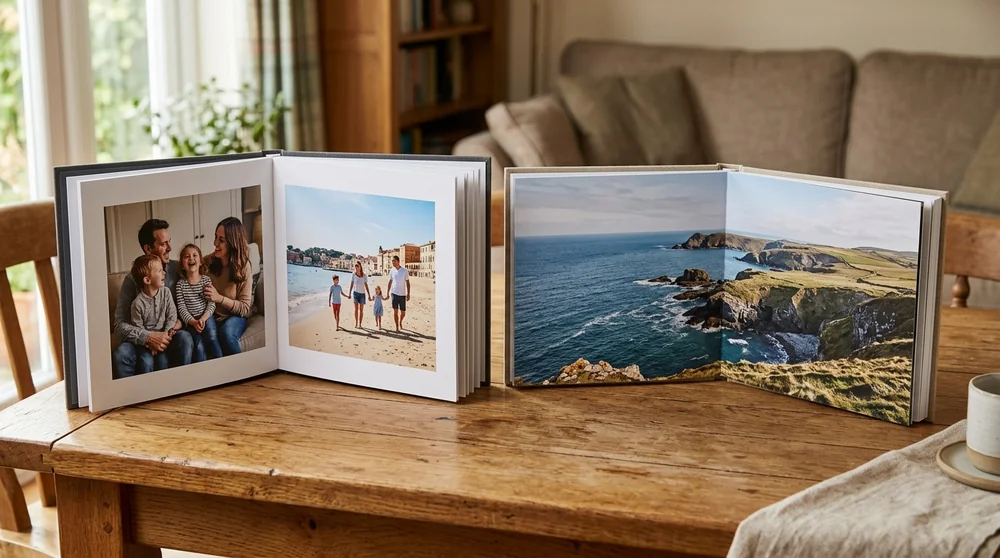
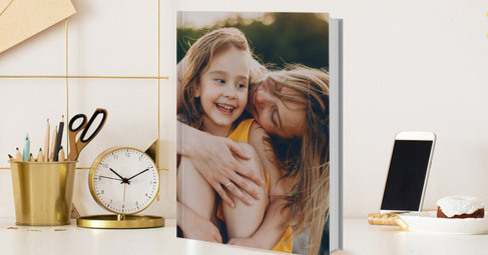
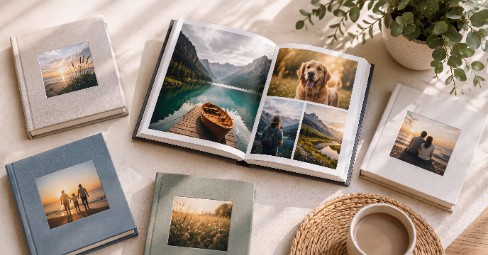
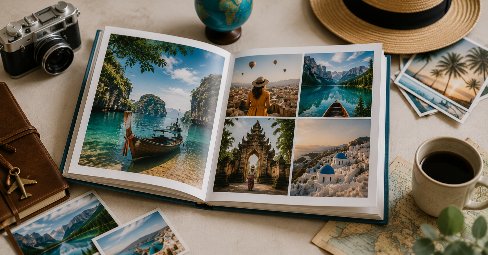
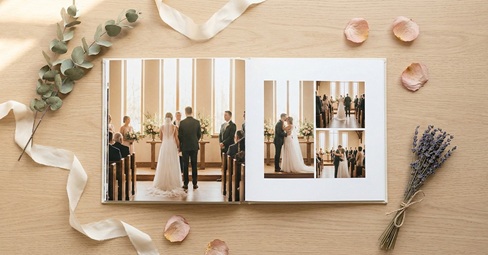
Choose a square photo book if your photos are a mix of upright and wide shots, because a square page holds both with less cropping. Choose a landscape photo book if most of your photos are wide, or you want panoramas to run across a full spread. At MYPICTURE, square books start at £13 and landscape books at £8.
Most people pick the shape of their photo book last, after the cover and the paper. That is the wrong way round. Shape is the one choice that decides how much of every single photo survives the print. A standard phone photo is 4:3. Drop it into a square page and a quarter of the width is gone before you have chosen a font.
This guide compares the two shapes on the things that actually change your book: how much gets cropped, what it costs in pounds, how many pages you can add, and whether it will sit on your shelf without hanging off the edge. Binding, paper and size are covered in separate guides, linked where they come up.
The short version
Square suits mixed camera rolls. MYPICTURE squares come in 20 x 20 cm from £13 and 30 x 30 cm from £30, with up to 248 pages.
Landscape suits wide photos. The A-format books can be set to landscape orientation: A5 from £8, A4 from £12, A3 from £65.
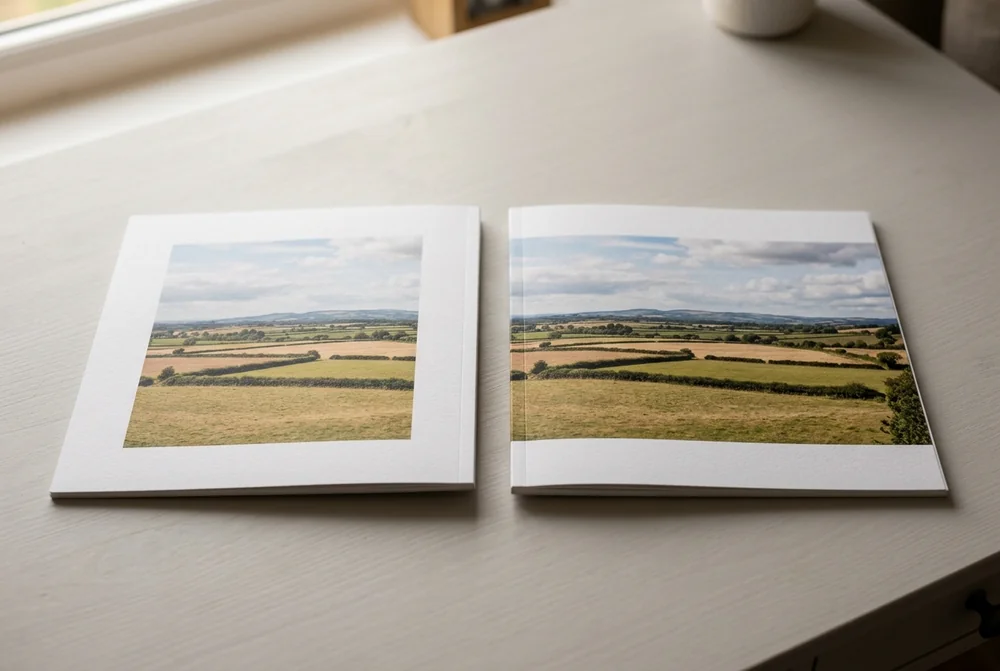
The trade-off is cropping. A 4:3 phone photo loses about 25% of its width on a square page, but only about 6% of its height on an A4 landscape page.
Big square costs less than big landscape. A 30 x 30 cm square starts at £30. An A3 landscape starts at £65, and that gap does not close.
Whichever you choose, scroll your camera roll first and count. If more than seven photos in ten are wide, go landscape. If it is close to an even split, go square.
Why the shape of a photo book matters more than the size
Size decides how impressive a book looks on the day it arrives. Shape decides where it lives for the next thirty years, and how often anyone opens it.
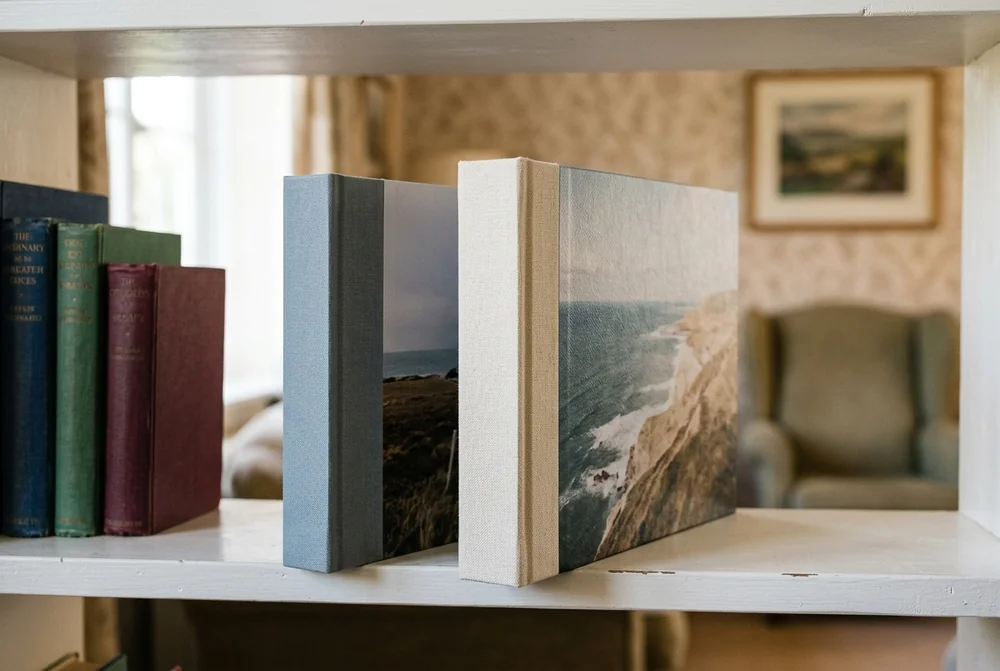
A book that fits a normal bookshelf spends most of its life closed, upright and in the dark. A book that hangs over the edge of the shelf ends up flat on a coffee table instead, in daylight. That matters more than it sounds. The National Archives conservation guidance on caring for photographs lists light exposure, and sunlight in particular, as a direct cause of fading, and notes that some fading continues even in the dark. Storage is not a detail. It is the difference between a book your grandchildren can still read and one that has gone flat and yellow.
Shape also decides how much of each photo you keep. Cropping is not free. Every centimetre you cut away is detail you paid to print, and on a large page it can push a phone photo below the resolution it needs to look sharp. That is covered in full further down.
The good news is that this is a genuinely reversible decision at MYPICTURE. Orientation is chosen at step three of the photo book builder, after the size and the template, so you can see a mock-up before you commit.
Square photo books: what they do well, and where they struggle
A square photo book has equal width and height. MYPICTURE makes two: 20 x 20 cm from £13, and 30 x 30 cm from £30. The 20 x 20 cm takes 14 to 248 pages. The 30 x 30 cm takes 24 to 248 pages. Both come in hardcover or softcover, and the 20 x 20 cm also comes as a booklet. Choose the photographic print option and layflat binding is included at no extra cost, so the two pages of a spread sit completely level.
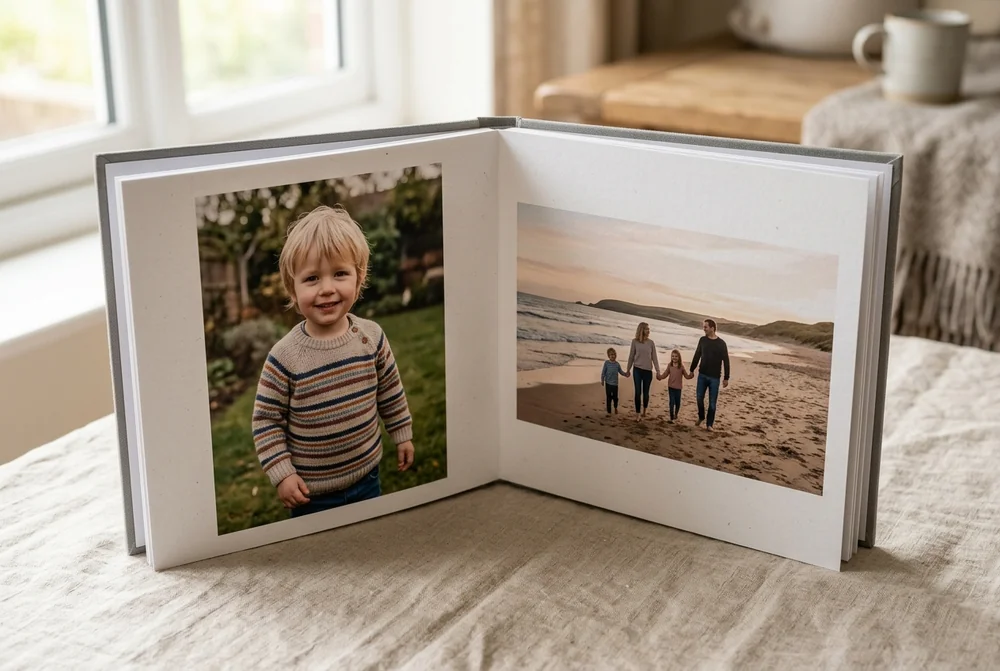
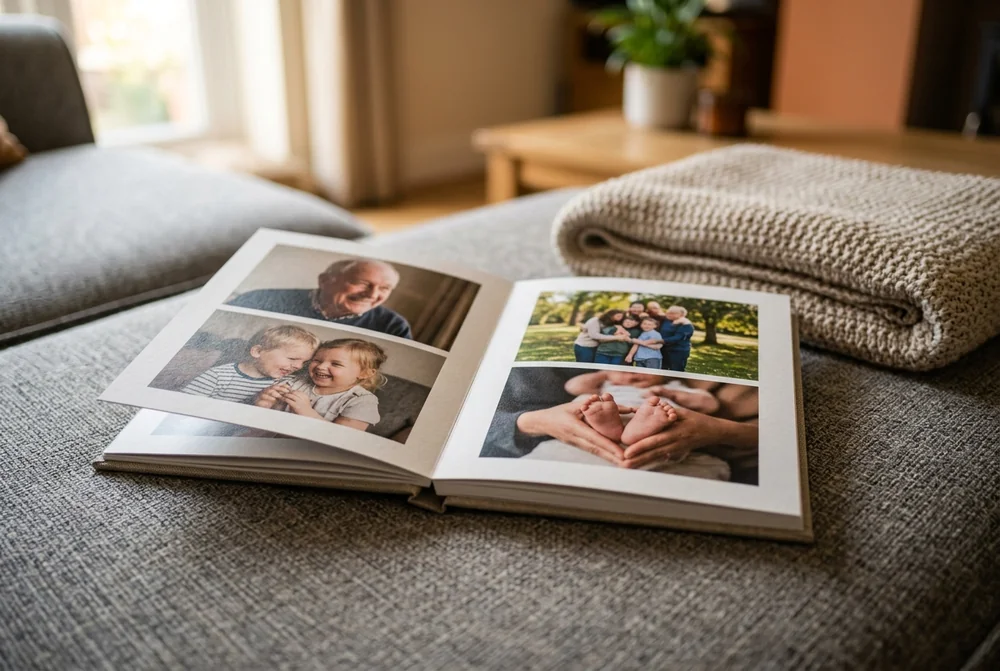
The real strength of a square book is that it does not take sides. An upright photo and a wide photo both fit on the same page at close to full size, so you are not forced to crop half your collection to match the other half. That makes square the safe pick for family albums, baby books and anything built from a phone camera roll, where the mix of upright and wide shots is close to even. It is also the easiest shape to scale. Design a 30 x 30 cm book and the same layouts drop into a 20 x 20 cm copy without redesigning a thing, which is why photographers use square for parent albums and gift copies.
Where square struggles is at the extremes. A true panorama on a square page is tiny, with a band of empty space above and below it. A tall, full-length portrait has the same problem sideways. And MYPICTURE only makes two square sizes. If you want a small square book as a gift, there is nothing under 20 x 20 cm here, and CEWE genuinely has the better range on this one point: three square sizes including a 15 x 15 cm and a 21 x 21 cm from £11.99, which undercuts our 20 x 20 cm. Our own round-up of the best photo books in the UK says the same thing, and it is worth knowing before you order.
Landscape photo books: what they do well, and where they struggle
Landscape means the book is wider than it is tall. At MYPICTURE, landscape is not a separate product. It is an orientation you set on the A-format books: A5 from £8, A4 from £12 and A3 from £65. Turned on their side, an A5 landscape page is 21 x 14.8 cm, an A4 landscape page is 29.7 x 21 cm, and an A3 landscape page is 42 x 29.7 cm. Page counts run 14 to 200 for A5, 14 to 248 for A4, and 26 to 100 for A3.
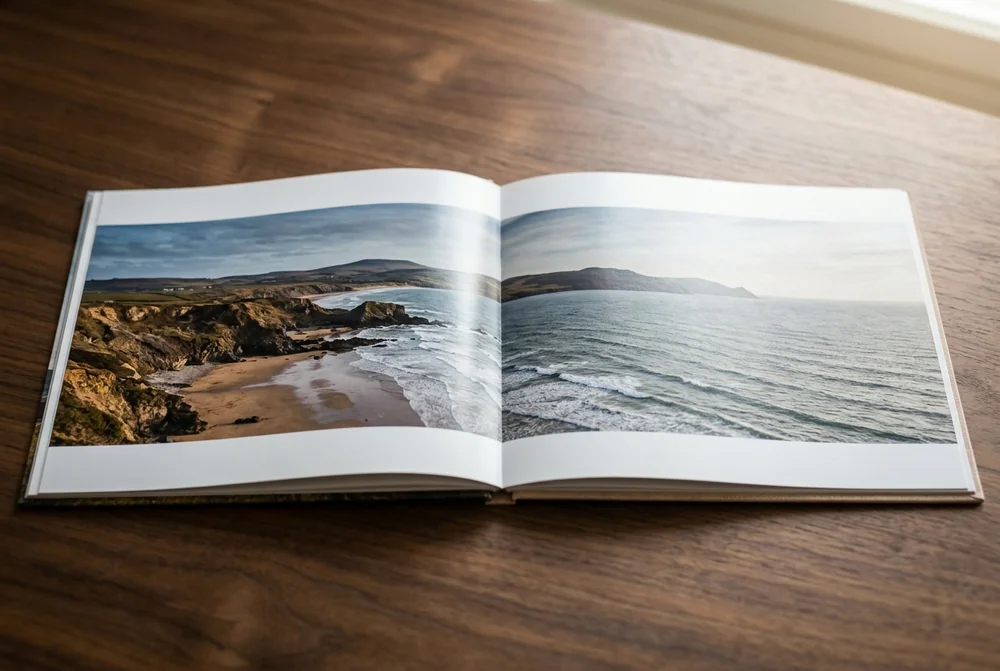
Landscape wins on two things, and it wins hard. The first is wide photos, which is most photos: your eye reads a spread from left to right without interruption, and a single wide shot fills a page properly instead of floating in white space. The second is panoramas. Pick the photographic print option and layflat comes as standard, so a panorama runs across both pages with no gutter swallowing the middle. On a 42 cm wide A3 landflat spread that is 84 cm of uninterrupted image, which no square format can match.
The problem with landscape is everyday life. A 29.7 cm wide A4 book hangs over the edge of most standard bookshelves, which are usually around 25 to 28 cm deep, so it ends up stored flat instead of upright. Stored flat and opened on a table, a wide book puts more strain on the spine each time, which shortens its life on cheaper bindings. Upright photos also suffer: a portrait shot on a landscape page either sits small with space either side, or gets cropped hard. And the price ladder is steep. Going from A4 to A3 takes you from £12 to £65, while going from 20 x 20 cm to 30 x 30 cm only takes you from £13 to £30. If size is your main question rather than shape, our A4 or A3 photo book guide goes through that ladder properly.
Square vs landscape: side by side
Square photo book
Landscape photo book
Price from
£13 (20 x 20 cm)
£8 (A5)
Sizes at MYPICTURE
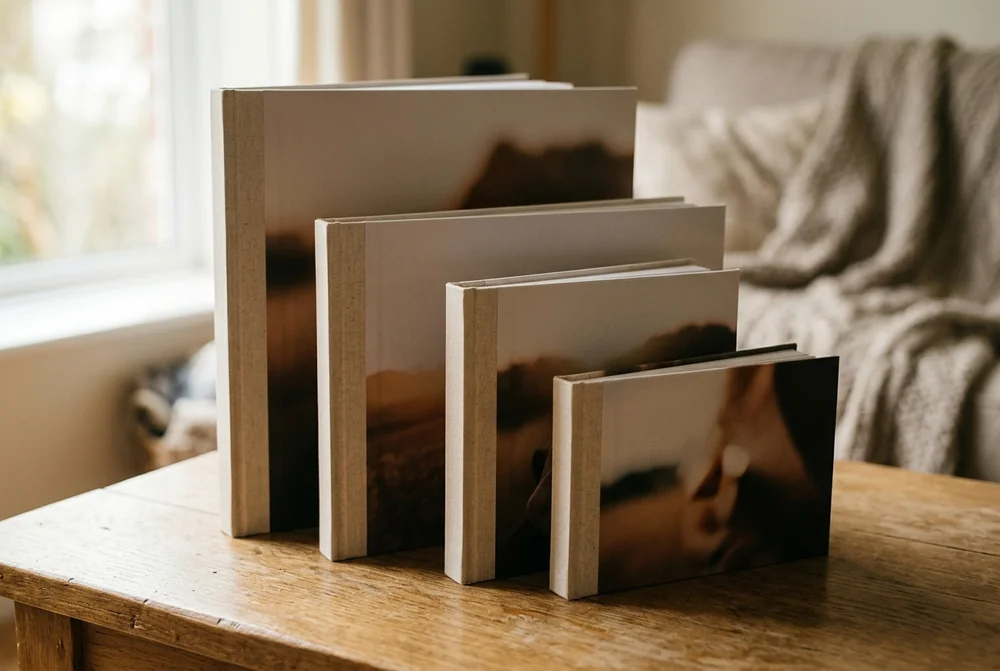
20 x 20 cm, 30 x 30 cm
A5 (21 x 14.8 cm), A4 (29.7 x 21 cm), A3 (42 x 29.7 cm)
Large size price
£30 (30 x 30 cm)
£65 (A3)
Maximum pages
248
248 (A4), 200 (A5), 100 (A3)
Crop on a 4:3 phone photo
About 25% of the width
About 6% of the height
Crop on an upright 4:5 photo
About 20% of the height
About 43% of the height
Panoramas across a spread
Workable, but narrow
Best in class, up to 84 cm on A3
Fits a standard bookshelf
Yes, both sizes
A5 yes, A4 and A3 usually overhang
Best for
Mixed camera rolls, family albums, baby books, gift copies
Travel, landscapes, group shots, panoramas, weddings
Read that as a division of labour rather than a scoreboard. Landscape is the specialist: it is better than square at the thing it is built for, and worse at everything else. Square is the generalist: it is never the best possible home for a panorama, but it is never a disaster for anything either. If you know exactly what is going in the book, pick the specialist. If you are working from a camera roll you have not sorted yet, pick the generalist.
How much of your photo gets cut? The cropping maths
Every photo has an aspect ratio, which is its width compared with its height. Every page has one too. When they do not match, something has to go. Here is exactly how much, for the ratios your photos are most likely to be in.
Your photo
Where it comes from
On a square page
On an A-format landscape page
4:3
Most phone cameras, default setting
Loses about 25% of the width
Loses about 6% of the height
3:2
DSLR and mirrorless cameras
Loses about 33% of the width
Loses about 6% of the width
16:9
Video stills, wide phone mode
Loses about 44% of the width
Loses about 20% of the width
1:1
Older Instagram posts
Loses nothing
Loses about 29% of the height
4:5 upright
Instagram portrait posts
Loses about 20% of the height
Loses about 43% of the height
Two things stand out. Landscape is kinder to wide photos than square is, by a long way: 6% against 25% for a normal phone photo. But square is far kinder to upright photos: 20% against 43%. That is the whole argument in two numbers.
Cropping also costs you resolution, and that is where it can go wrong on a big page. A 12-megapixel phone photo is 4032 x 3024 pixels. Crop it square and you are left with 3024 x 3024. At the 150 DPI rule we use for print, that still covers about 51 cm, so it fills a 30 x 30 cm page comfortably. Crop that same photo to 16:9 for a wide page and the short side drops to 2268 pixels, which covers about 38 cm — fine on A4, tight on A3. If you plan to go large, our guide to photo print resolution explains how to check a file before you commit to a size.
Which costs less? A worked example
Take the same 60 holiday photos and put them through both shapes. All MYPICTURE starting prices are for the minimum page count, and extra pages cost more, so treat these as the floor rather than the final bill.
Book
Shape
Starting price
Minimum pages
Maximum pages
A5
Landscape or portrait
£8
14
200
A4
Landscape or portrait
£12
14
248
20 x 20 cm
Square
£13
14
248
30 x 30 cm
Square
£30
24
248
A3
Landscape or portrait
£65
26
100
At the small end there is almost nothing in it. An A5 landscape at £8 and a 20 x 20 cm square at £13 are five pounds apart, and that five pounds buys you a page more than twice the area. At the large end the picture flips completely. A 30 x 30 cm square is £30. An A3 landscape is £65, more than double, and it caps out at 100 pages while the square runs to 248.
So the honest cost advice is this: if you want a big book, square is the cheaper way to get one, and it holds more. If you want the cheapest book that still looks like a proper album, an A5 landscape at £8 is hard to beat. The £65 A3 is worth it only when the photos genuinely earn that width, which usually means panoramas and professional work rather than a phone camera roll. Not sure which pages you need? The QuickBook designer lays your photos out automatically and shows you the page count before you pay.
Choosing by what you actually shoot
Forget the theory for a moment and look at the photos you have. This is what each type of collection wants.
Phone photos, unsorted. Go square. Phones shoot 4:3 by default but people turn them sideways constantly, so a typical camera roll is a near-even mix. Square handles that mix with the least damage.
Travel and landscapes. Go landscape. Wide scenery is the one thing square genuinely cannot serve, and layflat spreads on the photographic print option are made for it.
Weddings. Either, and it depends on your photographer. Ceremony and reception shots are usually wide, which points to landscape. But if you have a lot of full-length portraits, square protects them better. Ask to see the gallery before you choose.
Babies and newborns. Go square. Close-up shots of a small face fill a square page beautifully in either orientation, and a 20 x 20 cm book is easy to hand round.
Instagram archives. Go square if the posts are old (1:1) and think carefully if they are newer, because 4:5 portrait posts lose about 20% on a square page and about 43% on a landscape one.
Mixed years and family history. Go square, and go big. Old scanned prints come in every ratio imaginable, and the 30 x 30 cm at £30 with 248 pages gives you room for all of them.
One more practical note. Shape is not the only thing that changes how a book feels in the hand. Binding does too, and the two decisions interact: a wide book benefits far more from a stiff cover than a small square one does. Our comparison of hardcover and softcover photo books covers that side of it.
A three-question test to settle it
1. Open your camera roll and scroll. Are more than seven photos in ten wider than they are tall? If yes, choose landscape. If it is closer to an even split, choose square.
2. Do you have panoramas or wide group shots you want across a full spread? If yes, choose landscape, and choose the photographic print option so layflat is included.
3. Is this book going on a normal bookshelf rather than a coffee table? If yes, choose square, or an A5 landscape. An A4 or A3 landscape book will hang over the edge.
If all three answers point the same way, you have your answer. If they split, the tie-breaker is question one, because it is the only one measured against the photos you already have rather than the ones you imagine putting in. When people regret a photo book, it is almost always because half their pictures came out cropped, not because the shelf was the wrong depth.
Why choose MY-PICTURE.CO.UK over other competitors?
MYPICTURE competes on price and page count rather than on prestige. Every photo book is printed and bound in the UK, taking 3 to 5 working days to make and 3 to 6 working days to deliver.
Books start at £8 for A5, and the Lowest Price Guarantee means we monitor UK competitors weekly and will beat a like-for-like price by 5%. The table below compares only the points where that position is measurable. It is a scoped comparison, not a claim that we win on everything — CEWE has a wider square size range and a stronger reputation for print quality, and we say so above.
*Ratings and prices correct as of August 2026. Prices exclude delivery; all brands run periodic promotions.
Shape is the first decision and the one that is hardest to undo once the book is printed, so it is worth five minutes with your camera roll before you start. Once you know which shape your photos want, the rest of the build is quick.
Frequently asked questions
What is the most popular size for photo books?
A4 and 20 x 20 cm are the two most commonly ordered formats in the UK, because both sit in the middle of the range on price and both fit a normal bookshelf. At MYPICTURE, A4 starts at £12 and 20 x 20 cm starts at £13, and both take up to 248 pages. Smaller A5 books at £8 are popular as gifts, while 30 x 30 cm and A3 are usually chosen for weddings and milestone albums.
What is the best size for a photo album?
For a general family album, 20 x 20 cm or A4 is the best balance of page area, price and shelf fit. Go bigger, to 30 x 30 cm, if the photos are high resolution and the album marks a major occasion such as a wedding. Go smaller, to A5, if the book is a gift or will be carried around. Bigger pages need more resolution, so check your files before choosing a large format.
How many photos should be in a photo book?
Between two and four photos per page is a comfortable range, so a 30-page book holds roughly 60 to 120 photos. Fewer photos per page makes each one bigger and gives the book a calmer, more designed feel. MYPICTURE books run from 14 pages up to 248 depending on the format, so there is room either way. Most people choose too many photos rather than too few, and the book reads better if you cut.
What are common mistakes in photo book layouts?
The three most common mistakes are cropping heads or feet at the page edge, using low-resolution files on large pages, and putting an important detail in the centre of a two-page spread where the fold sits. The first two are avoided by matching your book shape to your photo shapes. The third is avoided by choosing layflat binding, which is included at no extra cost on MYPICTURE photographic print books.
Is a square or landscape photo book better for a wedding?
Landscape is the traditional choice for weddings because ceremony, reception and group shots are usually wide, and a full-spread panorama works beautifully. Square is the better choice if your photographer delivered a lot of upright portraits, because an upright photo loses about 20% on a square page against about 43% on a landscape one. Look at the gallery first, then choose the shape that crops the fewest of your favourite images.
Can I mix portrait and landscape photos in a square photo book?
Yes, and that is the main reason square exists. A square page holds an upright photo and a wide photo at close to the same size, so neither one has to be cropped hard to sit alongside the other. This makes square the most forgiving shape for an unsorted phone camera roll. Mixing orientations in a landscape book is possible too, but the upright shots either run small or lose a lot of height.