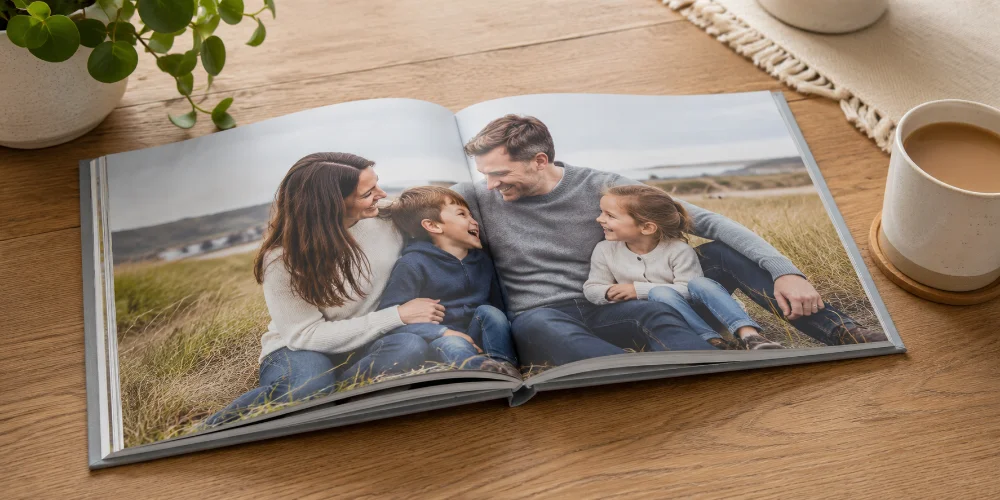
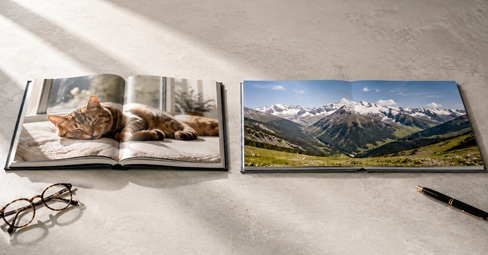
Most of us have thousands of photos sitting on our phones. Holidays, birthdays, the dog doing something daft, the kids growing up faster than we would like. And almost none of those photos ever get looked at again.
A photo book fixes that. It turns a camera roll into something you can hold, flick through and pass around the table at Christmas. No charger needed, no scrolling, no adverts.
But choosing one is harder than it should be. There are more than a dozen photo book services in the UK, prices run from free to well over a hundred pounds, and the jargon can be baffling. Layflat? GSM? Case binding? What does any of it mean, and how much of it actually matters?
This guide answers all of it. We have compared every major UK photo book provider, explained the paper and binding choices in plain English, and put together size, price and resolution tables you can check your own photos against. By the end, you will know exactly which photo book to order and why.
Key Takeaways
Photo books in the UK start from around £8 for an A5 book and rise to £100+ for large premium layflat albums.
A5 and 20×20cm books suit everyday memories and gifts; A4 and 30×30cm suit weddings, travel and coffee-table display.
Layflat binding opens completely flat at 180°, so photos can run across both pages without disappearing into the spine. It is the single most important upgrade for wedding and travel books.
Paper weight is measured in gsm. Standard pages are 150–200gsm; premium layflat pages run 270–380gsm — roughly twice as thick.
Aim for photos of around 300 dpi at print size. A sharp full-page A4 photo needs a file of roughly 2,500×3,500 pixels — fine for most phones from 2016 onwards, but not for WhatsApp-compressed copies.
CEWE holds the current Which? Best Buy and is the quality benchmark; budget-friendly UK-made options such as My Picture (from £8, layflat included on photographic print) offer the strongest value.
For gifting, allow at least two weeks between ordering and the big day. Photo books are made to order and cannot be rushed like a stock item.
What Makes a Good Photo Book?
Every photo book service says its books are beautiful. Some of them are even right. When we compared providers for this guide, we judged them on the same six things the professional testers at Which? and the photography press use:
Print quality — accurate colours, sharp detail, and no muddy shadows in darker photos.
Paper — thickness (gsm), finish (matt, gloss or satin), and whether pages feel like a keepsake or a leaflet.
Binding — how the book is held together, whether it opens flat, and whether the spine will survive years of flicking through.
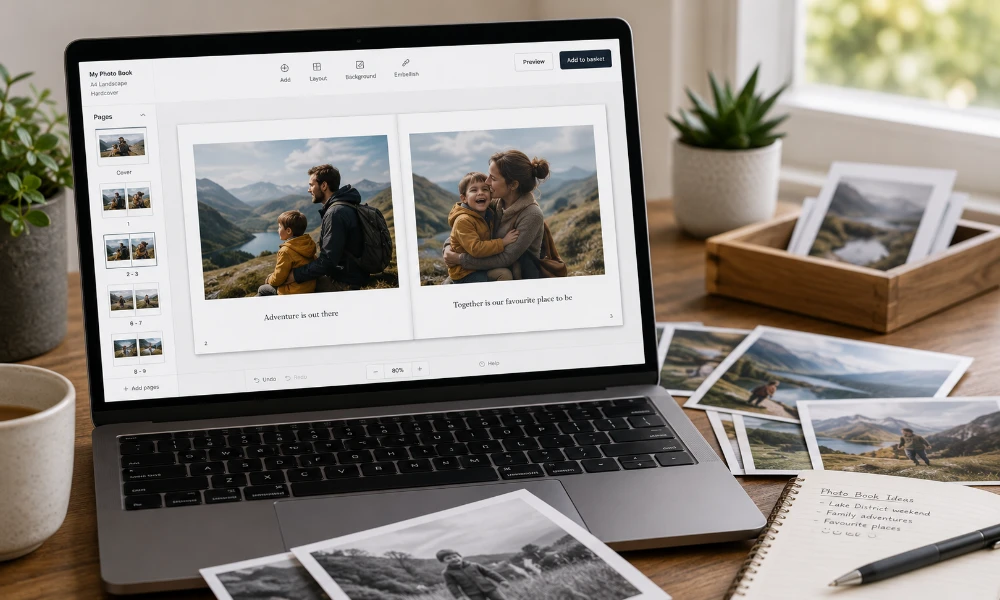
Editor software — how easy it is to build the book, whether there is an auto-fill option, and whether it works on a phone.
Price — not just the headline “from” price, but what a realistic 26–40 page book actually costs with the options you want.
Delivery — where the book is printed and how long production and shipping typically take.
Keep those six in mind as you read the comparison below. A cheap book with flimsy pages is no bargain, and a gorgeous book that arrives after the wedding anniversary is no use to anyone.
The UK Photo Book Market in 2026 at a Glance
Here is the whole UK market in one table. “From” prices are the cheapest book each provider sells at full price — expect to pay more for bigger sizes, extra pages and premium paper. Prices were checked in mid-2026 and move around with promotions, so always confirm on the provider’s site.
Provider
From
Layflat option?
Printed in UK?
Standout feature
Trustpilot Rating
My Picture
£8
Yes — included on photographic print
Yes
Widest binding choice in Which? testing; Factory Prices
4.5/5.00
Snapfish
£9.99
Yes (310gsm)
Yes
Frequent half-price sales; cheapest entry deals
4.3/5.00
Bob Books
£12.99
Yes
Yes (London)
Pro-photographer favourite; up to 6 paper types
4.4/5.00
Vistaprint
~£10–£15
Selected sizes
Varies
Bulk discounts for multiple copies
4.4/5.00
Mixbook
~£12–£15
Yes
Yes
Best-rated editor; books up to 400 pages
4.4/5.00
Rosemood
£18
Yes (340gsm)
No (France)
Traditional sewn binding and hand-finishing
4.4/5.00
Photobox
~£20–£26
Yes (270gsm)
Yes
Big-name brand with regular 40–50% offers
4.1/5.00
Papier
£24
No
Yes
Design-led covers on textured Mohawk paper
4.0/5.00
Popsa
~£20+
Yes (upgrade)
Yes
AI builds the whole book in about 15 minutes
4.4/5.00
Blurb
~£15–£60+
Yes
Varies
Pro tools; sell your book in its bookshop
2.8/5.00
The Providers in Detail
My Picture — best value UK-made books
That is us — so judge this entry with that in mind — but the facts stand up to checking. Our photo books start from £8 for an A5 book at the Factory Price, rising through A4 (from £12), 20×20cm (from £13) and 30×30cm (from £30) to a large A3 format. Everything is printed in the UK.
Two things stand out. First, layflat binding comes as standard when you choose photographic print on real photo paper — most rivals charge a chunky premium for it. Second, when Which? tested ten UK services, ours offered the widest choice of bindings of the lot: hardcover, softcover, ring-bound and booklet. There is also an Eco Photo Book from £17 printed on FSC-certified recycled paper.
Snapfish — cheapest deals
Snapfish is the bargain-hunter’s pick. Its regular half-price sales mean a medium hardcover can drop to around £14–£15, and books are printed in the UK with fast production. The trade-off is the paper: standard pages are a fairly light 200gsm, and reviewers have marked its print quality down for muddy shadows in darker photos. Fine for casual books; think twice for a wedding album.
Bob Books — the professional’s choice
A London independent trading since 2006, Bob Books is quietly loved by professional photographers. Up to six paper types, proper layflat, and premium materials throughout. Prices start at £12.99 and climb, but the quality justifies it.
Mixbook — best editor
Mixbook’s online editor is repeatedly rated the best in the business, with AI auto-creation, smart captions and books up to 400 pages — double most rivals. UK printing keeps delivery sensible. Watch for its frequent discount codes.
Photobox — the household name
Photobox is probably the brand your mum has heard of. Standard books use 200gsm glossy pages, layflat books step up to 270gsm, and there are near-constant 40–50% promotions — so never pay full price. Quality is decent rather than outstanding, and its Trustpilot score sits around 4.0.
Rosemood — the artisan option
Rosemood books are made in a French atelier using traditional sewn binding — the only mainstream provider still doing this — with hand-finished touches such as hot-foil stamping. Layflat pages are a hefty 340gsm. Beautiful for weddings; prices and delivery times reflect the craftsmanship.
Papier — the stylish one
Papier brings its stationery-brand design sense to photo books, printed on lovely textured Mohawk paper with fabric and foiled cover options. From £24 for an A5 softback. No layflat, and the size range is small — this is a style purchase more than a specification one.
Popsa, Vistaprint, Blurb and Google Photos
Popsa is a London-built app whose AI lays out an entire book in about 15 minutes — clever, though prices sit above the budget labs. Vistaprint is the cheap-and-cheerful bulk option, handy for ordering several copies, with mixed print-quality reviews. Blurb serves photographers and self-publishers with professional layout tools and even lets you sell your book. Google Photos turns an album into a simple hardcover or softcover from £15.99 in minutes — convenient, but with very limited design control and no layflat.
Photo Book Bindings Explained
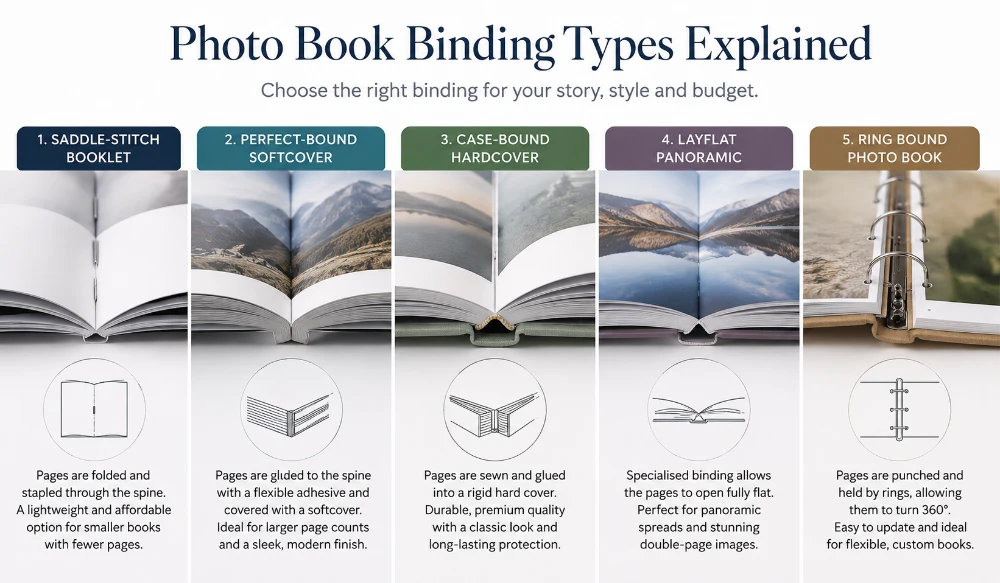
Binding is the difference between a book that survives twenty Christmases and one that sheds pages by Easter. There are five types you will meet, and providers rarely explain them properly.
Binding
How it works
Best for
Watch out for
Booklet (saddle-stitch)
Folded pages stapled through the spine
Slim, cheap books up to ~48 pages
No printable spine; least durable
Perfect-bound softcover
Pages glued into a flexible cover
Everyday books, travel journals
Does not open flat; photos near the spine get lost
Hardcover (case-bound)
Pages bound into rigid board covers
Gifts and keepsakes
Costs more; still has a centre gutter unless layflat
Layflat
Spreads printed as one sheet, glued back-to-back
Weddings, panoramas, showpiece albums
Fewer maximum pages; higher price at most providers
Ring-bound (spiral)
Pages punched onto a wire spiral
Recipe books, kids’ books, desk use
Less gift-like; wire can catch
The rule of thumb: softcover for everyday, hardcover for gifts, layflat for the photos you care about most. If a photo book is going to be opened once a year and passed around a full dinner table, hardcover earns its money.
Paper Types and GSM: What the Numbers Mean
What is gsm? GSM stands for grams per square metre and measures paper weight. Ordinary office paper is about 80gsm. Standard photo book pages run 150–200gsm, while premium layflat pages run 270–380gsm — thick enough that they feel closer to card than paper.
Weight matters because thin pages curl, show print through from the other side, and simply feel cheap in the hand. Here is how the main providers compare:
Provider
Standard pages
Premium / layflat pages
My Picture
170gsm satin (digital print)
Real photo paper, layflat as standard
CEWE
160–200gsm
368–382gsm photographic
Rosemood
150gsm
340gsm layflat
Snapfish
200gsm
310gsm lustre-silk layflat
Photobox
200gsm
270gsm layflat
Papier
Textured Mohawk Superfine
—
Matt, gloss or satin?
Matt — soft, no glare, no fingerprints, kind to skin tones. The most popular choice for family and wedding books, and the finish Which? testers tend to favour.
Gloss — punchy colours and deep blacks, brilliant for vivid travel shots, but it reflects light and collects fingerprints.
Satin or lustre — the in-between: more life than matt, less shine than gloss. A safe pick if you cannot decide.
If your book mixes people and places — which most do — matt or satin is the sensible default. Save gloss for books that are all landscapes, cityscapes and colour.
What Is a Layflat Photo Book?
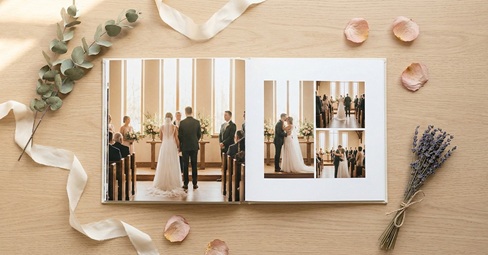
A layflat photo book opens completely flat at 180 degrees, with no dip in the middle. Each double-page spread is printed as one continuous sheet, then the sheets are glued back-to-back. That means a single photo can run across both pages without any of it vanishing into the spine.
Open an ordinary perfect-bound book and the pages curve down into the centre — the “gutter”. Anything printed there gets swallowed. On a layflat book there is no gutter at all, which is why wedding photographers insist on it: the first-kiss shot can fill a full 40–60cm spread, edge to edge, faces intact.
Layflat pages are also far thicker — 270 to 380gsm depending on the provider — so the book feels substantial and the pages will not crease. The trade-offs are a lower maximum page count and, at most companies, a noticeably higher price. Choosing photographic print with us includes layflat at no extra charge, which is worth knowing if the surcharge elsewhere has put you off.
Choose layflat if: it is a wedding, anniversary or milestone book; you love panoramic landscape shots; or the book will be handled by lots of people. Skip it if: you want maximum pages for the money, or it is a casual book you will update every year.
Photo Book Sizes: Which One Should You Choose?
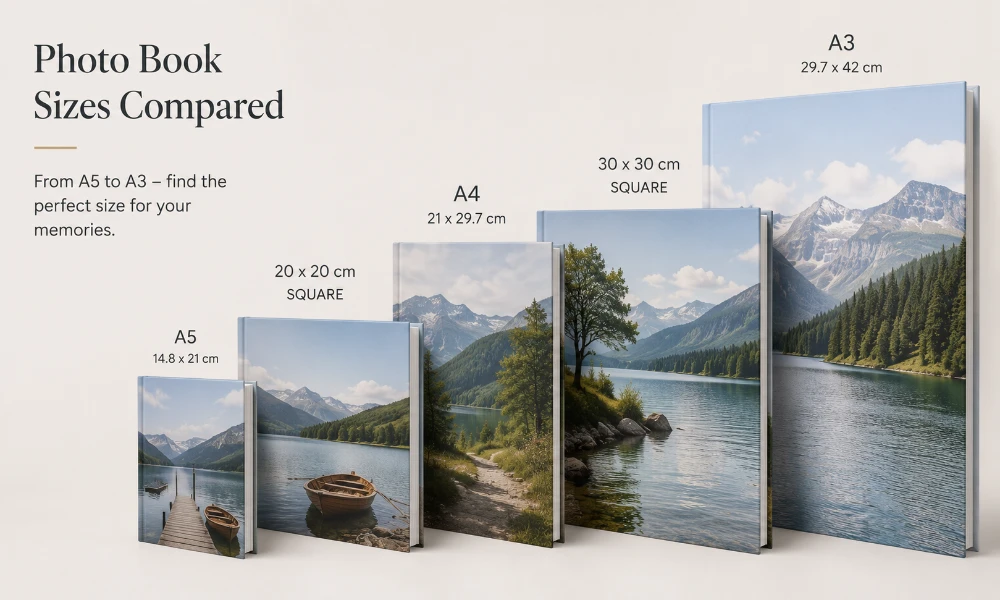
Size shapes everything: price, shelf fit, and how your photos feel on the page. UK providers cluster around five sizes.
A4 is the safest all-round choice — big enough for full-page photos to breathe, small enough for any bookshelf, and priced in the sweet spot. Landscape A4 suits holiday and scenery photos; portrait A4 suits people. Square formats are lovely for baby books and phone photography, because square crops waste none of the page.
One practical tip: match the book’s orientation to your photos. If your camera roll is mostly landscape shots, a portrait book forces awkward crops on every page. Check before you commit — it is the most common sizing regret.
Photo Resolution: Will Your Photos Print Sharp?
This is where photo books go wrong most often — and it is completely avoidable. Printed pages need far more detail than a phone screen, so a photo that looks fine on your mobile can print soft and fuzzy at full-page size.
The rule of thumb: aim for around 300 dpi at print size. To find the biggest sharp print your photo can make, divide its pixel width and height by 300 — that gives you the safe maximum size in inches. Around 225 dpi is an acceptable floor for photo book pages.
Photo use in the book
Minimum pixels needed
Roughly equals
Small photo (quarter page, A4 book)
1,000×1,300
1–2 megapixels
Half-page photo (A4 book)
1,700×2,500
4 megapixels
Full A4 page
2,500×3,500
8–9 megapixels
Full layflat spread (A4 book)
5,000×3,500
17+ megapixels
Full 30×30cm square page
3,500×3,500
12 megapixels
Almost any phone from 2016 onwards clears these bars comfortably — as long as you use the original files. The classic mistake is building a book from photos saved out of WhatsApp or Facebook, which compress images down to one or two megapixels. Always go back to your camera roll or cloud backup for the originals, and take editor warnings about low resolution seriously: they appear for a reason.
If you want the full picture on pixels, dpi and print sizes — including what to do about older scanned photos — our guide to photo print resolution walks through it step by step.
How to Design a Photo Book People Actually Look At
The best photo books are edited, not emptied. Nobody wants to wade through 400 near-identical shots of the same beach. Here is the process that turns a camera roll into a book people genuinely sit and read.
1. Curate ruthlessly
Aim for 40–80 photos for a typical book, or 80–120 for a wedding. Pick one photo per moment, not five. If two shots are similar, keep the one with the better expressions — emotion beats technical perfection every time.
2. Give the book a spine (the story kind)
Chronological order works for weddings, trips and baby books — morning to night, day one to day fourteen, birth to first birthday. Thematic order works for family yearbooks: group by people, places or seasons rather than strict dates.
3. Breathe
Two to four photos per spread is the sweet spot, with the occasional single full-page hero shot for your very best images. White space is not wasted space — it is what makes the good photos look good. Cramming eight photos onto a page turns them all into thumbnails.
4. Respect the edges
Keep faces and anything important at least 5mm from the trim edges, and away from the centre gutter unless you have a layflat book. Editors show a safe-zone line — believe it.
5. Caption lightly
Dates, places and names — that is usually enough. In thirty years, “Whitby, August 2026” will be the most valuable text in the book. Stick to one or two fonts throughout; a photo book is not the place to audition your font library.
6. Sleep on it
Preview every page, check names and dates, then leave the project overnight and look once more with fresh eyes before ordering. Typos are forever in print. For a fuller walkthrough — including layout ideas page by page — see our guide to creating a personalised photo album.
Photo Books by Occasion
Wedding photo books
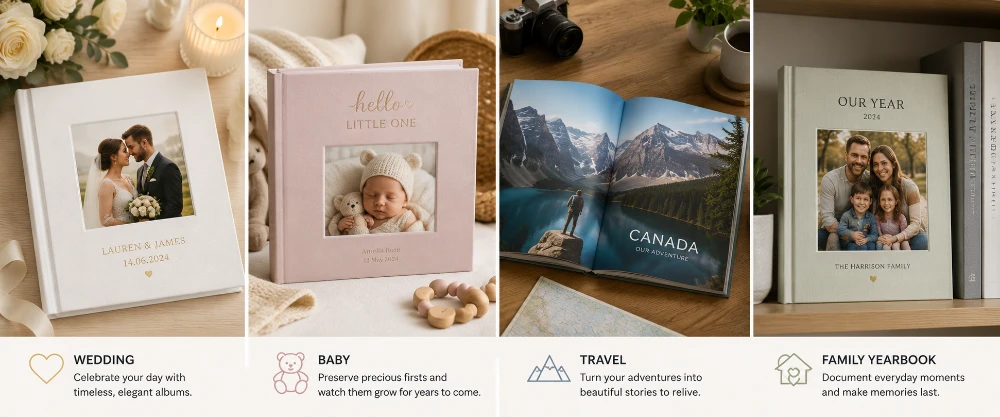
This is the occasion layflat was made for. Choose a large hardcover layflat — 30×30cm or A4 landscape — and run the day chronologically: getting ready, ceremony, confetti, speeches, first dance. Give the very best image a full double-page spread. Many couples also have that one hero shot printed separately as a set of photo prints for parents and grandparents — the book for you, the prints for them.
Travel photo books
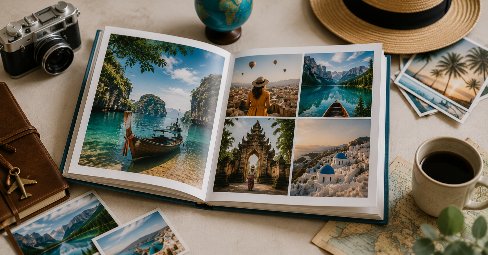
Order by itinerary rather than by photo quality, so the book reads like the trip felt. Landscape formats suit scenery; layflat lets mountain panoramas run across the full spread. Add place names as captions — you will not remember which Greek harbour was which by 2031. One book per big trip beats one giant book per decade.
Baby’s first year
Square formats are the favourite here, structured month by month or milestone by milestone: first smile, first tooth, first steps, first birthday cake facial. Leave a little space for written notes — weights, funny sounds, what made them laugh. These books get re-read more than any other kind.
The family yearbook
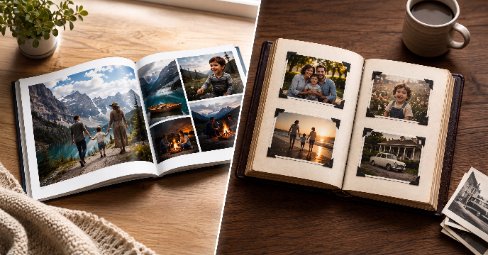
One book per year, same size and style every year, built over the Christmas break. Group by season or by event. After five years you have a shelf that tells your family’s whole story — and the annual ritual takes a single evening once you are in the habit.
Memorial and tribute books
A photo book is one of the kindest things you can make after losing someone. Run their life in order, from the earliest photo you can find to the most recent, and caption generously — the stories matter as much as the pictures. Several copies for family members cost little more than one.
What a Photo Book Costs in 2026
Headline “from” prices are for the smallest book with minimum pages. Here is what realistic budgets actually buy, based on full prices across the UK market in mid-2026:
Under £15: an A5 or small softcover with 20–26 pages — perfect for a monthly family book, a stocking filler or a first try. Snapfish sale deals and the FreePrints monthly freebie live here too.
£15–£30: the biggest slice of the market. A4 hardcovers with 26–40 pages, small squares with premium paper, and our 20×20cm and A4 books at Factory Prices. Most family and travel books land in this band.
£30–£60: large squares, layflat upgrades at most providers, more pages, and premium papers. The wedding-book heartland.
£60+: A3 statement books, leather and linen covers, artisan binding from the likes of Rosemood, and professional-grade albums. Built for once-in-a-lifetime occasions.
Two ways to stretch any budget: never pay full price at the promotion-heavy brands (Photobox and Snapfish discount almost constantly), and remember that extra pages usually cost £1–£2 each — a 60-page book can quietly cost double a 26-page one. If you are new to ordering prints and books online, our guide to printing photos online in the UK covers how uploading, previewing and delivery work from start to finish.
Ordering Deadlines: Photo Books as Gifts
Photo books are made to order — printed, bound and trimmed for you from scratch. Typical UK production runs two to four working days, with delivery on top, so the realistic window from clicking “order” to holding the book is one to two weeks.
The golden rule: order at least two weeks before you need it. For Christmas, that means early December at the latest — the pre-Christmas rush stretches every provider’s production times, and courier networks slow down too.
The UK gifting dates worth planning around: Christmas Day (25 December), Mothering Sunday (7 March 2027) and Father’s Day (20 June 2027), plus the birthdays and anniversaries only your calendar knows about. Providers publish “order by” dates each December — check them, then order a week earlier anyway.
And if a photo book will not arrive in time, a same-photos plan B exists: a photo calendar uses the same uploaded pictures and turns the gift into something they will look at every day of the coming year.
Nine Photo Book Mistakes to Avoid
These are the errors that come up again and again in one-star reviews — all preventable, none the printer’s fault:
Using compressed photos saved from WhatsApp or social media instead of originals.
Ignoring the low-resolution warning in the editor and hoping for the best.
Overcrowding pages — eight thumbnails where two good photos should be.
Putting faces in the gutter of a non-layflat book, where the spine swallows them.
Placing text or heads at the trim edge — anything within ~5mm of the edge can be cut.
Mixing heavy filters — a sepia page next to a saturated one looks jarring in print.
Random photo order with no story — books without a thread do not get re-read.
Skipping captions entirely — future you will not remember the where and when.
Ordering without proofreading — preview every page; a printed typo is permanent.
Photo Book Trends in 2026
AI does the boring bit
The biggest shift in years: nearly every major provider now offers AI auto-layout, which picks your best shots, skips duplicates, keeps faces away from crops and builds the whole book in minutes. CEWE has its Smart Layout, Mixbook its Auto-Create, Popsa built its entire app around the idea — and our QuickBook turns 22–200 uploaded photos into a finished layflat softcover on real photo paper for £13, no software download, straight from your phone. You still get final say on every page; the AI just saves you the two hours of dragging and dropping.
Less clutter, more white space
Design taste has moved decisively towards clean, minimalist layouts — one or two photos per page, generous margins, restrained captions. Busy scrapbook-style templates with stickers and swirls are fading fast.
Greener paper
FSC-certified and recycled papers have gone from niche to expected. CEWE and Photobox offer FSC stock, and our Eco Photo Book uses recycled paper with a natural matt finish. If sustainability guides your shopping, the option now exists at most price points.
Film looks and candid moments
The photos going into books are changing too: warm film-style edits, unposed candids and phone photography dominate. The polished-studio look is out; the real-life look is in — which suits photo books perfectly, because real life is what they are for.
The Final Word
A photo book is one of the few things you can buy for under £20 that genuinely gets more valuable every year. The market in 2026 is the best it has ever been: quality is up, AI tools have removed the effort, and there is a well-made option at every budget from a free monthly softcover to a hand-sewn heirloom.
The honest summary: buy CEWE if you want the award-winner and money is no object, buy from us if you want UK-made quality at Factory Prices with layflat thrown in, and whichever name ends up on the box — use your original photos, keep the layouts clean, and order two weeks before you need it.
Your camera roll is already full of the raw material. All it is waiting for is a cover.
Frequently Asked Questions
What is a photo book?
A photo book is a professionally printed, bound book of your own photographs, designed online and delivered to your door. Unlike a traditional album with slip-in pockets, the images are printed directly onto the pages, alongside any captions and backgrounds you choose. Prices in the UK start from around £8.
What is a layflat photo book?
A layflat photo book opens completely flat at 180 degrees with no dip at the spine, because each spread is printed as a single sheet and the sheets are glued back-to-back. Photos can run across both pages uninterrupted, which is why layflat is the standard choice for wedding albums.
How much is a photo book in the UK?
UK photo books start at about £8 for a small A5 softcover and typically cost £15–£30 for an A4 hardcover with 26–40 pages. Large layflat and premium albums run £40–£100+. Extra pages usually add £1–£2 each, and promotion-heavy brands frequently discount 40–50%.
How do I make a photo book?
Choose a size and cover, upload your photos, arrange them in an online editor — or let an auto-fill tool build the layout — add captions, preview every page, then order. It takes anywhere from fifteen minutes with an AI tool to a couple of evenings for a hand-crafted wedding book.
How many photos should go in a photo book?
Around 40–80 photos suits a typical 26–40 page book, at two to four photos per spread with occasional full-page images. Wedding books usually carry 80–120 photos across more pages. Fewer, better photos always beats more, smaller ones — curation is what makes a book worth re-reading.
Which photo book is best in the UK?
CEWE holds the current Which? Best Buy and leads on outright print quality, while My Picture offers the strongest value with UK-made books from £8 and layflat included on photographic print. Mixbook has the best editor, Bob Books suits professionals, and Snapfish wins on sale-price deals.
A4 or A5 photo book — which should I pick?
Pick A4 for holidays, weddings and family yearbooks — photos get room to breathe and full-page images look superb. Pick A5 for everyday memory books, monthly baby updates and smaller gifts, where its lower price and handy size win. If in doubt, A4 is the safer all-rounder.
Are Google Photos books any good?
They are decent for speed and convenience — Google builds a simple hardcover or softcover from an album in minutes, from £15.99. But design control is minimal, there is no layflat option and paper choice is limited, so they suit quick casual books rather than keepsakes or wedding albums.
What happened to Apple photo books?
Apple shut down its built-in Print Products service — including photo books — in September 2018. Mac users now order through dedicated providers instead, either via websites and apps such as those compared in this guide, or through third-party printing extensions that plug into the Photos app.
Can I make a photo book from phone photos?
Yes — photos from almost any smartphone made since 2016 print sharply at A4 size and below, provided you upload the original files. Avoid images saved from WhatsApp or social media, which are heavily compressed, and heed any low-resolution warnings the editor shows before you order.
Matt or gloss pages — which is better?
Matt is the safer choice for most books: no glare, no fingerprints and flattering, natural skin tones, which is why it dominates wedding and family albums. Gloss makes colours punchier and blacks deeper, suiting vivid travel and landscape books. Satin sits between the two.
How long does a photo book take to arrive?
Expect one to two weeks in total for UK orders. Production typically takes two to four working days because every book is printed and bound individually, with courier delivery on top. Around Christmas, order in early December — production and delivery both slow in the seasonal rush.
Do photo books fade?
A well-made photo book kept out of direct sunlight will stay vibrant for decades. Print technology matters — quality providers use pigment-based or latex inks and archival papers precisely because they resist fading. Store books upright on a shelf away from damp and radiators, as you would any book.
Can I reorder the same photo book later?
Usually, yes — most providers save your project in your account so you can reorder copies or make small updates later, though saved-project time limits vary from 45 days to indefinitely. If a book matters, download or back up the original photos as well; projects are not archives.