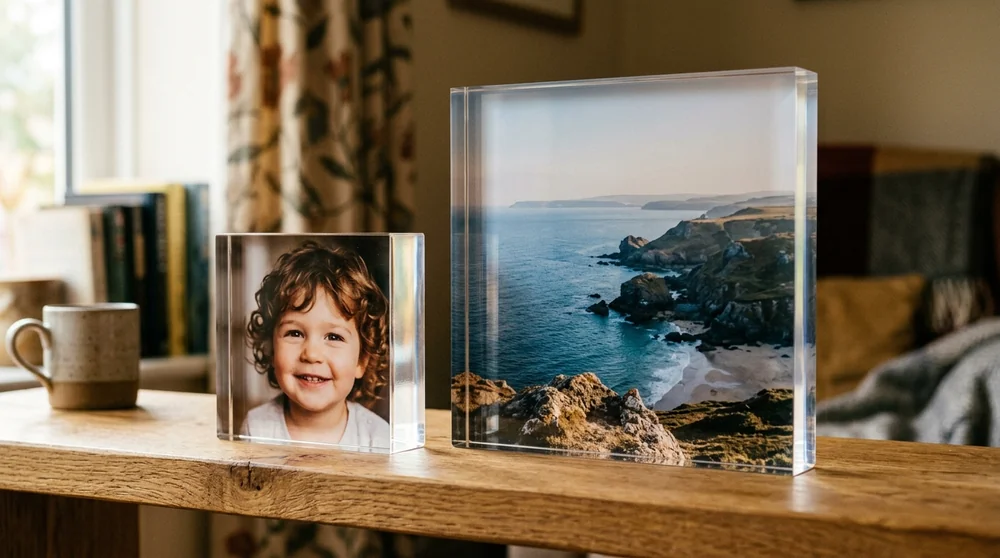
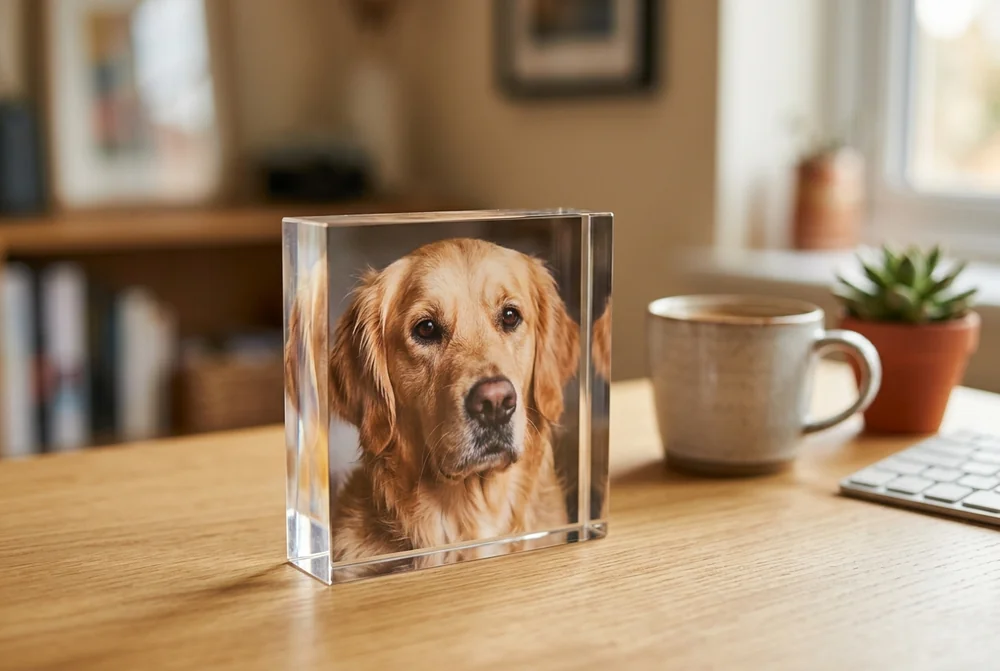
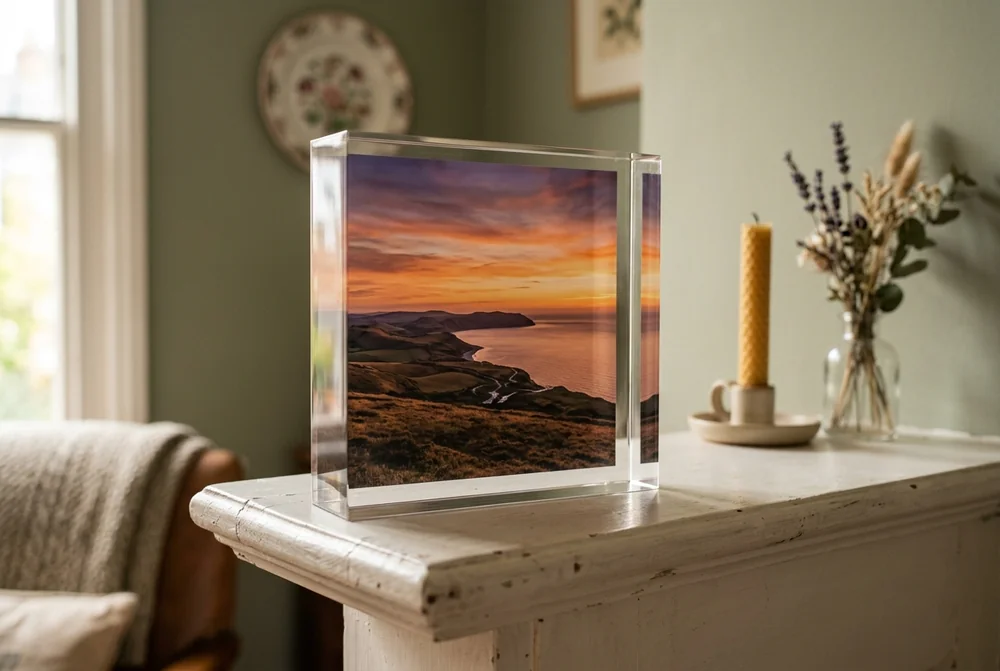
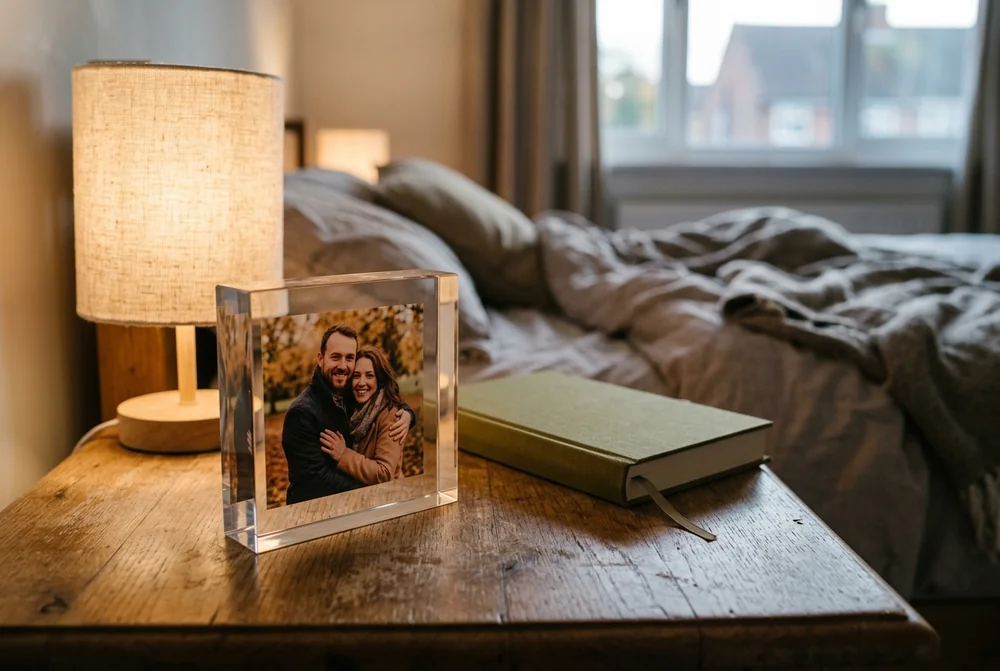
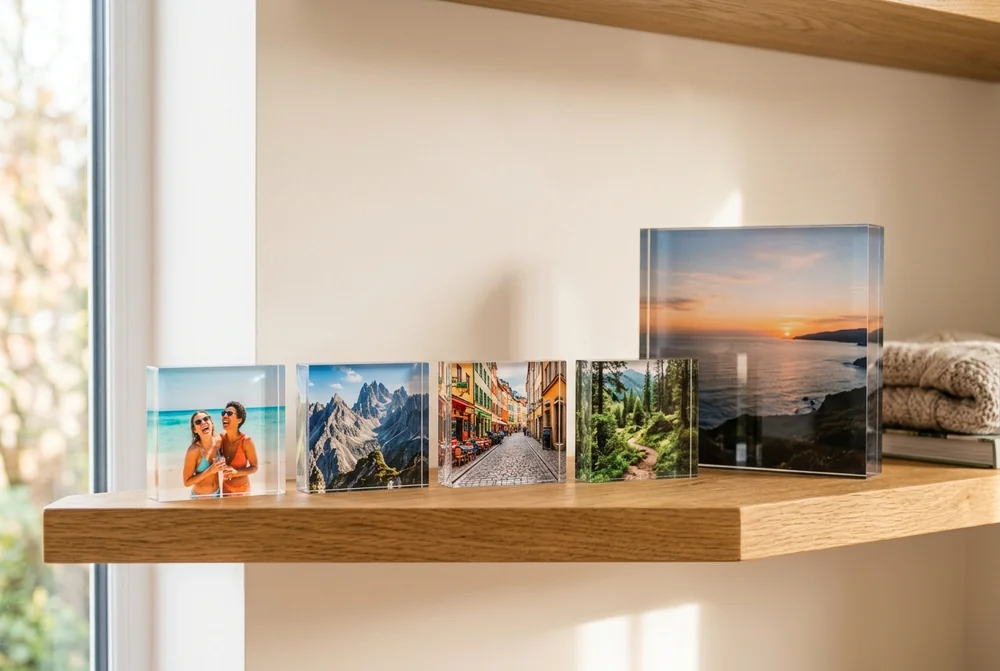
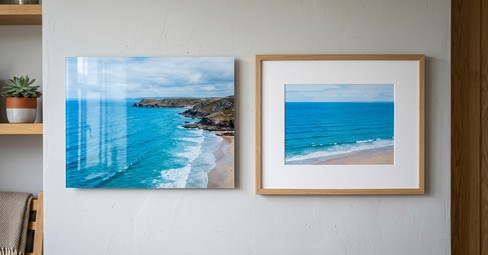
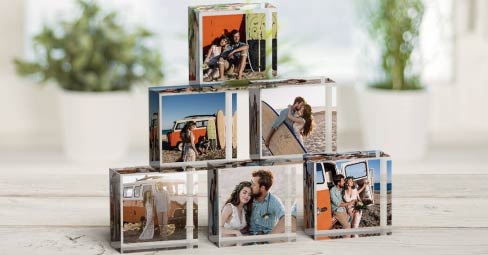
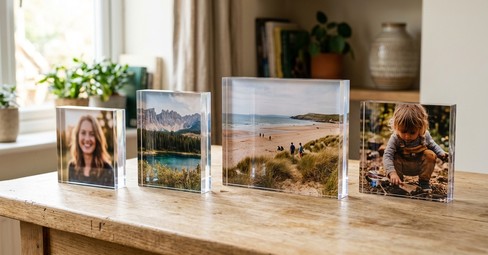
Pick the 10x10cm acrylic photo block for a desk, a bedside table or a set of several small blocks together. Pick the 20x20cm block when the photo is the main thing in the room and people will look at it from across the sofa. At MYPICTURE the small block is £14.00 and the large is £34.00.
Most people choose a size by looking at a picture on a screen, which is why so many blocks arrive smaller than expected. A 10x10cm block is about the size of a beer mat. A 20x20cm block covers four times that area and has real weight in the hand. The gap between them is bigger than the numbers suggest.
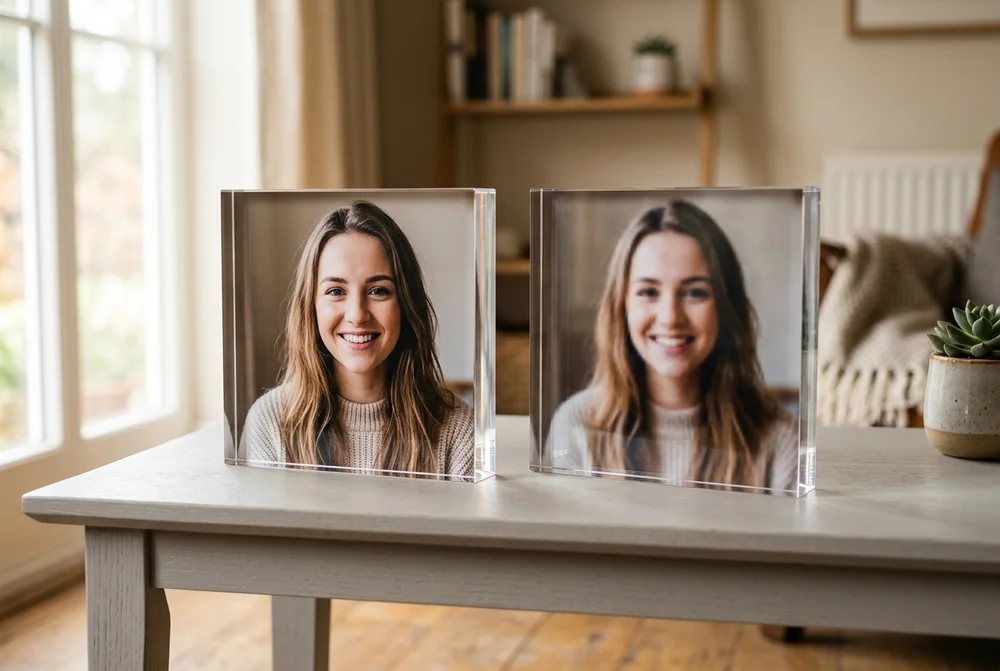
There is also a second question that almost no shop asks you, and it decides the answer for a lot of people: does your photo actually have enough pixels for the bigger block?
The short version
The small block is £14.00 and the large is £34.00. Both are 25mm thick acrylic glass, printed edge to edge, and both stand up on their own with nothing to fix or hang.
The 20x20cm block gives four times the display area for 2.4 times the price. That works out at 8.5p per square centimetre for the large block against 14p for the small one, so the big block is better value per centimetre.
The real trade-off is distance, not money. A 10x10cm block works at arm's length. A 20x20cm block works from across a room. Choose by where the person will be standing.
Your photo needs about 2,362 pixels across for a sharp 20x20cm block, and only 1,181 for a 10x10cm one. A photo that has been sent through WhatsApp often fails the first test and passes the second.
Whichever size you pick, crop your photo to a square before you upload it, so you decide what gets cut rather than the software.
Why the size choice matters more with an acrylic block than with a frame
A picture frame is mostly edge. The mount and the moulding add centimetres around the photo, so a small print still takes up a decent amount of shelf. An acrylic block has no edge at all. The print runs right to the sides of the glass, so the size you order is the size you see. A 10x10cm block really is 10cm of picture and nothing else.
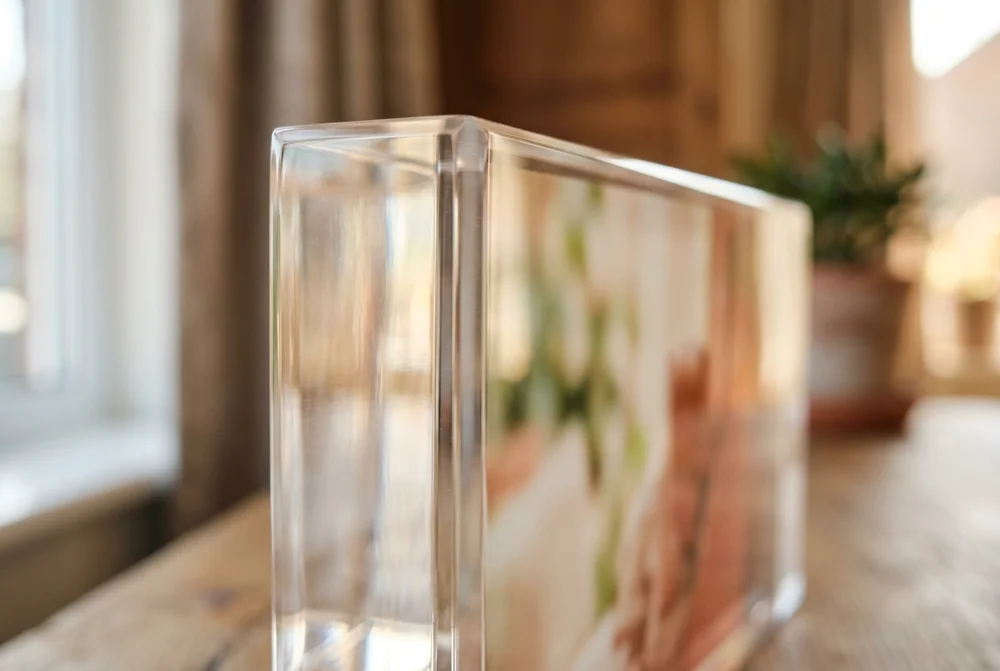
The thickness changes things too. Both MYPICTURE block sizes are cut from 25mm acrylic glass. That depth catches light and throws it back through the image, which is what gives the block its glow. On a small block that effect reads as a neat, jewel-like object. On a large block it reads as a piece of decor. Same material, very different jobs.
The 10x10cm block: what it does well, and where it struggles
The 10x10cm square is the entry size in the MYPICTURE personalised acrylic photo block range, at £14.00 against an average retail price of £55.90. It is 25mm thick, printed with nine-colour technology and finished with a scratch-resistant laminate. It weighs enough to stay put on a desk without a stand.
What it does well is close-up viewing. At a desk you are looking at the photo from about 50cm away, and at that distance a 10x10cm block fills as much of your view as a much bigger print would across a room. It also suits faces. One person, one pet, one close-up: the square crop pushes you to fill the frame, and that is exactly what a small block needs.
It is also the size that works in groups. Three or four small blocks on a shelf cost less than one large block each and let you show four moments rather than one. If that is the direction you like, our photo blocks range includes the miniature MIXBLOX for even smaller cluster displays.
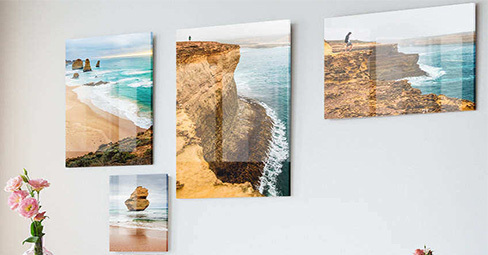
Where it struggles is anything with detail. A wide landscape, a group of eight people at a wedding, a busy street scene: at 10x10cm the detail turns to mush and the picture stops being readable. It also disappears on a mantelpiece or a wide sideboard, where the surrounding space swallows it. If you want something for a wall rather than a surface, an acrylic photo print is the better format, and we cover the difference in our guide to acrylic blocks versus acrylic prints.
The 20x20cm block: what it does well, and where it struggles
The 20x20cm square is the largest block MYPICTURE makes, at £34.00 against an average retail price of £135.90. It uses the same 25mm acrylic, the same borderless print and the same clear polished sides. The difference is area: 400 square centimetres against 100.
What it does well is hold a room. Put one on a mantelpiece, a hall table or a chest of drawers and it becomes the thing people look at. It is also the size that lets a landscape work. A beach, a hillside, a city skyline: all of these need width to read properly, and 20cm gives you that. Group shots survive here too, because each face still gets enough pixels to be recognisable.
It also earns its place as a gift. A £14 block reads as a nice little thing. A £34 block, which arrives with real heft to it, reads as a proper present. For an anniversary or a big birthday that difference matters more than the twenty pounds.
Where it struggles is on a desk, where it is genuinely too big and blocks your sightline to the monitor. It is also unforgiving with a low-quality photo, which is the section below. And it is worth being straight about the competition here: WhiteWall also offers 10x10cm and 20x20cm acrylic blocks at the same 25mm thickness, and they are a specialist lab with TIPA awards and branded Fujifilm and Kodak papers. Their delivery runs to around 12 working days and their prices sit higher. If you want laboratory-grade colour work and are happy to wait, they are a fair choice, and our round-up of the best acrylic prints and photo blocks in the UK says the same.
10x10cm vs 20x20cm: side by side
10x10cm block
20x20cm block
Price
£14.00
£34.00
Display area
100 sq cm
400 sq cm
Cost per sq cm
14p
8.5p
Acrylic thickness
25mm
25mm
Pixels needed at 300 DPI
1,181 x 1,181
2,362 x 2,362
Viewing distance
Up to about 1 metre
2 to 4 metres
Suits
One face, one pet, one close-up
Landscapes, group shots, statement gifts
Best spot
Desk, bedside table, shelf cluster
Mantelpiece, hall table, sideboard
The table is not really a scoreboard. It shows two products doing two different jobs. The small block is a personal object you keep near you. The large block is a piece of decor that other people see. Plenty of homes have room for both, and if you are buying for someone else, the large one is almost always the safer choice, because a gift needs to announce itself.
Does your photo have enough pixels?
This is the question that settles the size for a lot of people, and no product page will ask it.
Printing looks sharp at around 300 DPI, which means 300 dots of ink for every inch of print. Work backwards from the block size and you get a firm pixel number:
10x10cm needs 1,181 x 1,181 pixels for a 300 DPI print. That is about 1.4 megapixels.
20x20cm needs 2,362 x 2,362 pixels for the same sharpness. That is about 5.6 megapixels.
The bare minimum is 150 DPI, which halves both figures to 591 pixels and 1,181 pixels. Below that you will see softness.
Here is why it matters. A 12-megapixel phone photo measures 4,032 x 3,024 pixels. Crop it to a square and you keep 3,024 pixels, which prints at 384 DPI on a 20x20cm block. That is comfortably sharp. So an original photo straight off your phone is fine at either size.
The trouble starts with photos that have travelled. A picture forwarded through WhatsApp is usually squashed down to around 1,600 pixels on its long edge. Crop that to a square and you have roughly 1,200 pixels left. On a 10x10cm block that is 305 DPI and looks great. On a 20x20cm block it is 152 DPI, which is right at the floor and will look soft up close. Screenshots, photos saved from social media and old digital camera files have the same problem.
The rule is simple. If the photo came off a phone or camera and has not been sent anywhere, both sizes work. If it arrived by message, by email or by download, check the pixel dimensions before you order the large block, or order the small one instead. Our guide to photo resolution for printing shows how to find those numbers on a phone and on a computer.
Which costs less? A worked example
Say you want to show four holiday photos on a shelf.
Four 10x10cm blocks come to £56.00. One 20x20cm block comes to £34.00. So the four-block display costs £22 more and shows four moments instead of one. Neither is wrong, but the maths is worth seeing before you decide.
Now compare like with like on area. The 20x20cm block gives you four times the picture of the 10x10cm block for 2.4 times the money. Per square centimetre, the large block costs 8.5p and the small one costs 14p. If your only measure is picture per pound, the large block wins clearly, and the same pattern holds across the middle sizes: 15x10cm is £19.00 and 20x15cm is £24.00.
One practical note on delivery. MYPICTURE delivers free on orders over £49. A 20x20cm block plus a 10x10cm block comes to £48.00, which lands a pound short. Adding a third small block takes you to £62.00 and over the threshold, so it is worth checking your basket total before you pay for postage on a near miss.
Where each size actually fits: desk, shelf, mantelpiece
Measure the surface before you order. Most disappointment with photo blocks comes from a size that was right for the photo and wrong for the furniture.
Office desk. Go 10x10cm. A standard desk gives you about 20cm of clear depth behind the keyboard, and a 20x20cm block sits high enough to cut across your monitor.
Bedside table. Go 10x10cm. Typical bedside tables are 40cm to 45cm wide and already carry a lamp, a book and a charger.
Bookshelf. Either works, but check the shelf height. Standard shelf gaps run around 25cm to 30cm, so a 20x20cm block fits but leaves little air above it. A 10x10cm block sits comfortably and leaves room for the eye.
Mantelpiece. Go 20x20cm. A UK mantelpiece is usually 100cm to 130cm wide, and anything smaller than 20cm looks lost against that span.
Hall table or console. Go 20x20cm. This is a surface people walk past at two or three metres, which is exactly the distance the large block is built for.
A cluster of several. Use 10x10cm blocks, and vary the heights by standing one or two on a small book or riser. Odd numbers look more natural than even ones.
A quick trick before you buy: cut the size out of a cereal box and stand it where the block will go. Live with it for a day. It costs nothing and it is more accurate than any photo on a website.
A three-question test to settle it
1. How far away will people stand? Under a metre, choose 10x10cm. Two metres or more, choose 20x20cm.
2. How many things are in the photo? One face or one subject, 10x10cm is enough. A landscape, a group or anything with background detail, go 20x20cm.
3. Where did the photo come from? Straight off a phone or camera, either size works. Forwarded, downloaded or screenshotted, check the pixels first and default to 10x10cm.
If your three answers split, the deciding one is question three. Size is a choice, but resolution is a limit. A sharp small block will always look better than a soft large one, and no amount of clever printing fixes pixels that are not there.
Why choose MY-PICTURE.CO.UK over other competitors?
MYPICTURE competes on price rather than prestige. The acrylic photo block range runs from £14.00 for 10x10cm to £34.00 for 20x20cm, all cut from 25mm acrylic glass and printed in Europe.
The Lowest Price Guarantee means that if you find the same size and model cheaper at another UK online shop, MYPICTURE beats that price by 5%, which does a fair amount of the comparison shopping for you. The table below compares specific things, not everything.
*Ratings and prices correct as of August 2026. Prices exclude delivery; all brands run periodic promotions.
If you are still weighing it up, order the 10x10cm block first. It costs £14.00, it tells you exactly how the acrylic reads in your own light, and it is the cheapest possible way to find out whether the large one belongs on your mantelpiece.
Frequently asked questions
Which acrylic photo block is the best size to buy?
For most people the 10x10cm block is the best first buy, because it suits desks and bedside tables and costs £14.00. Choose the 20x20cm block at £34.00 when the photo needs to be seen from across a room, when it is a landscape or group shot, or when it is a gift that should feel substantial. The deciding factor is viewing distance, not price.
What sizes do acrylic photo blocks come in?
UK acrylic photo blocks usually run from around 10x10cm up to around 20x20cm. MYPICTURE offers four sizes: 10x10cm at £14.00, 15x10cm at £19.00, 20x15cm at £24.00 and 20x20cm at £34.00. Other UK suppliers use paper sizes instead, such as A7, A6 and A5. Square formats are less common than rectangles, so check before you crop your photo.
Why are acrylic photo blocks so expensive?
The cost sits in the acrylic, not the print. A 20x20cm block contains 25mm of optically clear, polished acrylic glass, which is heavy, expensive to cut and easy to scratch during production. The photo is then bonded inside it and sealed, so any flaw means the whole block is scrapped rather than reprinted. That is why a block costs several times what the same photo costs on paper.
What are the disadvantages of acrylic photo blocks?
Acrylic blocks are heavier than frames, they show fingerprints, and the glossy surface reflects lamps and windows, so placement matters. They cannot be hung on a wall, since they are made to stand on a flat surface. They also expose a weak photo, because the depth effect draws the eye straight into the detail. For wall display, an acrylic print is the better choice.
Can you get a square acrylic photo block?
Yes, though square is less common than rectangular. MYPICTURE offers two true squares, 10x10cm at £14.00 and 20x20cm at £34.00. WhiteWall offers the same two square sizes. Photobox's acrylic blocks are rectangular only, at 10x15cm and 20x15cm. If you want a square block, crop your photo to a square before uploading so nothing important is trimmed off.
Is a 20x20cm acrylic block too big for a desk?
For most desks, yes. A 20x20cm block stands 20cm tall and takes up 20cm of depth, which on a typical desk means it sits in front of your monitor and eats the space behind your keyboard. The 10x10cm block is the desk size. Save the 20x20cm block for a mantelpiece, a hall table or a sideboard, where there is room around it.