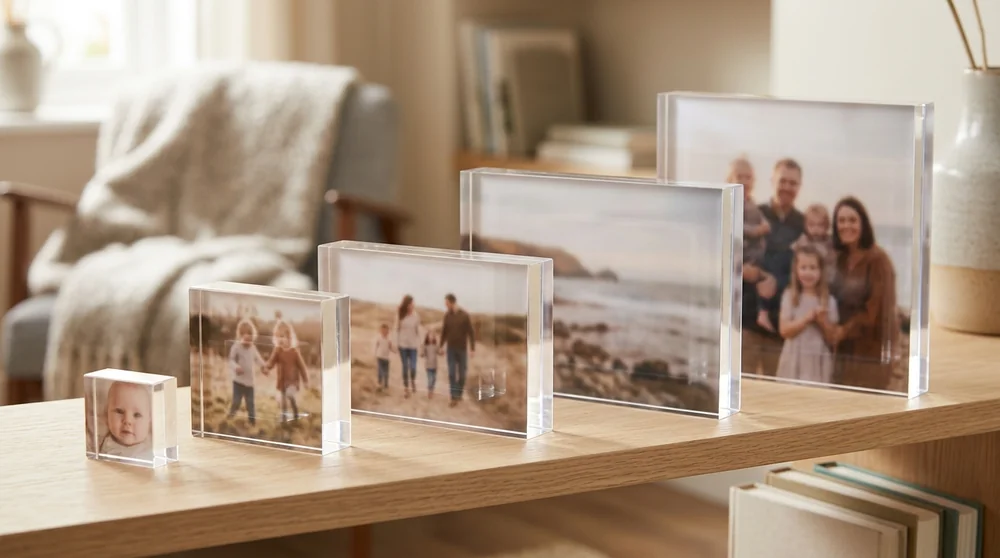
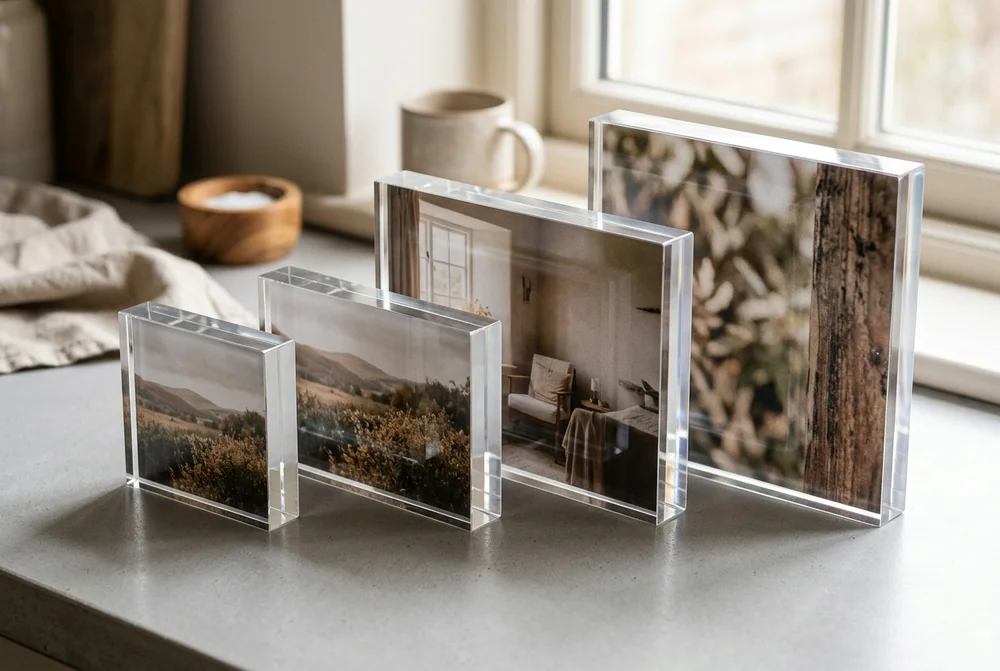
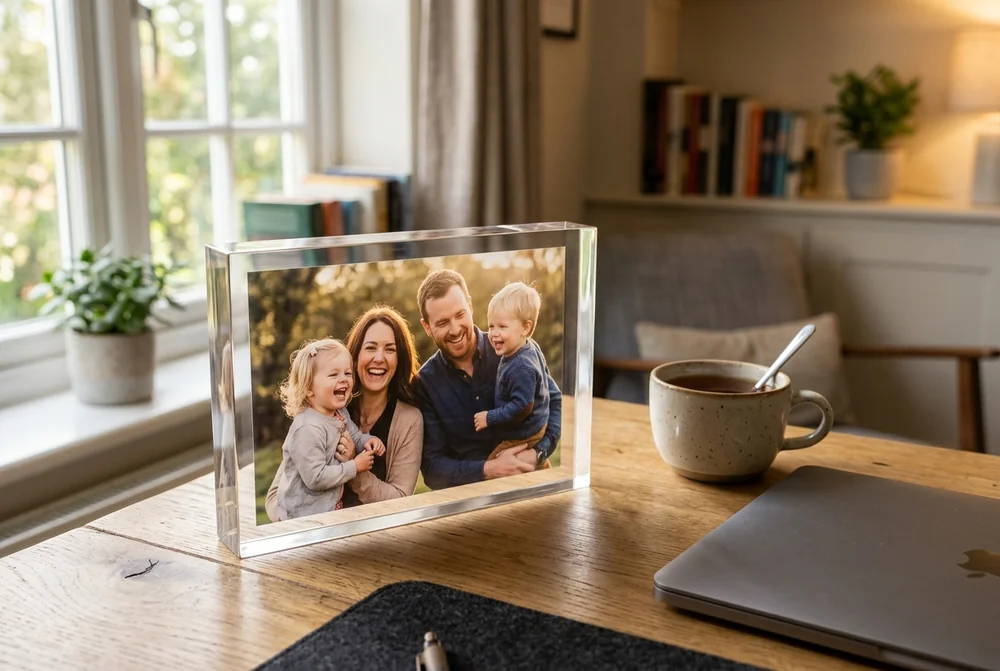
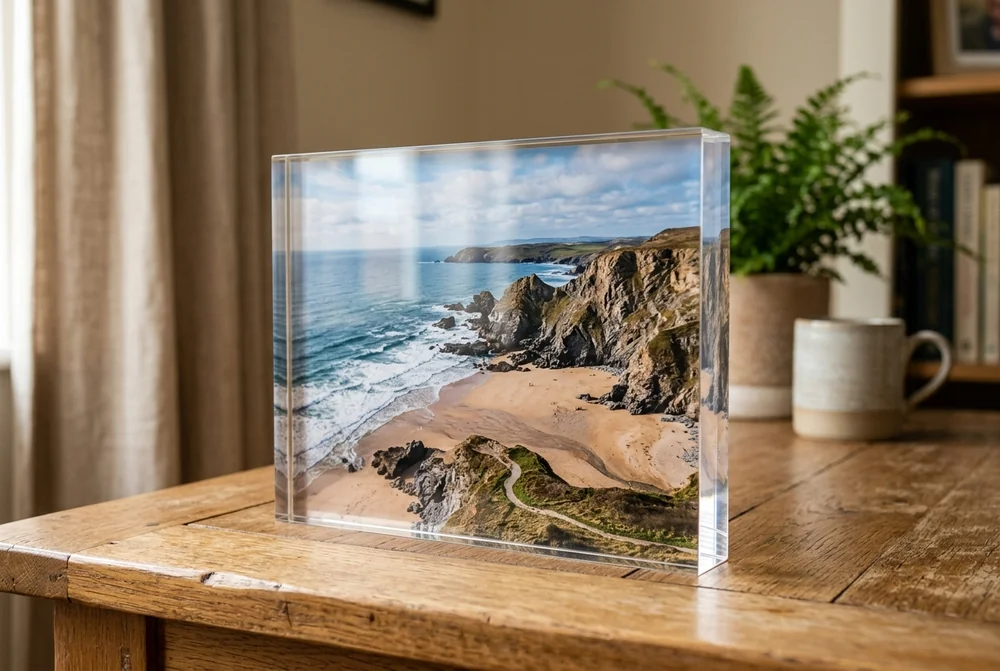
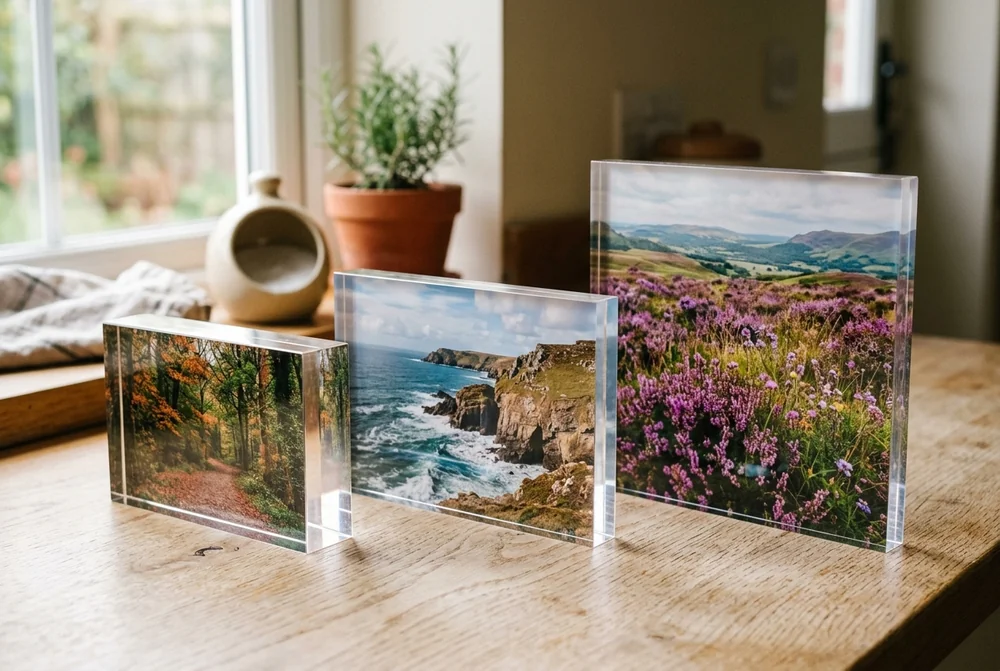
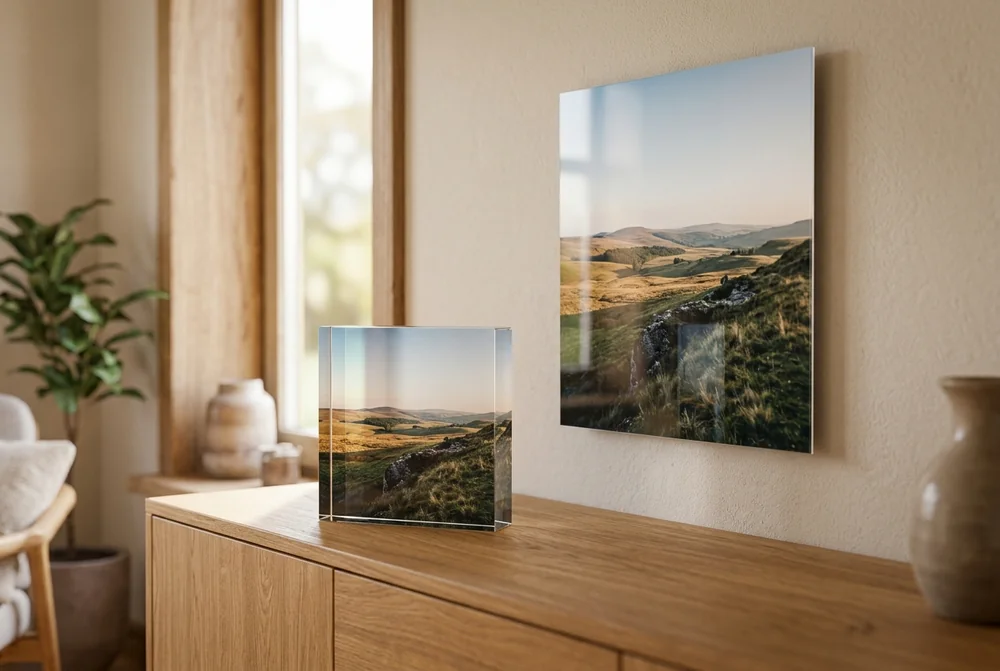
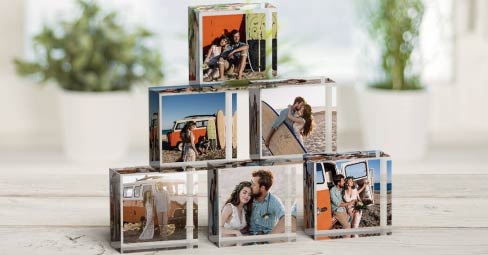
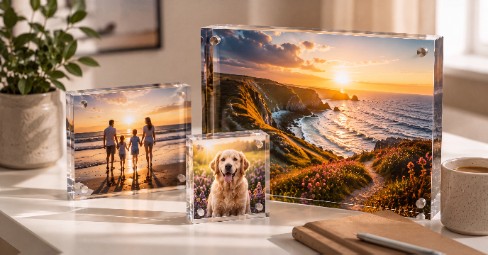
Most UK acrylic photo blocks come in five sizes: 5 x 5cm, 10 x 10cm, 15 x 10cm, 20 x 15cm and 20 x 20cm. Pick 15 x 10cm for a desk, 20 x 15cm for a shelf and 20 x 20cm as a gift centrepiece. At MYPICTURE, prices run from £6.00 to £34.00.
The confusion comes from the shops. One brand lists blocks in centimetres, the next in inches, and a third in A-sizes borrowed from paper. The same object can appear as 15 x 10cm, 6 x 4in and A6 on three different websites, which makes comparing them harder than it should be.
There is a second trap that costs people more. A block size is the size of the print, not the shape of your photo. Choose a square block for an ordinary phone picture and you lose a quarter of the image before it is even made.
The short version
Five sizes cover almost everything. 5 x 5cm, 10 x 10cm, 15 x 10cm, 20 x 15cm and 20 x 20cm are the formats you will meet across the UK market.
15 x 10cm is the safe choice. Large enough to read from across a room, small enough to sit beside a monitor without taking over the desk.
20 x 15cm is the only size that matches a phone photo exactly. Every other size crops something.
Prices at MYPICTURE start at £6.00 for a 5 x 5cm mini block and reach £34.00 for 20 x 20cm. Checked 14 August 2026, and they move during sale periods.
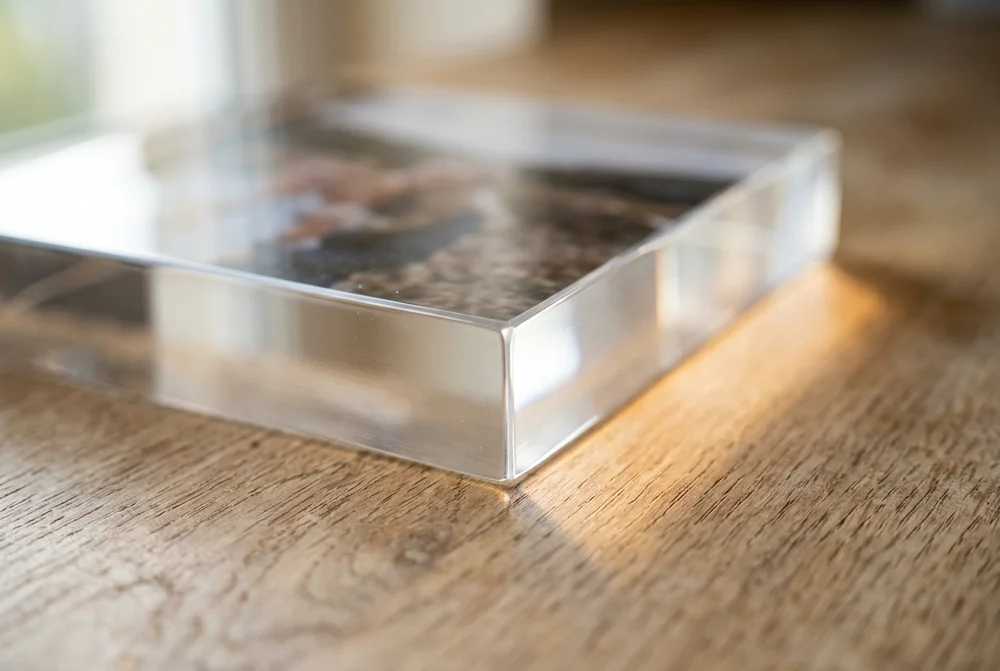
Every block is 2.5cm deep, whatever the print size. Depth is what creates the glow, so even a small block looks substantial.
Why size behaves differently on acrylic
Acrylic is not a frame. It is 2.5cm of solid material sitting on top of your picture, and it moves light around. Acrylic transmits roughly 92% of the light that reaches it, which is more than glass, and it weighs about half as much (technical properties of PMMA acrylic).
That changes how big a block looks. A 10 x 10cm block reads as a bigger object than a 10 x 10cm paper print in a slim frame, because the depth catches light and throws a soft shadow onto the surface below. When you are comparing sizes on a screen, add roughly one step in your head.
It also changes where a block works. Light has to reach it, so a block tucked behind a monitor or pushed onto a dark shelf loses the effect you paid for. If you want the background on how these are built, we cover it in our guide to what an acrylic photo block is.
Every UK acrylic photo block size, in one table
Size (cm)
Inches (approx.)
Nearest paper size
Shape
Minimum photo at 150 DPI
MYPICTURE price
5 x 5
2.0 x 2.0
–
Square (1:1)
300 x 300 pixels
£6.00 (MIXBLOX)
10 x 10
3.9 x 3.9
–
Square (1:1)
600 x 600 pixels
£14.00
15 x 10
5.9 x 3.9
Slightly larger than A6
Landscape (3:2)
900 x 600 pixels
£19.00
20 x 15
7.9 x 5.9
Close to A5
Landscape (4:3)
1,200 x 900 pixels
£24.00
20 x 20
7.9 x 7.9
–
Square (1:1)
1,200 x 1,200 pixels
£34.00
Every one of these is 2.5cm deep. Prices were checked on 14 August 2026 and shift during promotions, so treat them as a starting point rather than a fixed figure.
The paper-size column is a rough guide, not a match. A 20 x 15cm block measures 200 x 150mm; A5 paper is 210 x 148mm. Close, but you cannot slide one into a mount cut for the other.
What each size actually suits
5 x 5cm. Group displays. A single mini block on its own looks lost. Six or nine of them clustered along a shelf look deliberate, which is why MIXBLOX mini photo blocks are sold as sets rather than singles.
10 x 10cm. Desks and bedside tables. Small enough that nobody needs to move it to reach a lamp, big enough to hold one face clearly.
15 x 10cm. The all-rounder. Office desks, kitchen windowsills, hall tables. If you are buying a gift and you do not know where it will end up, this is the size to buy.
20 x 15cm. Shelves and mantelpieces, seen from a couple of metres away. Also the size for a group photo, because faces stay readable rather than turning into dots.
20 x 20cm. A centrepiece. One of these on a sideboard does the job of three smaller frames, and it looks like a decision rather than an accumulation.
A rule that holds up in most rooms: measure the surface it will stand on, then pick a block no wider than a third of it. A 20 x 20cm block on a 45cm bedside table is trying too hard.
Will your photo fit? The crop trap
Block sizes have shapes, and your photo has a shape too. When the two do not match, something gets cut off — and the software will choose what unless you choose first.
Most phones shoot at 4:3 by default. A 12-megapixel photo is usually 4,032 x 3,024 pixels. Here is what happens to that photo at each block size:
20 x 15cm is 4:3. Nothing is cropped. The photo fits exactly as you shot it.
15 x 10cm is 3:2. You lose about 11% off the top and bottom.
10 x 10cm and 20 x 20cm are square. You lose 25% off the sides.
5 x 5cm is square. The same 25% loss, and on a small block a tight crop is more obvious.
Twenty-five per cent is a lot. On a portrait it is usually shoulders and background, which rarely matters. On a group shot or a wide landscape it is often a person, or the thing that made the picture worth printing in the first place.
There are two sensible responses. Crop the photo yourself before you upload it, so you decide what goes. Or pick 20 x 15cm and keep the frame exactly as you shot it.
One more to watch: a photo shot at 16:9, which covers most video frames and some phone modes, loses about 44% of its width on a square block. Check that one before you order.
How many pixels each size needs
Printing needs roughly 150 pixels per inch to look sharp at arm's length. Multiply the block size in inches by 150 and you have your minimum.
That produces the numbers in the table above: 600 x 600 pixels for a 10 x 10cm block, 1,200 x 900 for 20 x 15cm, and 1,200 x 1,200 for the largest square.
The good news is that almost any photo taken in the last decade clears this comfortably. A 12-megapixel phone photo is 4,032 x 3,024 pixels — more than three times what the biggest block needs, even after a square crop has taken a quarter of the width.
The photos that fail are the ones that have been through something. A picture saved from a messaging app, a screenshot of a screenshot, a thumbnail pulled off a social feed: these often arrive at 600 pixels wide or less, which is enough for 5 x 5cm and nothing above it. Our guide to photo print resolution explains why compression does the damage.
If you are unsure, open the file and check its dimensions before you order. It takes ten seconds and it saves a return.
Size and price compared across UK brands
Brand
Acrylic block sizes offered
Smallest
Largest
Price from
MYPICTURE
5 x 5cm mini, 10 x 10, 15 x 10, 20 x 15, 20 x 20cm
5 x 5cm
20 x 20cm
£6.00 mini, £14.00 full size
WhiteWall
10 x 10, 15 x 10, 18 x 13, 20 x 15, 20 x 20cm
10 x 10cm
20 x 20cm
£22.95
Bags of Love
A7, A6, A5, square 10.5 x 10.5cm
A7 (10.5 x 7.8cm)
A5 (21 x 14.7cm)
£12.95
ASDA Photo
4 x 4in, 5 x 5in, 6 x 4in, 7 x 5in, 8 x 6in
4 x 4in
8 x 6in
£6.50
Photobox
10 x 15cm, 20 x 15cm
10 x 15cm
20 x 15cm
£26.99
Snapfish
A6 (6 x 4in), A5 (8 x 6in)
A6
A5
£14.99 (promotional)
What the table shows is that MYPICTURE and WhiteWall are the only two services here offering a full ladder from 10 x 10cm up to 20 x 20cm, and WhiteWall opens at £22.95 against £14.00.
Where rivals win, they win honestly. ASDA Photo is cheaper than anyone on small blocks at £6.50 for a 4 x 4in, and Bags of Love make theirs by hand in the UK. If your only requirement is the lowest possible price on one small block, ASDA is the answer and we would rather say so.
Range matters when you want a size that is not 6 x 4. Photobox lists two sizes. Snapfish lists two. Neither offers a square block or anything larger than 20 x 15cm, so if you want a square photo or a centrepiece, they are ruled out before price enters the conversation.
Figures checked 14 August 2026. Photo services discount constantly, so every price here is a starting point.
A worked example: one big block or four small ones?
Say you have four holiday photos and roughly £60 to spend.
Four 15 x 10cm blocks come to £76.00, which is over budget. Three come to £57.00 and land under it, with free delivery because the order clears £49.
One 20 x 20cm block costs £34.00. Add six 5 x 5cm MIXBLOX at £6.00 each and the total is £70.00 — one large piece plus a cluster, which is a more interesting shelf than four identical rectangles.
Two 20 x 15cm blocks cost £48.00. That is one pound short of the £49 free delivery threshold, which is worth knowing before you reach the checkout.
The pattern is worth noticing. A 20 x 20cm block costs 2.4 times what a 10 x 10cm block costs, but it carries four times the print area. Buying one large block is better value per square centimetre than buying several small ones, and it makes more impact in a room. Buy small blocks when you want a group, not when you want to save money.
Where the size range runs out
Acrylic blocks stop at 20 x 20cm at MYPICTURE, and most UK services stop somewhere close to that. There is a physical reason. Solid acrylic 2.5cm thick gets heavy quickly, and a block that size already needs a surface that will take the weight without wobbling.
If you want acrylic larger than that, you need a different product rather than a bigger block. Acrylic photo prints are 3mm panels that hang on a wall and run to far larger formats, giving the same glossy depth without the mass. The trade-off is that they need fixings and a wall, where a block needs neither. We compare the two in detail in acrylic block vs acrylic print.
The other limits worth knowing before you commit to a size:
Fingerprints show at every size, and they show more across a large flat face than a small one.
Reflections grow with the surface. A 20 x 20cm block facing a window will mirror that window.
Acrylic scratches more readily than glass. MYPICTURE blocks carry a scratch-resistant laminate, but a key dropped on one still leaves a mark.
No block hangs on a wall. If the photo has to go on a wall, the problem is the product, not the size.
A three-question test to settle your size
Where will it stand? A desk or bedside table means 10 x 10cm or 15 x 10cm. A shelf or mantelpiece means 20 x 15cm. A sideboard, on its own, means 20 x 20cm.
What shape is the photo? If it is an ordinary phone picture and you do not want to crop it, 20 x 15cm is the only size that fits without losing anything.
Is it a gift or is it for you? For a gift, 15 x 10cm is the safest answer, because it works wherever the recipient decides to put it. For yourself, buy the larger one. Nobody has ever looked at a block they bought and wished it were smaller.
If the three answers disagree, let the room decide. A photo you had to crop still looks right in a well-sized block. A block that is too big for its surface never looks right, whatever is printed on it.
Why choose MY-PICTURE.CO.UK over other competitors?
MYPICTURE competes on price and range rather than on prestige. The blocks are made in Europe, start at £6.00 for a 5 x 5cm mini and £14.00 for a full-size 10 x 10cm, and come in five formats where most rivals list two. Production takes two working days, delivery is free over £49.
The Lowest Price Guarantee beats any like-for-like UK price by 5% — which means a good deal of the comparison shopping has already been done for you.
*Ratings and prices correct as of August 2026. Prices exclude delivery; all brands run periodic promotions.
If you are still deciding, 15 x 10cm is the size most people should buy, and 20 x 15cm is the size to buy when the photo matters more than the shelf. Both sit on the personalised acrylic photo block page, and the configurator shows you the crop before you pay for it.
Frequently asked questions
What are the available sizes for acrylic photo blocks?
Across the UK market, acrylic photo blocks are usually sold in 5 x 5cm, 10 x 10cm, 15 x 10cm, 20 x 15cm and 20 x 20cm. Some brands list the same sizes in inches as 2 x 2in, 4 x 4in, 6 x 4in and 8 x 6in, or as paper sizes such as A7, A6 and A5. MYPICTURE offers all five, with every block 2.5cm deep.
How do you choose the right size acrylic photo block?
Start with the surface it will stand on and pick a block no wider than a third of it. Then check the photo's shape: 20 x 15cm is the only common size that matches a standard phone picture without cropping. For a gift where you do not know the destination, 15 x 10cm is the safest choice because it suits a desk, a shelf and a windowsill equally well.
What is a 2x2 acrylic photo block?
A 2x2 acrylic photo block is a mini block measuring 2 inches by 2 inches, which is about 5 x 5cm. The term comes from listings that use inches rather than centimetres. These small blocks are designed to be grouped rather than displayed alone. The MYPICTURE equivalent is MIXBLOX, a 5 x 5cm acrylic mini block priced at £6.00 each.
Why are acrylic blocks so expensive?
The cost sits in the material and the finishing rather than the printing. A block is a solid piece of cast acrylic 2.5cm thick, with polished edges, and the photo is printed directly under it. That is far more material than a paper print, and each block is made individually. They are not always expensive, though: mini blocks start at £6.00 and a full-size 10 x 10cm block is £14.00 at MYPICTURE.
What are the disadvantages of acrylic photo blocks?
Four things catch people out. Fingerprints show on the polished surface and need wiping with a soft damp cloth. Reflections are strong, so a block facing a window will mirror it. Acrylic scratches more easily than glass, even with a protective laminate. And no block hangs on a wall, so if the photo is destined for a wall you want an acrylic print rather than a block.
Which acrylic photo block is the best?
There is no single best block, because the right one depends on where it will stand and what shape your photo is. For most people the answer is 15 x 10cm, which suits nearly any surface. For a photo you do not want cropped, 20 x 15cm is the only size that matches a standard phone picture. For a statement piece on a sideboard, 20 x 20cm.