UK Photo Frame Sizes: Every Standard Size from 6×4 to A1
 by Sophie Hartley– 5 years of experience in photo products
Choosing the right photo frame size should be straightforward, but it rarely is. You walk into a shop, see labels like "6×4," "A4 frame size," or "50x70 frame," and suddenly you're second-guessing everything. Does 6×4 mean inches or centimetres? Will your favourite holiday snap fit an A3 picture frame without awkward cropping? And what on earth is the difference between a 10×8 and an 8×10?
This guide cuts through the confusion. Whether you're framing a single passport size photo for your desk or planning a full gallery wall with poster frames and large-format prints, you'll find every standard photo frame size used in the UK right here. Each size is listed in both inches and centimetres, so you can match your photos and picture frames with confidence. You'll also find handy conversions for common queries like 8 inch by 8 inch in cm, 16inch in cm, and 20inch to cm, so you never have to guess again.
Beyond the numbers, you'll also discover which sizes work best for different rooms, how to avoid common mistakes when ordering picture frames online, and practical steps for measuring your photos correctly. Whether you're browsing photo frames and picture frames at a high-street retailer or shopping online, by the end you'll know exactly which frame suits your space, your photos, and your budget.
In this article, you'll discover:
-
What are the most common standard photo frame sizes in the UK, and what do they measure in centimetres?
-
Which photo frame sizes work best for small prints like 6×4 and 7×5?
-
How do A-series paper sizes (A5, A4, A3, A2, A1) translate to picture frame sizes?
-
What is the difference between imperial and metric frame sizing, and why does it matter?
-
How do you measure a photo or print to find the perfect frame?
-
Which frame sizes suit different rooms, from bedside tables to living room feature walls?
-
What materials and styles should you consider when choosing picture frames?
At a Glance: UK photo frame sizes range from the compact 6×4 inch (15.2×10.2 cm) right up to the dramatic A1 (59.4×84.1 cm). The most popular standard photo frame sizes are 6×4, 7×5, 10×8, A4, and A3. This guide covers every size with exact measurements in both inches and centimetres, plus practical advice on choosing the right frame for your photos and your home.
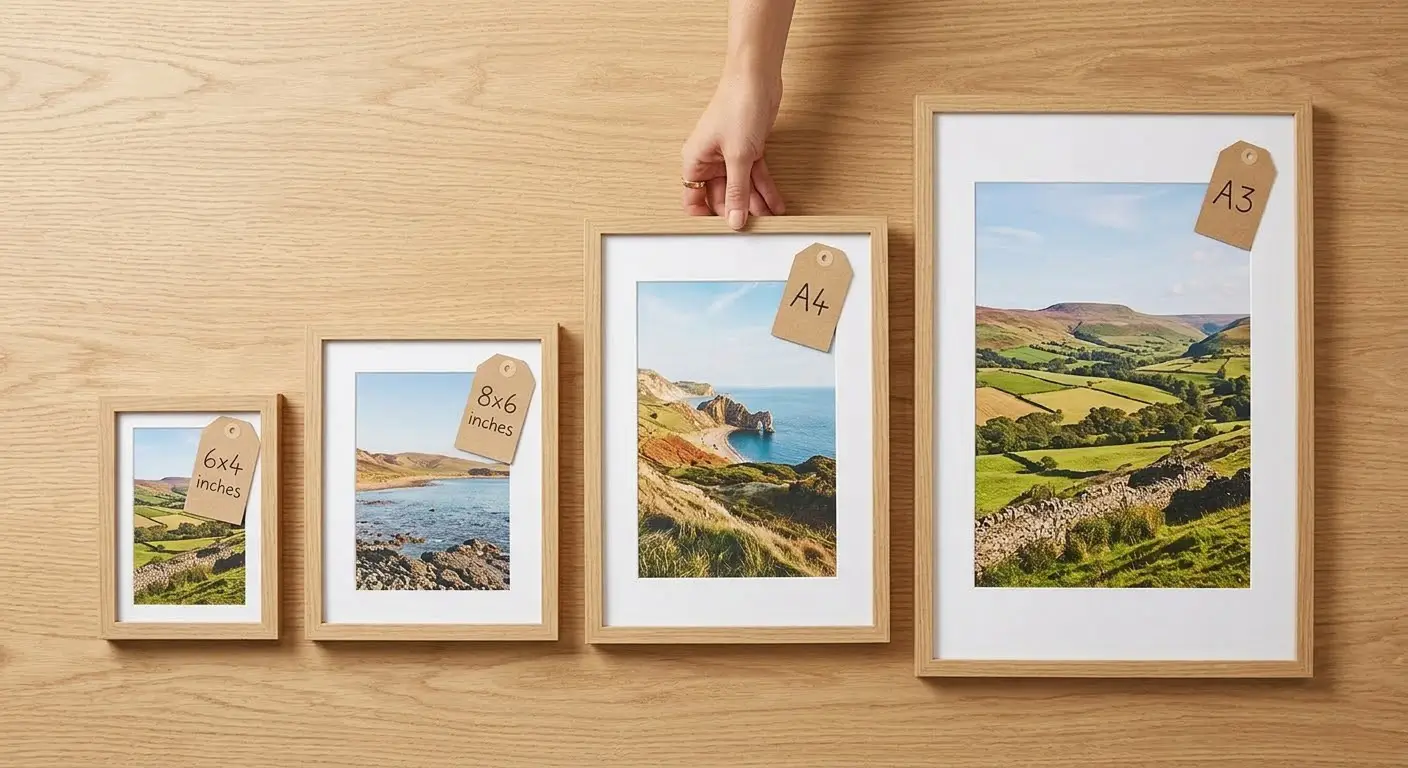
Standard Photo Frame Sizes in the UK: The Complete Reference
Understanding standard photo frame sizes saves you time, money, and the frustration of ordering a frame that doesn't fit. In the UK, photo frame photo & picture frames follow two sizing systems: imperial (inches) and metric (centimetres). Most high-street and online retailers, including My Picture, list both measurements, but knowing the relationship between them helps you shop with confidence.
The table below covers every common photo frame size you'll encounter in British shops and online stores. Keep it bookmarked for quick reference whenever you're ordering prints or browsing picture frames.

Complete UK Photo Frame Sizes Chart
| Common Name | Inches | Centimetres | Typical Use |
|---|---|---|---|
| 6×4 | 6 × 4 in | 15.2 × 10.2 cm | Standard photo prints, desk frames |
| 7×5 | 7 × 5 in | 17.8 × 12.7 cm | Slightly larger prints, greeting cards |
| 8×6 | 8 × 6 in | 20.3 × 15.2 cm | Portrait and landscape photos |
| 8×8 | 8 × 8 in | 20.3 × 20.3 cm (8 by 8 inches in cm) | Square prints, Instagram-style photos |
| 10×8 | 10 × 8 in | 25.4 × 20.3 cm | Wedding photos, family portraits |
| 12×10 | 12 × 10 in | 30.5 × 25.4 cm | Medium wall art, group photos |
| 14×11 | 14 × 11 in | 35.6 × 27.9 cm | Large portraits, art prints |
| 16×12 | 16 × 12 in | 40.6 × 30.5 cm | Statement wall photos |
| 20×16 | 20 × 16 in | 50.8 × 40.6 cm | Feature wall prints |
| 24×20 | 24 × 20 in | 61 × 50.8 cm | Large wall displays |
| A5 | 8.3 × 5.8 in | 14.8 × 21 cm | Small prints, postcards |
| A4 | 11.7 × 8.3 in | 21 × 29.7 cm | Documents, certificates, art prints |
| A3 | 16.5 × 11.7 in | 29.7 × 42 cm | Posters, large art prints |
| A2 | 23.4 × 16.5 in | 42 × 59.4 cm | Large posters, gallery-style displays |
| A1 | 33.1 × 23.4 in | 59.4 × 84.1 cm | Statement posters, exhibition prints |
| 50×70 cm | 19.7 × 27.6 in | 50 × 70 cm | European poster standard |
This chart covers the picture frame photo sizes you'll see most often. Notice that imperial sizes (6×4, 10×8) and A-series sizes (A4, A3) don't overlap neatly. An A4 frame size, for example, is 29.7×21 cm, which doesn't match any traditional inch-based frame. That's why checking measurements before ordering matters so much. For quick reference, A3 dimensions in cm are 29.7×42, while a conversion like 30inch to cm gives you 76.2 cm and 46 inch is cm works out to 116.84 cm.
Imperial vs. Metric: Why Both Systems Exist
The UK sits in an unusual position. We grew up with inches for photo prints (think of the classic 6×4 photo from the chemist), yet our paper sizes follow the international A-series metric standard. This dual system means that photo frames sold in Britain come in both imperial and metric dimensions. Even simple conversions cause confusion: 2 inches by 2 inches in cm is just 5.08×5.08 cm, yet many people have to look it up every time.
When you see "A4 photo frames" in a shop, the frame's internal opening measures exactly 29.7×21 cm. But a "10×8 frame" measures 25.4×20.3 cm, which is close to A4 but not identical. Putting an A4 print into a 10×8 frame, or vice versa, leaves visible gaps or requires trimming. Always match like with like: imperial prints go in imperial frames, and A-series prints go in A-series frames.
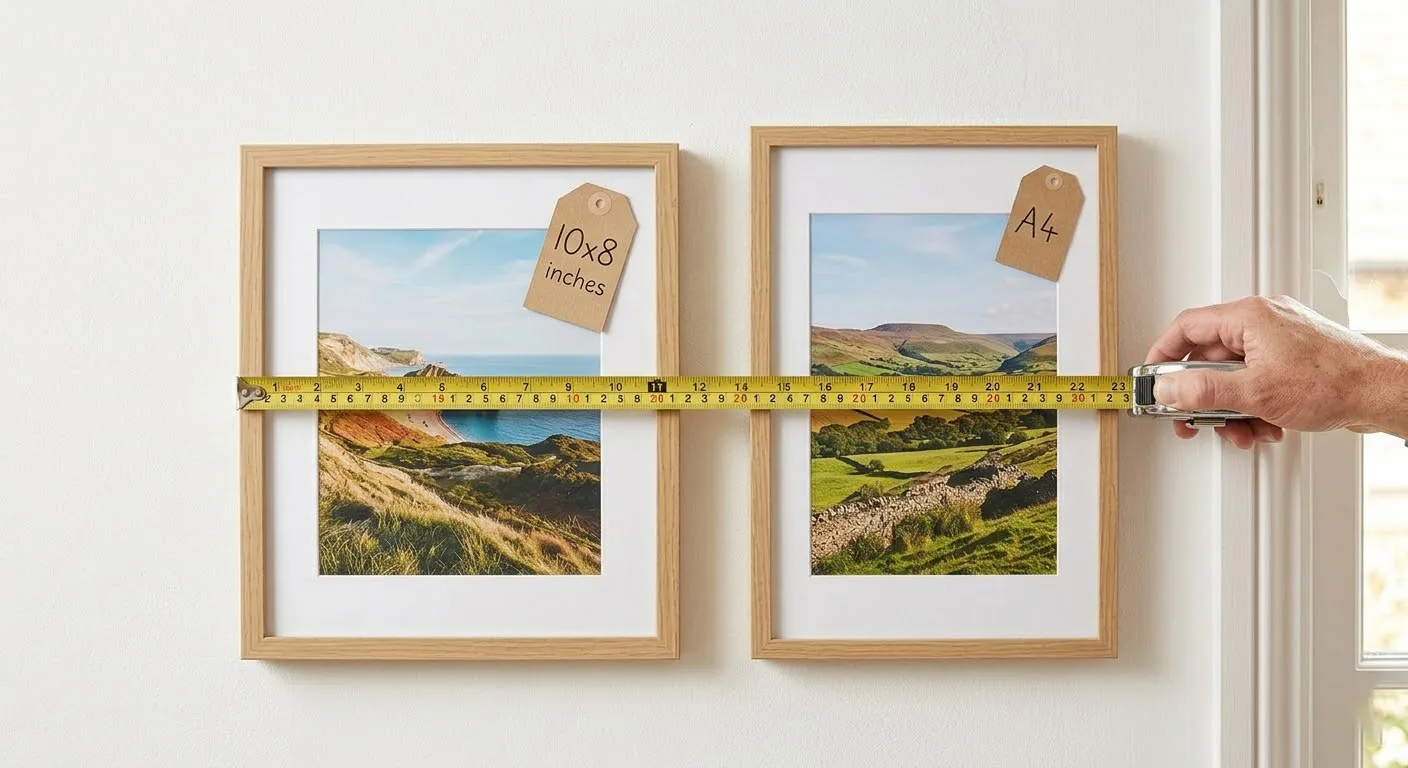
Small Photo Frame Sizes: 6×4, 7×5, and 8×6 Frames for Everyday Memories
Small picture frames are the workhorses of any home. They sit on bedside tables, cluster along mantelpieces, and fill bookshelves with personality. The three most popular small sizes in the UK are 6×4, 7×5, and 8×6 photo frames, and you'll find a wide range of photo frames in all of these sizes at most retailers.
6×4 Photo Frames: The British Classic
The 6×4 frame (15.2×10.2 cm) is the most widely used photo frame size in the country. It matches the standard print size from most photo labs, making it the natural choice for everyday snapshots. If you've ever collected prints from Boots or ordered photos online, chances are they were 6×4.
These frames are perfect for desks, shelves, and small wall groupings. Because they're compact, you can arrange several together without overwhelming a space. A cluster of five or six 6×4 photo frames on a hallway shelf tells a story far more powerfully than a single large print.
7×5 Frames: A Step Up in Detail
At 17.8×12.7 cm, the 7×5 frame gives your photos a little more breathing room. Faces are clearer, landscapes show more detail, and the slightly larger format feels more deliberate than a casual 6×4 snap. This size is popular for framed school photos, engagement portraits, and holiday highlights.
8×6 Frames: The Versatile Middle Ground
The 8×6 frame (20.3×15.2 cm) bridges the gap between small and medium. It's large enough to display on a wall yet compact enough for a desk or side table. Many photographers recommend this size for portrait shots because it shows enough detail without dominating a room. You'll also find a wide range of picture frames in this size widely stocked across the UK.
If you're looking to create a set of matching framed photo prints in these smaller sizes, ordering them together ensures consistent quality and colour across the set.
| Size | Best For | Display Location |
|---|---|---|
| 6×4 | Everyday snaps, wallet photos | Desks, shelves, mantelpieces |
| 7×5 | School photos, engagement shots | Side tables, small wall groups |
| 8×6 | Portraits, holiday highlights | Walls, desks, bookshelves |
Medium and Large Picture Frame Sizes: 10×8 to 24×20 for Feature Displays
Once you move beyond 8×6, picture frames start to become proper wall art. Medium and large frames command attention, anchor a room's design, and give your best photographs the space they deserve.
10×8: The Wedding and Portrait Favourite
The 10×8 frame (25.4×20.3 cm) is a staple for wedding photos, graduation portraits, and family group shots. It's large enough to appreciate fine detail yet small enough to fit comfortably on a console table or in a gallery wall arrangement. Many professional photographers deliver prints in this size because it strikes an ideal balance between impact and practicality. If you're planning a framed photo display for a wedding or event, the 10×8 is an excellent starting point.
12×10 and 14×11: Stepping Into Wall Art Territory
At 12×10 (30.5×25.4 cm) and 14×11 (35.6×27.9 cm), your framed photos start to feel like genuine wall art rather than tabletop accessories. These sizes work beautifully in hallways, above sideboards, and in bedroom gallery walls. They're also excellent for displaying art prints and illustrations alongside photographs. Many people choose these sizes for displaying professional photography, as they show high-quality images at their best.
16×12, 20×16, and 24×20: Statement Pieces
Large frames from 16×12 up to 24×20 are designed to be focal points. A 20×16 frame (50.8×40.6 cm) above a fireplace or a 24×20 frame (61×50.8 cm) centred on a living room wall creates an instant talking point. At these sizes, image quality matters enormously. Make sure your source photo is high resolution (at least 300 DPI at the print size) to avoid pixelation.
For large-format wall displays, you might also consider a canvas print, which delivers a gallery-quality look without the weight of glass and a traditional frame. Canvas works particularly well for sizes above 20×16.
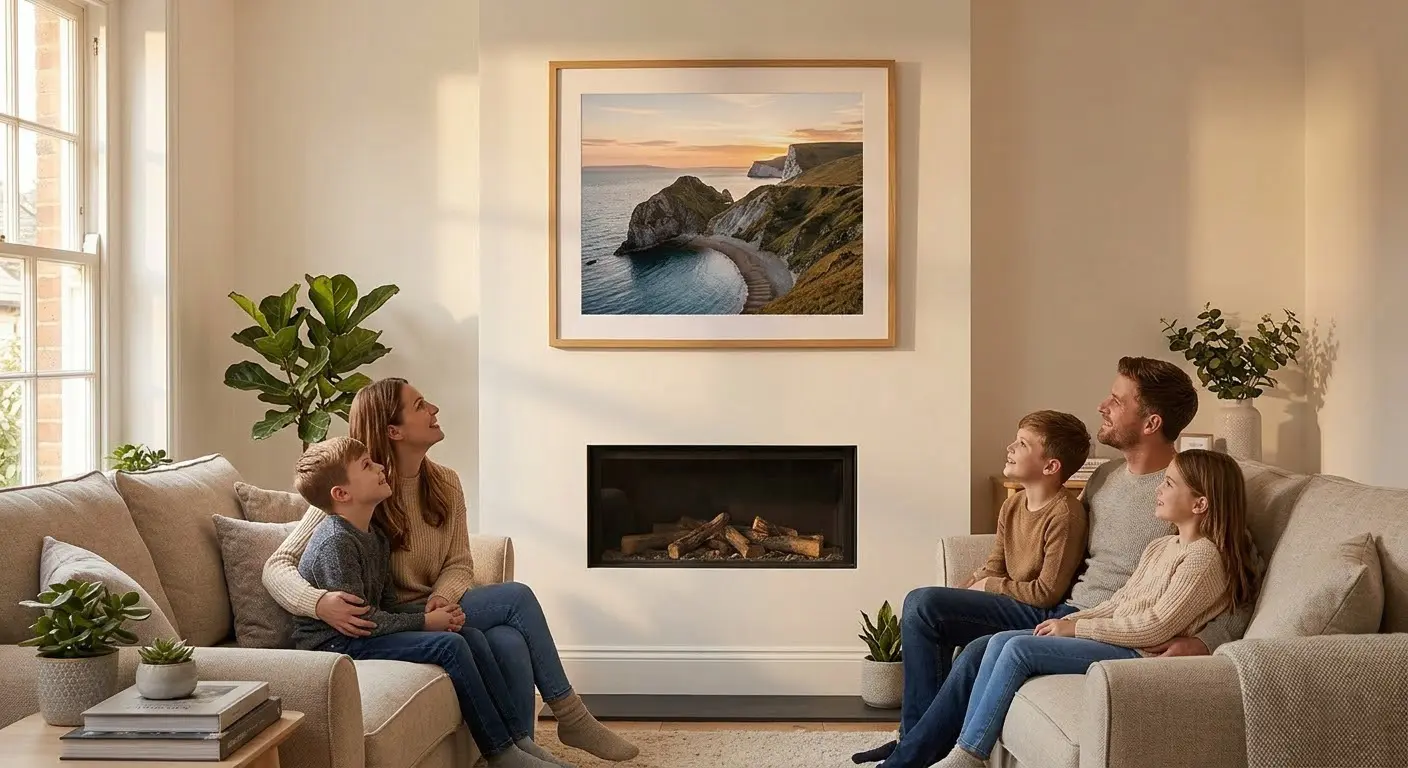
A-Series Picture Frame Sizes: A5, A4, A3, A2, and A1 Explained
The A-series sizing system is based on the international ISO 216 standard. Each size is exactly half the area of the next size up, which makes scaling and printing remarkably consistent. In the UK, A-series frames are especially popular for certificates, poster frames, art prints, and professional documents.
A5 Frame (14.8×21 cm)
The A5 frame is compact and elegant. It's half the size of A4, making it ideal for postcards, small art prints, and greeting cards. You'll often see A5 frames on desks and bookshelves, holding invitations, thank-you cards, or small illustrations.
A4 Frame Size (21×29.7 cm)
The A4 frame is one of the most searched-for picture frame sizes in the UK, and for good reason. A4 matches the standard paper size used for certificates, diplomas, children's artwork, and printed photographs. An A4 photo frame fits neatly on a wall, a shelf, or a desk, and its familiar proportions make it incredibly versatile.
When shopping for A4 photo frames, pay attention to whether the frame includes a mount (also called a mat). A mounted A4 frame has a larger outer dimension but displays the A4 image within a border, giving it a more polished, gallery-style appearance. If you want to learn more about how framing and mounting work together, our guide on how to frame a picture walks you through the process step by step.
A3 Picture Frame (29.7×42 cm)
An A3 frame doubles the display area of an A4, making it a popular choice for poster prints, large photographs, and art reproductions. With A3 dimensions in cm being 29.7×42, the A3 picture frame is a sweet spot for wall art: big enough to make an impact, yet not so large that it overwhelms a standard British room. If you're printing a photo specifically for an A3 frame, ensure your image is at least 3508×4961 pixels for crisp results at 300 DPI.
You can order high-quality prints in A3 and other sizes through My Picture's photo poster prints range, which are printed on premium paper and arrive ready to frame.
A2 Frame (42×59.4 cm)
The A2 frame enters large-format territory. It's a favourite for gallery-style displays, film posters, and oversized art prints. In a room with high ceilings or a wide open wall, an A2 frame commands attention without needing a cluster of smaller frames around it.
A1 Frame (59.4×84.1 cm)
A1 is the largest standard A-series frame size you'll commonly find. At nearly 60×84 cm, it's a true statement piece. A1 poster frames are used in galleries, offices, and feature walls where you want a single image to dominate the space. Because of its size, an A1 frame is almost always wall-mounted and benefits from a lightweight material like aluminium to reduce weight.
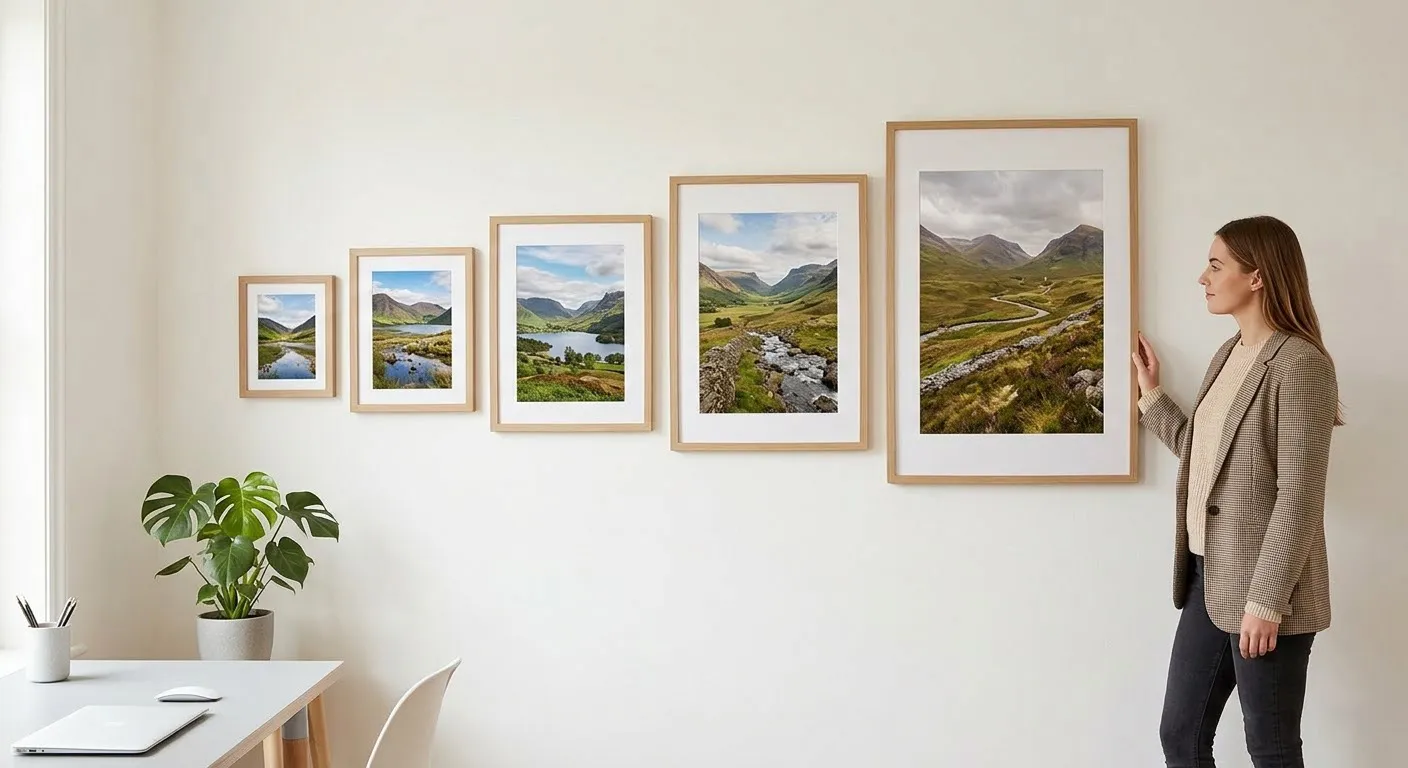
A-Series Frame Sizes at a Glance
| Size | Centimetres | Inches (approx.) | Best For |
|---|---|---|---|
| A5 | 14.8 × 21 cm | 5.8 × 8.3 in | Postcards, small prints, cards |
| A4 | 21 × 29.7 cm | 8.3 × 11.7 in | Certificates, children's art, photos |
| A3 | 29.7 × 42 cm | 11.7 × 16.5 in | Posters, large photos, art prints |
| A2 | 42 × 59.4 cm | 16.5 × 23.4 in | Gallery displays, film posters |
| A1 | 59.4 × 84.1 cm | 23.4 × 33.1 in | Statement wall art, exhibitions |
The 50×70 cm Frame: Europe's Favourite Poster Size
You'll notice the 50×70 frame appearing frequently in home décor shops, particularly those with Scandinavian-influenced ranges. This metric size (approximately 19.7×27.6 inches) doesn't correspond to any A-series or traditional imperial frame. It sits between A2 and A3 in area, offering a generous display without the commitment of a full A2.
The 50×70 cm frame is the standard for art posters across Europe, and it has become increasingly popular in British homes too. If you've bought a print from an online art marketplace, there's a good chance it was sized for a 50 x 70 frame. When shopping for this size, always confirm whether the listed dimensions refer to the frame's outer edge or the image opening, as the difference can be significant.
For a contemporary, frameless look at this size, acrylic photo prints offer a stunning alternative. The image appears to float on the wall, and the high-gloss finish intensifies colours beautifully.
How to Measure Your Photo and Choose the Right Frame Size in 5 Simple Steps
Getting the right fit between your photo and your frame is easier than you might think. Follow these steps and you'll avoid the most common sizing mistakes.
Step 1: Identify Your Photo's Exact Dimensions
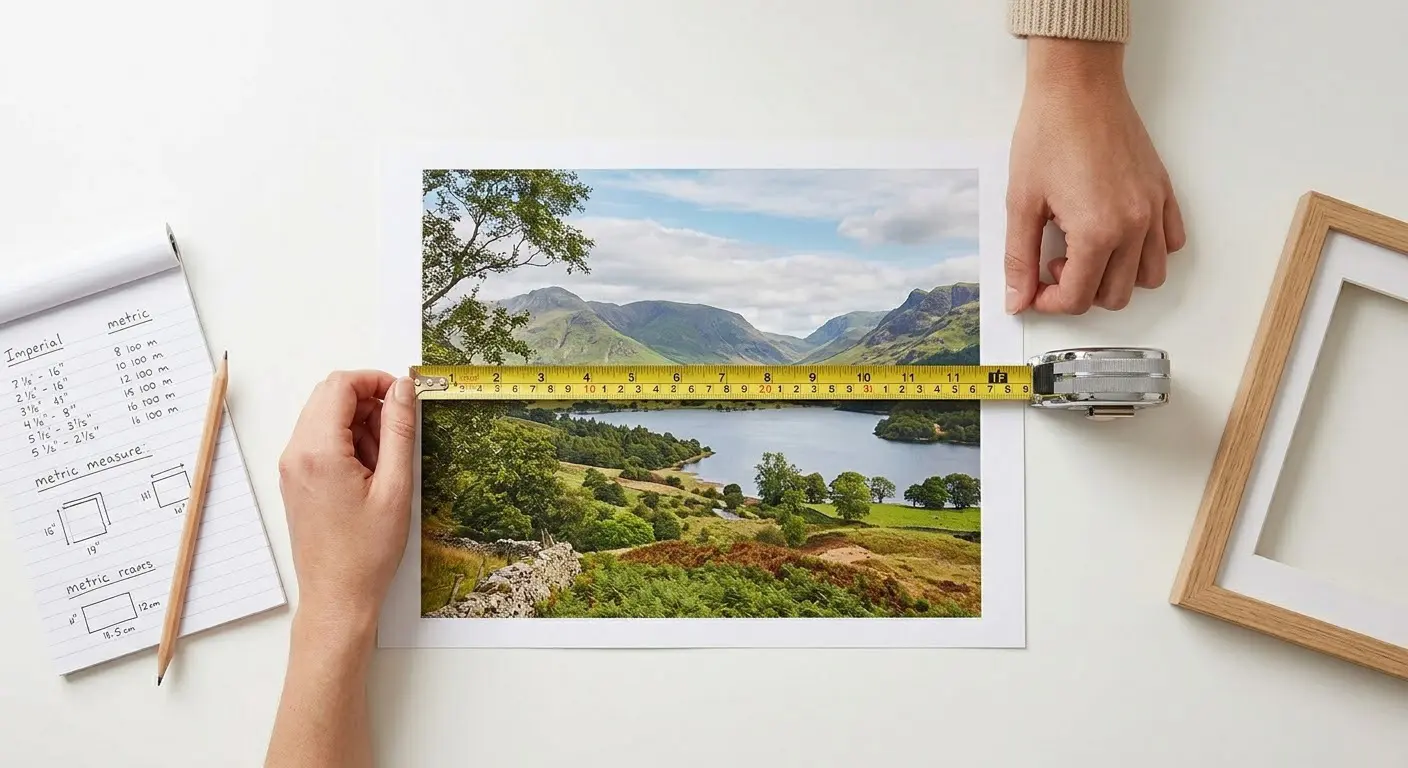
Use a ruler or tape measure to check the width and height of your printed photo or the digital file's print dimensions. Always measure in the same unit (inches or centimetres) that you'll use when ordering the frame.
Tip: For digital photos, right-click the file on your computer, select "Properties" or "Get Info," and check the pixel dimensions. Divide by 300 to get the maximum print size in inches at high quality.
Step 2: Decide Whether You Want a Mount
A mount (or mat) is the cardboard border between the photo and the frame edge. Mounts add a professional, gallery-quality look and draw the eye inward toward the image. If you want a mount, you'll need a frame that's one or two sizes larger than your photo. For example, a 6×4 photo with a mount typically fits a 10×8 frame.
Step 3: Match the Aspect Ratio
Aspect ratio is the relationship between width and height. A 6×4 photo has a 3:2 ratio, while an A4 print has roughly a 1:1.41 ratio. Placing a 3:2 photo into an A4 frame without cropping will leave uneven borders. Either crop your image to match the frame's ratio or use a custom-cut mount to fill the gap.
Step 4: Consider the Display Location
Where will the frame hang or stand? Measure the available wall space or shelf depth before committing to a size. A general rule: the framed photo should fill roughly two-thirds to three-quarters of the wall space above a piece of furniture. For a framed photo print above a bedside table, a 10×8 or A4 frame usually works perfectly. Above a sofa, consider 20×16 or larger.
Tip: Cut a piece of newspaper or wrapping paper to the frame's dimensions and tape it to the wall. Stand back and check whether the size feels right before ordering.
Step 5: Order and Verify Before Hanging
When ordering online, double-check that the product listing specifies the image opening size, not just the outer frame dimensions. With My Picture, trusted by over 350,000 satisfied customers and rated 4.8 out of 5 from more than 95,000 reviews, you can be confident that the sizes listed match exactly what arrives at your door.
Choosing the Right Frame Material and Style for Your Space
The size of your frame is only half the story. The material, colour, and profile of the frame itself dramatically affect how your photo looks on the wall. Here's a quick comparison of the most popular frame materials available in the UK.
Frame Material Comparison
| Material | Look & Feel | Weight | Best Room | Price Range |
|---|---|---|---|---|
| Wood | Classic, warm, traditional | Medium to heavy | Living rooms, bedrooms | ££–£££ |
| Metal/Aluminium | Sleek, modern, minimal | Light | Offices, hallways, kitchens | ££ |
| MDF/Composite | Versatile, many finishes | Light to medium | Any room, budget-friendly | £–££ |
| Acrylic (frameless) | Ultra-modern, high-gloss | Light | Feature walls, contemporary spaces | ££–£££ |
Wooden frames suit traditional and rustic interiors, while slim metal or aluminium frames complement modern, minimalist spaces. If you prefer a frameless aesthetic, aluminium photo prints mount directly to the wall and give your image a clean, contemporary edge.
For spaces where you want to swap photos regularly, MixPix photo tiles offer a clever alternative. These removable, repositionable tiles stick to the wall without nails or screws, and you can rearrange them whenever you fancy a change.
Pros of traditional picture frames:
-
Timeless, classic appearance
-
Wide range of sizes from 6×4 to A1
-
Available in wood, metal, and composite
-
Protect photos behind glass
Pros of frameless alternatives (canvas, acrylic, aluminium):
-
Modern, gallery-style look
-
Lighter weight, easier to hang
-
No glass to clean or risk breaking
-
Edge-to-edge image display
Conclusion
Finding the right photo frame size doesn't need to be complicated. The key is knowing your measurements, understanding the difference between imperial and A-series sizing, and matching your frame to both your photo and your room. From the humble 6×4 photo frame on a bedside table to a dramatic A1 poster frame anchoring a feature wall, every size has its place.
With this guide as your reference, you can shop for picture frames with complete confidence. And when you're ready to bring your favourite photos to life, My Picture makes it simple. With Made in Britain quality, FSC-certified materials, and a 4.8-star rating from over 95,000 reviews, your memories are in safe hands. Browse the full range of framed photo prints and find the perfect size for your home today.
Frequently Asked Questions About Photo Frame Sizes
-
The 6×4 inch (15.2×10.2 cm) frame is the most popular photo frame size in the UK. It matches the standard print size from most photo labs and online printing services, making it the default choice for everyday photographs.
-
An A4 frame size measures 29.7×21 cm, which converts to approximately 11.7×8.3 inches. This is close to, but not the same as, a 10×8 inch frame. Always check whether your print is A4 or 10×8 before ordering a frame to ensure a proper fit.
-
A 50×70 cm frame (approximately 19.7×27.6 inches) is a European poster standard, while an A2 frame measures 42×59.4 cm (approximately 16.5×23.4 inches). The 50 x 70 frame is noticeably larger than A2. They are not interchangeable, so always match your print size to the correct frame.
-
A mount is optional but recommended for a polished, gallery-style finish. It creates a border between the image and the frame, drawing the viewer's eye to the photograph. If you use a mount, choose a frame that's one or two standard sizes larger than your photo.
-
For sharp results, your image should be at least 300 DPI (dots per inch) at the intended print size. For an A3 frame, that means a minimum of 3508×4961 pixels. For a 20×16 inch frame, aim for 6000×4800 pixels. Most modern smartphone cameras produce images large enough for frames up to A3 or 16×12.
-
Gallery walls work best with a mix of sizes. A popular combination includes two or three medium frames (10×8 or A4), several smaller frames (6×4 or 7×5), and one larger anchor frame (A3 or 16×12). Keeping the frames in the same colour or material creates cohesion, while varying the photo frame sizes adds visual interest.