Acrylic photo displays look fantastic. The glass-like surface makes colours pop, adds a sense of depth, and gives even an ordinary phone snap a proper gallery finish. The trouble is the names. Block, print, box, cube, glass, perspex — shops use all of them, sometimes for the same thing and sometimes for very different things. No wonder people get confused before they buy.
This guide clears it up. We'll explain exactly what an acrylic photo block, an acrylic print and an acrylic box frame each are, how they're made, what they cost in the UK, and which one suits your photo, your room and your budget. By the end you'll know precisely which to choose — and you won't pay for the wrong thing.
We make all of these ourselves, so we'll be honest about where each one shines and where it doesn't. There's no single winner here. The best choice depends on where the photo is going and what you want it to do.
Key takeaways
The short version, before we get into the detail:
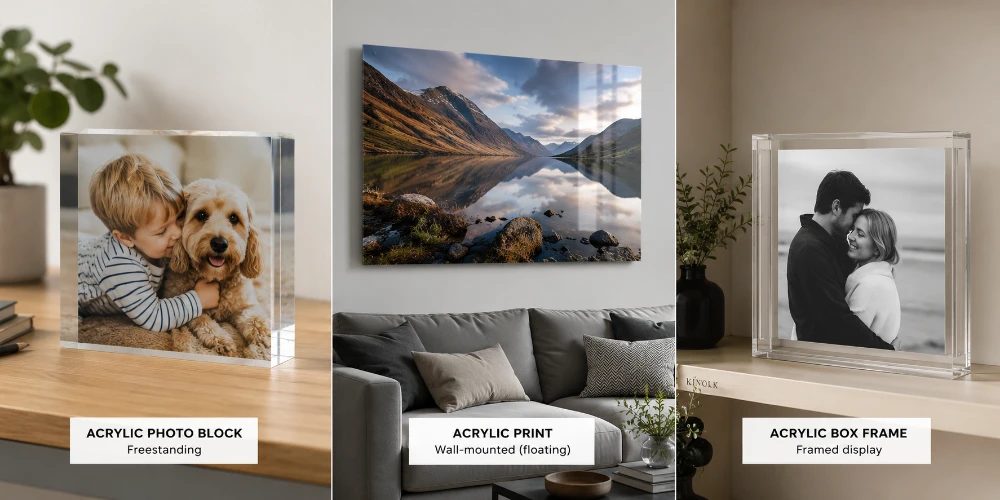
Acrylic photo block: a thick, freestanding block of acrylic glass that stands on a desk or shelf. No fixings, no drilling. Best for gifts and small keepsakes.
Acrylic print: a slim acrylic panel that hangs on the wall and appears to float. Best for statement wall art with rich, glossy colour.
Acrylic box frame: a photo held inside or behind a clear acrylic frame or box, often with a print you can swap. Best if you like changing your photos.
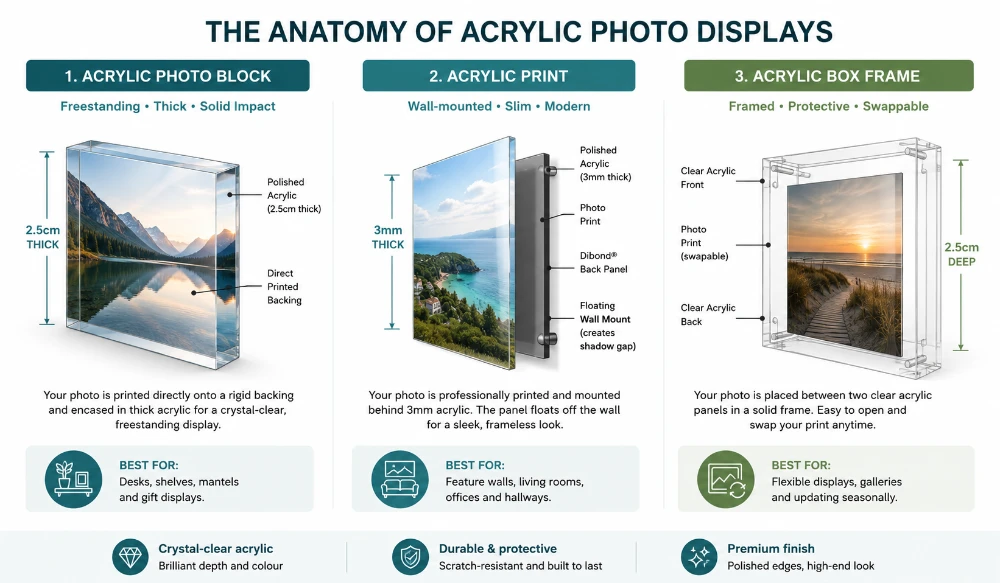
Depth is the giveaway: a block is chunky (ours are 2.5cm deep); a wall print is thin (3mm); a box frame sits somewhere in between with a visible border.
Colour comes from the print method: direct printing is bold and hard-wearing; face-mounted (laminated) printing gives the deepest, gallery-grade colour.
For your budget: small blocks start from around £6, wall prints from £13, so you don't need to spend a fortune to get the acrylic look.
The quick answer: which acrylic photo product is which?
If you only read one section, make it this one. Here's each product in a single sentence.
Acrylic photo block — a solid, freestanding acrylic block with your photo behind it, made to sit on a surface without any hanging hardware.
Acrylic print — a thin sheet of acrylic glass with your photo behind it, designed to mount on the wall with hidden fixings so it looks like it's floating.
Acrylic box frame — a clear frame or shallow box that holds your photo, giving a layered, three-dimensional look, usually with a print you can change whenever you like.
Everything else — depth, price, how they're hung, which photos suit them — flows from those three basic ideas. Let's put them head to head.
Acrylic block vs print vs box frame: at a glance
This table sums up the practical differences. We'll unpack each row in the sections below.
Feature
Acrylic photo block
Acrylic print
Acrylic box frame
Where it goes
Desk, shelf, mantel
On the wall
Wall or shelf
Typical depth
Chunky (about 2.5cm)
Slim (about 3mm)
Deeper, with a border
How it's displayed
Stands on its own
Floats on the wall
Photo sits in a frame
Fixing needed
None
Wall fixings (hidden)
Stand or wall fixing
Swap the photo?
No
No
Often yes
Best for
Gifts, keepsakes, desks
Statement wall art
Changeable displays
Starting price (UK)
From £6 (mini) / £14
From £13
Varies by style
Prices shown are our Factory Price — we print and ship straight from our own factories in Europe, so you pay the factory rate rather than the usual retail mark-up. Sizes and prices are correct at the time of writing; check the product page for the current rate.
What is an acrylic photo block?
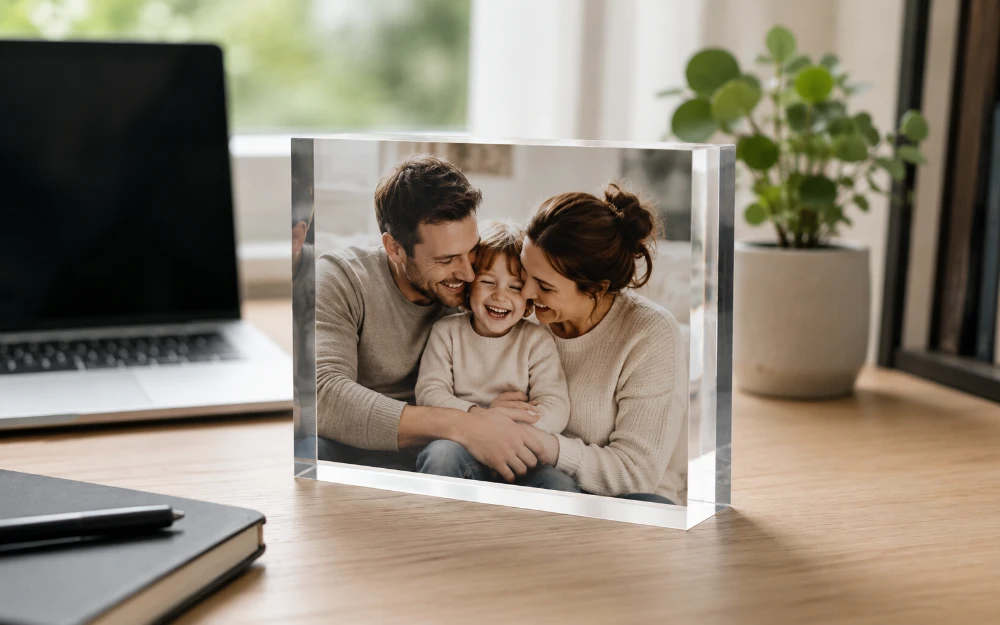
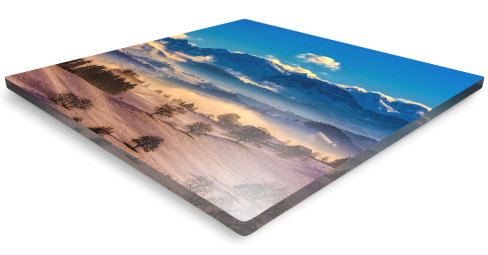
An acrylic photo block is a solid, chunky piece of acrylic glass with your photo set behind it. It stands upright on a flat surface all by itself — no stand, no hook, no wall damage. Think of it as a modern, frameless answer to the desk photo frame your gran kept on the sideboard.
The look is what sells it. Because the acrylic is thick, light travels through the edges and gives the image a soft glow and a real sense of depth. Our own acrylic photo blocks are 2.5cm deep, which is enough to create that gentle 3D effect without being too heavy to pick up.
How the photo goes on
With our acrylic blocks, your photo is printed straight onto a bright white backing sheet using a direct UV print. The block of acrylic glass is then fixed over the top, so you view the image through the glass. That glossy layer is what deepens the colours and protects the print underneath.
Sizes and the mini version
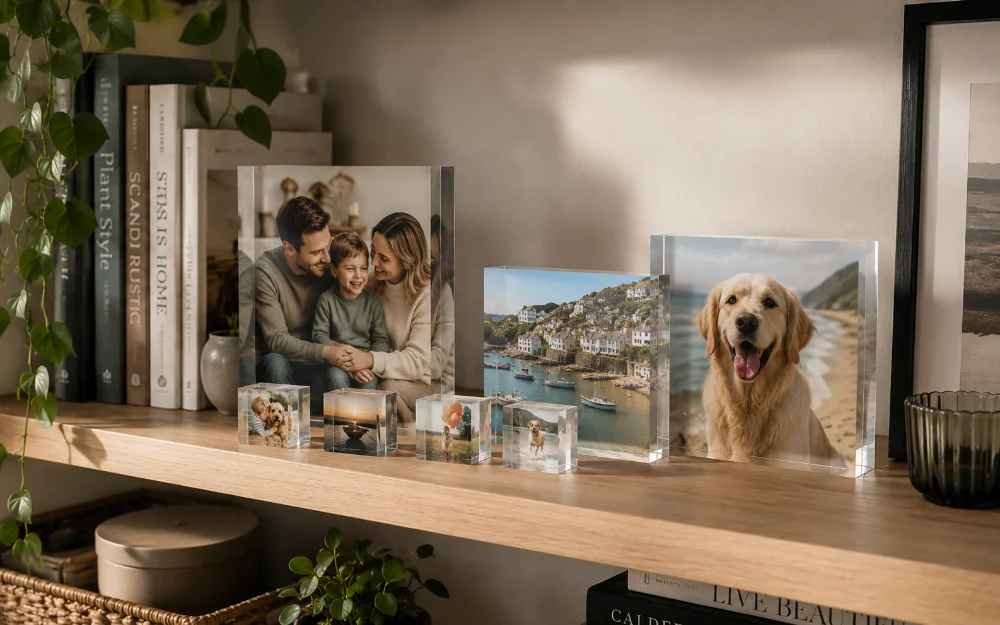
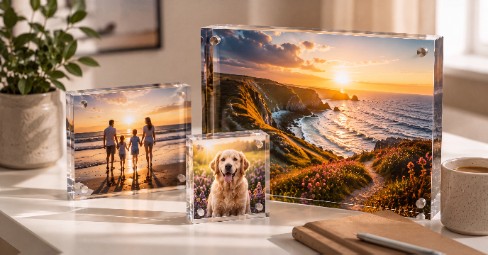
Full-size blocks come in handy formats — 10x10cm, 15x10cm, 20x15cm and 20x20cm — which sit nicely on a desk, shelf or windowsill. If you fancy a group display, our MIXBLOX mini acrylic blocks are tiny 5x5cm cubes made to be mixed and matched. Line up a few on a shelf, one photo per block, and you've got a playful little gallery you can rearrange whenever you like.
Who it's for
Blocks are brilliant gifts. They arrive looking premium, they need no assembly, and they work straight out of the box. A photo of the kids for a grandparent, a pet portrait for a desk at work, a holiday memory for the kitchen windowsill — all perfect jobs for a block. If it's going on a surface rather than a wall, a block is almost always the right call.
What is an acrylic print?
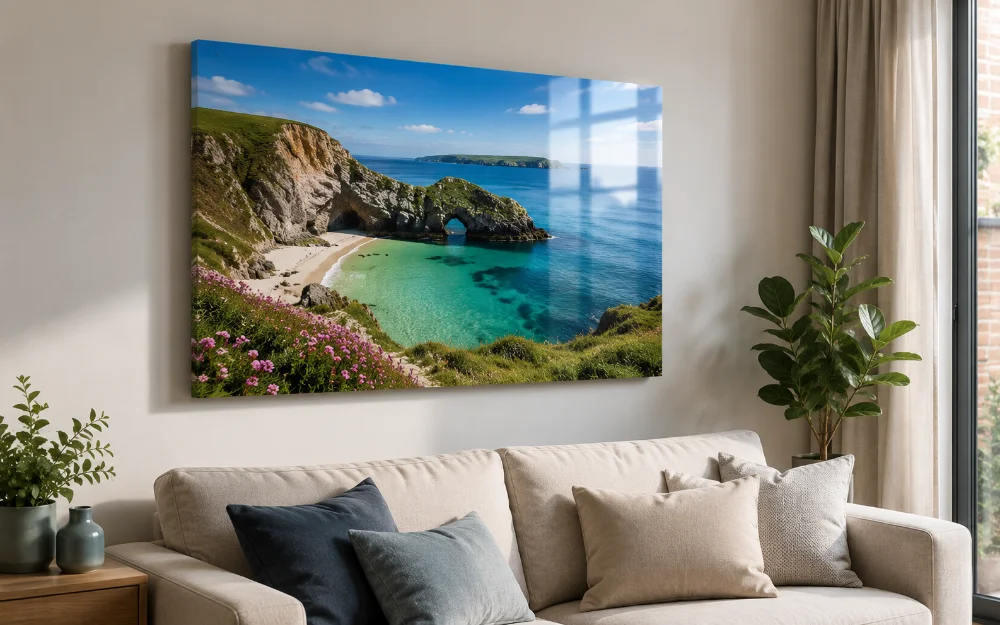
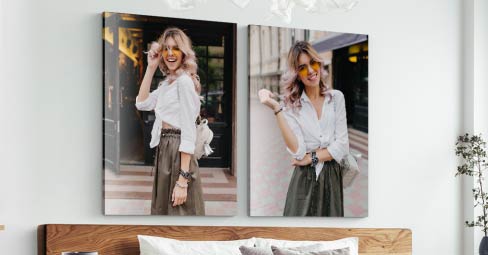
An acrylic print is the wall-art version. Your photo sits behind a slim sheet of acrylic glass, and the whole thing mounts to the wall with a hidden fixing so it looks like it's floating a centimetre or two off the surface. There's no visible frame, which gives it a clean, contemporary feel.
Our acrylic prints use a 3mm acrylic panel with hand-polished edges, cut to size on precision CNC machines at our production site in Cologne. The invisible hanging system tucks away behind the print, so all you see is the picture and that lovely glossy depth.
Two versions: Acrylic and Acrylic Premium
This is the bit most guides skip, and it matters. We offer two tiers, and the difference is the print method — which changes how the colours look.
Acrylic: a rich 6-colour direct print on a pure-white multilayer backing. Bold, punchy colour and a striking depth effect. Our standard option, from £13.
Acrylic Premium: an intense 12-colour print on lab-quality photo paper, laminated behind the glass. This is the face-mounted, gallery-grade route — exceptional colour saturation and the truest reproduction of your original. From £15.
If your photo is a straightforward, colourful shot, the standard Acrylic looks superb. If it's a detailed landscape, a professional portrait or anything where subtle tones matter, the Premium is worth the small step up. For an even more luxurious floating-gallery finish, our acrylic and aluminium prints pair the acrylic front with a rigid aluminium backing.
How it hangs
Smaller and medium prints use a neat hanger plate; larger prints use an aluminium back-frame that spaces the print off the wall. Both are hidden once fitted. If you want the full step-by-step, we've written a separate guide on how to hang acrylic prints, and there's more on the make-up of the panel in our explainer on what an acrylic print is.
Who it's for
Anyone who wants a photo to be the focal point of a wall. A big acrylic print above the sofa, in the hallway or behind the bed turns a snapshot into a proper piece of art. It's the acrylic option with real presence.
What is an acrylic box frame?
Here's where the naming gets slippery, so let's be clear. An acrylic box frame is a clear frame or shallow box that holds your photo, rather than bonding the photo permanently behind a solid panel. The photo usually sits between or behind clear acrylic, with a small border or gap that gives a layered, boxed-in look.
The big practical difference is that a box frame is often designed so you can take the photo out and swap it. A block and a wall print are made as one finished piece — the photo stays put. A box frame is more like a stylish holder.
"Block" vs "box"
Shoppers often use these words to mean the same thing, because a thick block is box-shaped. But they're not identical. A block is a solid piece with the photo fixed behind it. A box frame is hollow-ish — the photo sits inside it and can usually be changed. If you want to update your display now and then, that difference is the whole decision.
The MYPICTURE take on a box frame
We don't sell a plain acrylic box frame, but we do make a playful version: our Snow Globe Photo Frame. Your photo sits behind thick acrylic glass inside a glitter frame, and you can swap the 10x15cm print whenever you fancy a change. It's a lovely, lighthearted way to get the boxed acrylic look with the freedom to update the picture.
Who it's for
Box frames suit people who like variety — seasonal photos, new baby pictures every few months, a rotating shot of the latest family day out. If you love the idea of acrylic but hate committing to one image forever, a box-style frame is your friend.
How each one is made (and why it changes the colour)
All three products put your photo behind acrylic glass. What differs is how the photo is printed. This is the single biggest thing that affects how vivid and long-lasting your image looks, so it's worth understanding.
Print method
How it works
The look
Used for
Direct print
Ink is printed straight onto a white backing (or the acrylic itself)
Bold, vivid, hard-wearing
Acrylic blocks; standard Acrylic prints
Face-mounted (laminated)
A lab photo print is bonded behind the acrylic glass
Deepest colour, gallery-grade, most accurate
Acrylic Premium; acrylic + aluminium
Neither is "better" in every case. Direct printing is punchy, tough and great value — ideal for blocks and everyday wall prints. Face-mounting costs a little more but gives you the richest, most faithful colour, which is why it's the choice for premium wall art and anything with fine detail.
One myth worth busting: acrylic doesn't "add" colour that isn't there. What it does is protect the print and let light play through the surface, so the colours that are in your photo look deeper and cleaner than they would on plain paper.
Head to head: the things that actually matter
Now the real comparison. Here's how the three stack up on the points people ask about most.
Depth and the 3D effect
This is acrylic's party trick. A thick block gives the strongest sense of depth because there's more glass for light to travel through. A wall print is thinner, so the effect is subtler but still clearly there — especially on the Premium. A box frame creates depth in a different way, through the gap between the photo and the front of the frame. If pure "wow, that looks 3D" is your goal, the block wins.
Durability and fading
Acrylic is a genuinely hard-wearing material. Our acrylic prints are moisture, scratch and UV resistant, which is more than you can say for a bare paper print in a cheap frame. Kept out of direct sunlight and away from damp, an acrylic block or print will stay sharp and colourful for many years. No print of any kind loves a sunny south-facing window, though, so position it with a little care.
Glare and reflections
The glossy surface is part of the charm, but it does reflect light — just like the glass in a traditional frame. In a bright room or opposite a window you'll see some reflection. It's rarely a problem in normal light, but if a wall gets strong direct sun all day, think about placement or consider a matt option like aluminium instead. For a desk block, you can simply turn it slightly away from the light.
Weight and hanging
Acrylic is about half the weight of glass, so it's easier to hang and safer around children and pets than a heavy glazed frame. A block needs no fixing at all. A wall print needs the right fixings for your wall type, but the hidden system keeps everything tidy. A box frame usually stands on a surface or takes a single fixing.
Price
Here's real UK pricing for our acrylic wall prints, so you can see how size and tier affect cost. This is the kind of at-a-glance table most sites don't give you.
Size
Acrylic (from)
Acrylic Premium (from)
20x20cm
£13
£15
30x20cm
£17
£20
40x30cm
£27
£34
60x40cm
£42
£50
80x60cm
£69
£76
100x75cm
£108
£122
And for blocks, which come in at pocket-money prices for the smaller sizes:
Product
Size
Depth
Price (from)
Photo Acrylic Block
10x10 to 20x15cm
2.5cm
£14
MIXBLOX (mini)
5x5cm
2.5cm
£6 each
Snow Globe Frame
15x10cm print
—
£11
Every order is covered by our UK Lowest Price Guarantee: find the same product cheaper elsewhere in the UK and we'll beat that price by 5%. Delivery is free on orders over £49.
Which one should you choose?
Still weighing it up? Match what you want to the right product with this quick decision guide.
If you want…
Choose
Why
A desk or shelf keepsake
Acrylic photo block
Freestanding, no fixings, gift-ready
A group you can rearrange
MIXBLOX mini blocks
Small cubes made to mix and match
A statement on the wall
Acrylic print
Frameless, floating, real presence
The richest possible colour
Acrylic Premium
12-colour, face-mounted photo paper
To swap photos often
Acrylic box frame
Print lifts out and changes
A budget-friendly gift
MIXBLOX or small block
Premium look from around £6
Thinking about the room
A quick rule of thumb. Surfaces — desks, shelves, mantels, windowsills — want a block or a box frame. Empty wall space wants a print. If you're filling a big blank wall above a sofa or bed, go bigger than feels comfortable; large prints almost always look better than small ones lost in the middle of a wall.
Thinking about the occasion
For gifts, blocks are hard to beat — they feel special and need nothing doing to them. For a treat for your own home, a large acrylic print is the showpiece. For someone who redecorates on a whim or loves marking the seasons, a swappable box-style frame keeps things fresh.
Which photos work best on acrylic?
Acrylic rewards certain kinds of images. Because it deepens colour and contrast, it flatters photos that are already bright, sharp and full of life. Here's what tends to shine.
Vivid, colourful shots — sunsets, flowers, coastlines, city lights. Acrylic makes strong colour sing.
High-contrast images — the glossy finish lifts the difference between light and dark.
Bold black-and-white — acrylic gives mono photos a rich, deep, almost inky quality.
What to be careful with: very soft, hazy or low-light photos won't gain as much from the acrylic treatment, and a slightly blurry image will look no sharper behind glass. Resolution matters too — the bigger the print, the more pixels you need. Here's a rough guide.
Print size
Minimum resolution
Typical phone?
Small block (up to 20x20cm)
About 1000x1000px
Any recent phone is fine
30x20 / 40x30cm print
About 1600x1200px
Most phones fine
60x40cm print
About 2400x1600px
Recent phones fine
80x60cm print
About 3000x2400px
Check older phones
100x75cm and up
About 3600x2700px
Modern phones fine
Simple test: open the photo on your computer and view it at full size. If it looks sharp on screen, it'll be fine as a print. If it looks fuzzy or blocky, it'll look worse enlarged, so pick a different shot or a smaller size.
Acrylic vs canvas, aluminium and framed prints
Acrylic isn't the only way to put a photo on the wall, and it isn't always the right one. Here's how it compares with the other popular finishes, so you can choose with your eyes open.
Finish
Look
Depth / pop
Glare
Best for
From
Acrylic
Glossy, vivid, modern
Very high
Yes
Colourful, high-contrast photos
£13
Canvas
Textured, warm, matt
Low
None
Portraits, cosy and classic rooms
£4.50
Aluminium
Sleek, satin or matt
Medium
Low
Modern rooms, damp spaces
£13
Framed print
Classic, timeless
Low
Some
Traditional and formal settings
£14.90
In plain terms: choose acrylic for punchy colour and a modern, glassy finish; canvas for warmth, texture and zero glare; aluminium for a sleek matt look that shrugs off moisture; and a traditional framed print for a softer, classic feel. If you'd like to see how these work across different rooms and styles, our wall decor ideas for UK homes in 2026 are a good next read.
Looking after your acrylic block or print
Acrylic is easy to care for, but it does scratch if you treat it like a kitchen window. A little gentleness keeps it looking new for years.
Do
Don't
Dust with a soft, lint-free cloth — a microfibre cloth is ideal
Use glass cleaner, ammonia, alcohol or any harsh chemical — these cloud and damage acrylic
For marks, use a slightly damp cloth with, at most, a drop of mild washing-up liquid, then buff dry with a second soft cloth
Wipe with paper towels or anything abrasive, which can leave fine scratches
Keep it out of direct sunlight and away from damp to protect the colours
Scrub at a dry surface — dust it gently instead
Acrylic in UK homes: small spaces and 2026 trends
Acrylic suits the way a lot of us actually live. If you rent, or you're in a compact flat or new-build, a freestanding block gives you the premium photo look with no holes in the wall and nothing to make good when you move out. Pop it on a shelf and you're done.
For those who can hang things, 2026 is all about personal, characterful walls — gallery walls full of meaningful photos rather than bare, showroom-style minimalism. A glossy acrylic print of a favourite memory fits that mood perfectly, whether it's the anchor of a gallery wall or a single bold piece on its own.
Colour-wise, deep blues and warm earthy tones are having a moment in British homes. Acrylic's rich, saturated finish works beautifully against both — a vivid landscape or a warm golden-hour shot really lifts a darker wall.
The bottom line
Once you strip away the confusing names, the choice is simple. A block stands on a surface and makes a gorgeous gift. A print hangs on the wall and makes a statement. A box frame lets you swap your photos whenever the mood takes you. All three give you that glossy, deep, gallery-quality acrylic look — you're just choosing where it goes and how permanent you want it to be.
Match the product to the spot you have in mind, pick a bright and sharp photo, and you really can't go wrong. Whichever you choose, your favourite moment ends up looking better than you thought a photo could.
Frequently Asked Questions
What is the difference between an acrylic photo block and an acrylic print?
An acrylic photo block is a thick, freestanding piece of acrylic that stands on a desk or shelf with no fixings. An acrylic print is a slim acrylic panel that hangs on the wall and appears to float. The block is for surfaces; the print is for walls.
What is an acrylic photo block?
An acrylic photo block is a solid block of clear acrylic glass with your photo set behind it, made to stand upright on a flat surface. The thick glass creates a soft glow and a sense of depth. Ours are 2.5cm deep and need no stand or hanging hardware.
Are acrylic prints worth it?
For colourful, high-contrast photos, yes. Acrylic gives deeper colour, a glossy finish and a real sense of depth that paper prints can't match, and it's moisture, scratch and UV resistant. If you want warmth and texture instead, or a room with heavy glare, canvas may suit you better.
Do acrylic prints fade?
Acrylic prints are UV resistant and hold their colour well for many years when kept out of direct sunlight and away from damp. No print of any material is completely fade-proof in strong, constant sun, so it's wise to avoid hanging any photo on a wall that gets direct sunlight all day.
Do acrylic prints and blocks scratch easily?
Acrylic is scratch resistant but not scratch proof. In normal use on a wall or shelf it stays smooth and clear. Scratches usually come from cleaning with the wrong things — paper towels, abrasive cloths or harsh sprays — so stick to a soft microfibre cloth and it will stay looking new.
How do you clean an acrylic print or block?
Dust it with a soft, lint-free or microfibre cloth. For marks, use a slightly damp cloth with, at most, a drop of mild washing-up liquid, then buff dry. Never use glass cleaner, ammonia, alcohol or paper towels, as these cloud and scratch the acrylic surface.
Is an acrylic print better than canvas?
Neither is better overall — they do different jobs. Acrylic gives glossy, vivid colour and a modern, glassy depth, ideal for bright and high-contrast photos. Canvas gives a warm, textured, matt finish with no glare, which suits portraits and cosier, more traditional rooms. Choose to match your photo and your room.
What photos work best on acrylic?
Bright, colourful, high-contrast and sharp images work best, because acrylic deepens colour and lifts contrast. Sunsets, coastlines, city scenes and bold black-and-white photos look superb. Soft, hazy or low-light shots gain less, and a blurry photo won't look any sharper behind glass, so start with a crisp image.
How are acrylic prints hung on the wall?
Acrylic prints use a hidden fixing that holds the panel a little off the wall, giving that floating look. Smaller prints use a hanger plate; larger ones use an aluminium back-frame. Both are out of sight once fitted. Our full guide to hanging acrylic prints walks through it step by step.
What is the difference between Acrylic and Acrylic Premium?
Our standard Acrylic uses a bold 6-colour direct print on a white backing — punchy and great value. Acrylic Premium uses an intense 12-colour print on lab-quality photo paper, laminated behind the glass, for the deepest, most accurate colour. Premium suits detailed photos and professional shots where fine tones matter.
Is an acrylic photo block a good gift?
It's one of the best photo gifts going. A block arrives looking premium, needs no assembly and works straight out of the box on any desk or shelf. Small blocks start from around £6, so you get a high-end look without a high-end price, which makes them ideal for birthdays and thank-yous.
Acrylic photo block or acrylic box frame — which should I pick?
Pick a block if you want a finished, permanent piece with the strongest depth effect and no fuss. Pick a box frame if you like changing your photos, since the print usually lifts out and swaps. In short: block for "set and forget", box frame for "change with the seasons".