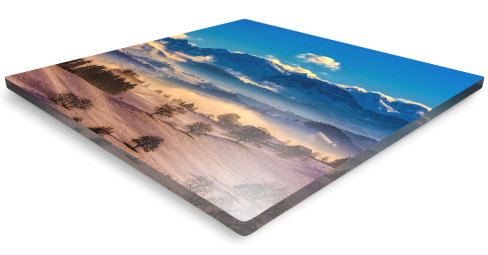
Acrylic photo blocks have quietly become one of the most popular photo gifts in the UK. You will spot them on office desks, bedside tables and mantelpieces all over the country. But if you have never bought one, the name alone does not tell you much. Is it glass? Is it a frame? Can you change the photo later? And why do prices for what looks like the same thing range from under £10 to over £30?
We print these every day, so we know the questions people ask before they buy. This guide answers all of them. By the end, you will know exactly what an acrylic photo block is, how it is made, what to pay, what size to pick, and whether it is the right choice for your photo, or whether something else would suit you better.
Key takeaways
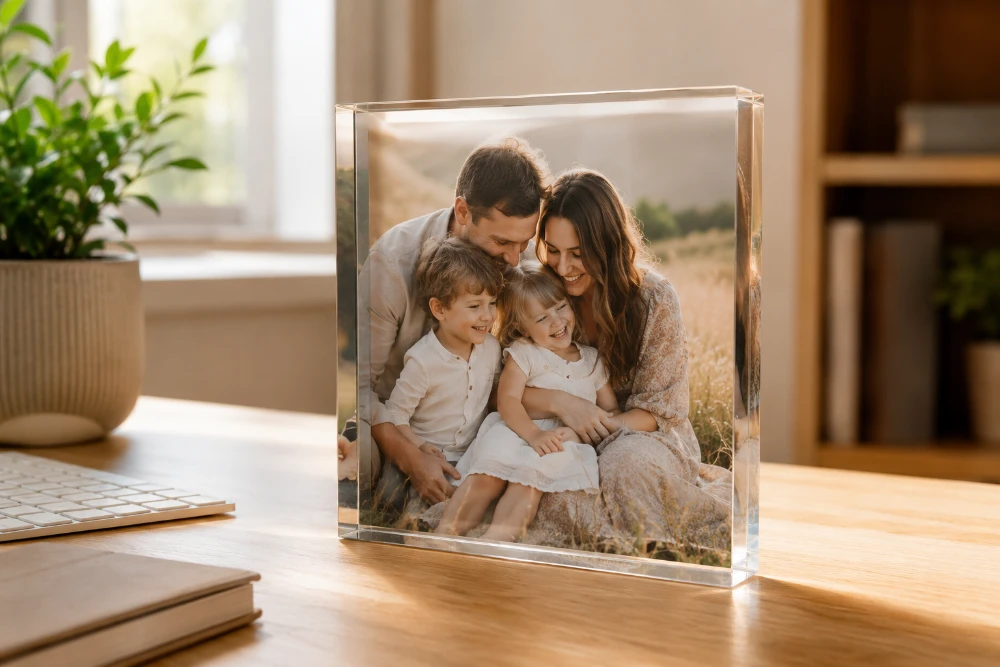
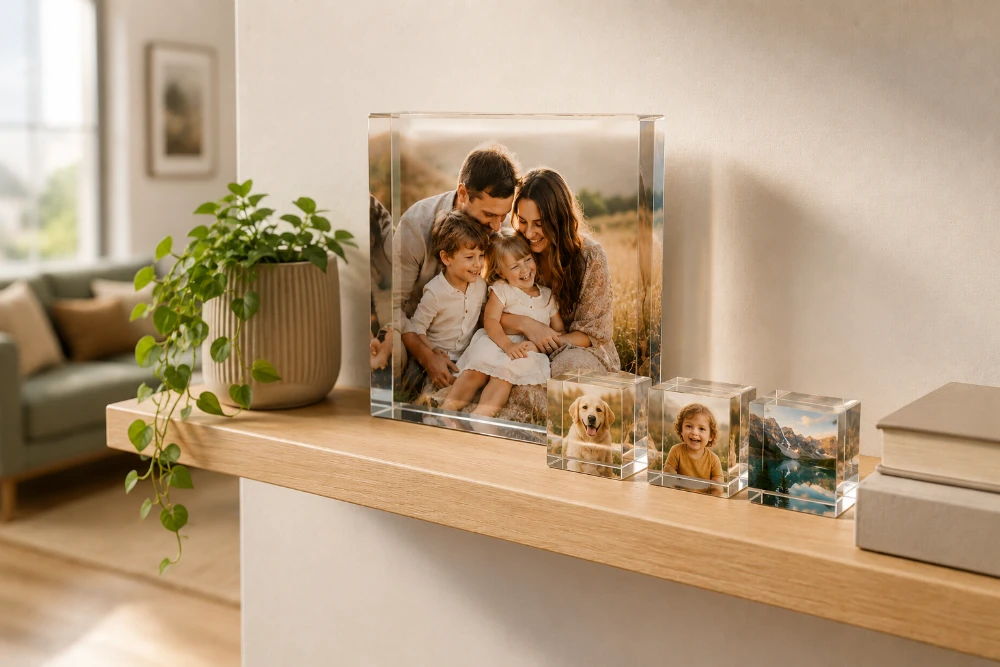
An acrylic photo block is a thick, free-standing slab of clear acrylic with your photo printed on or behind it. It stands on a desk or shelf with no frame, stand or fixings.
UK blocks are usually 16mm to 25mm thick. The thicker the block, the stronger the glass-like depth effect. Ours are a full 25mm.
Common UK sizes run from 5 x 5cm mini blocks up to 20 x 20cm. Prices range from about £6 for a mini to around £34 for a large premium block.
Acrylic is about half the weight of glass and far harder to break, which makes blocks safe around children and pets. The trade-off is that bare acrylic scratches more easily, so clean it gently.
Blocks are desk and shelf pieces, not wall art. If you want the same glassy look on your wall, you want an acrylic print instead.
In most blocks the photo is sealed in permanently, so choose a picture you will not want to swap. A few designs, like glitter shaker frames, do let you change the print.
What Is an Acrylic Photo Block?
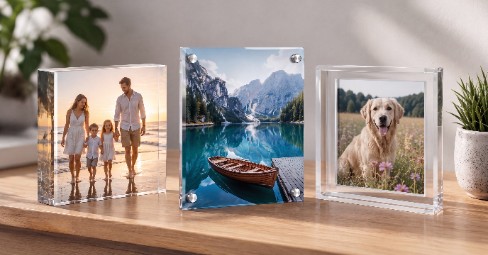
An acrylic photo block is a chunky piece of crystal-clear acrylic, usually square or rectangular, with your photo printed onto a backing that sits flush against the acrylic. The block is thick enough to stand up on its own, so there is no frame to buy, no stand to unfold and nothing to hang. You take it out of the box, put it down, and that is the job done.
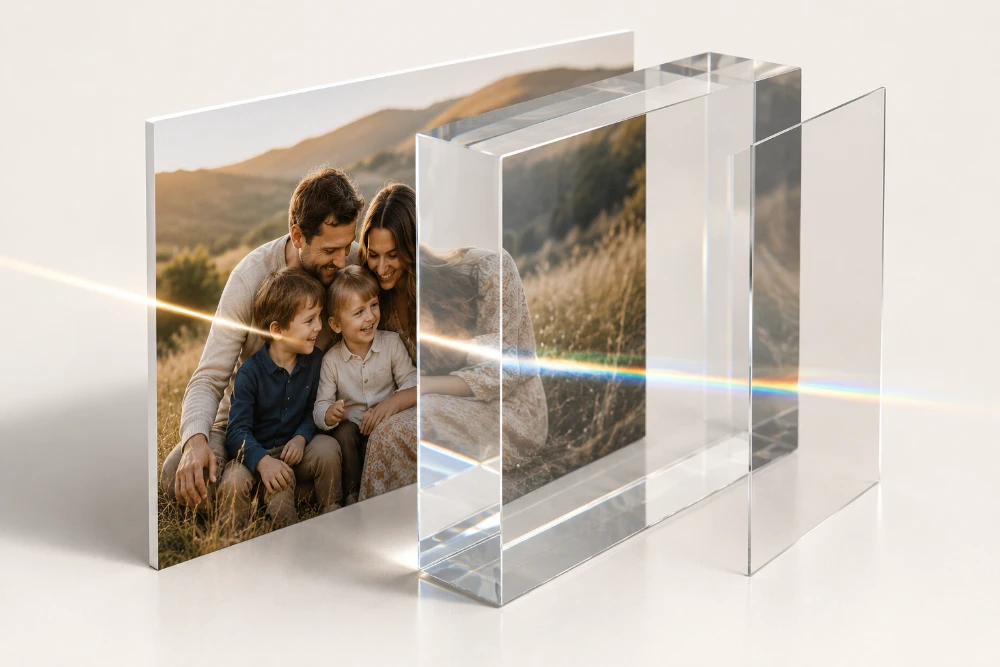
The thickness is what makes it special. Light enters through the polished top and sides, travels through the acrylic and lights the photo from within. The image looks deeper and more vivid than a normal print, almost as if it is floating inside the block. Move around it and the reflections shift, which gives the photo a subtle, lively quality that a flat print behind glass never has.
In plain terms
An acrylic photo block is a solid, frameless block of clear acrylic, typically 16 to 25mm thick, with a photo sealed on or behind it. It is designed to stand freely on a desk, shelf or mantelpiece, and the depth of the acrylic creates a 3D, glass-like effect that makes the image appear to float inside.
Shoppers use lots of names for the same product: acrylic block, acrylic picture block, photo block, glass photo block, acrylic desk block, even acrylic photo cube. Most of the time these all describe the same thing. The exceptions, like 3D laser-engraved crystal blocks and magnetic swap-photo blocks, work quite differently, and we cover those further down so you know exactly what you are ordering.
Acrylic, Perspex or Plexiglass: Is There a Difference?
This trips a lot of people up, so let us settle it. Acrylic, Perspex and plexiglass are all the same basic material: a clear plastic called PMMA, short for polymethyl methacrylate. Perspex is simply a well-known brand name for acrylic in the UK, in the same way Hoover is a brand name for a vacuum cleaner. Plexiglas is the equivalent brand name used in Europe and America.
So if you see a "Perspex photo block" and an "acrylic photo block" side by side, you are looking at the same type of product. What actually matters is the quality of the acrylic and how the block is made, which brings us to the next section.
One more naming wrinkle: many printers, including us, describe the material as acrylic glass. That is a common industry term for high-clarity acrylic. It is not real glass, and that is a good thing, as you will see when we compare the two.
How an Acrylic Photo Block Is Made
There are two main production methods used in the UK, and knowing the difference helps you judge what you are paying for.
1. Direct UV printing (the most common method)
Your photo is printed straight onto a white backing sheet using UV-cured inks, and the block of acrylic is then bonded to the front, so the image shows through the full depth of the material. This is how our own acrylic photo block is made: a direct UV print on a white backing, a 25mm block of hand-polished acrylic glass on top, and a scratch-resistant laminate to protect the finish. It produces crisp detail and rich colour, and it keeps the price sensible.
2. Face-mounting (the premium lab method)
Here the photo is printed on real photographic paper first, then bonded to the back of the acrylic under pressure. Specialist photo labs use this method for exhibition-grade work. It captures very fine detail, and you pay noticeably more for it. For a desk-sized block, most people honestly cannot tell the difference at normal viewing distance.
Cast acrylic vs extruded acrylic
The acrylic itself comes in two grades. Cast acrylic is made by pouring liquid acrylic between sheets of glass and letting it cure slowly, which gives better clarity, a harder surface and cleaner polished edges. Extruded acrylic is pushed through rollers, which is cheaper but softer and slightly less clear. Good photo blocks use cast acrylic with diamond-polished edges, so the sides look like glass all the way round. If a block is unusually cheap, thinner extruded acrylic is often the reason.
The Different Types of Photo Block (and What People Mean by Each)
Search for "photo block" in the UK and you will meet several products that look similar but behave very differently. Here is the full family, so you can be sure you are buying the right one.
Printed acrylic photo blocks
The classic product this guide is about: a solid 16 to 25mm block with your photo printed on or behind it, sealed in permanently. Best image quality, strongest depth effect, and the photo cannot be swapped.
Mini acrylic blocks
Small 5 x 5cm cubes designed to be displayed in groups: a row of holiday snaps on a windowsill, or a little cluster of the kids on a shelf. Our MIXBLOX mini photo blocks are this type, at £6 each with the same 25mm depth as the full-size block. Minis are also a lovely low-cost way to give a matching set, say one grandchild per block for a grandparent.
3D laser-engraved crystal blocks
These are a different product altogether, even though they are often called "3D photo blocks". A laser etches thousands of tiny points inside a solid block of optical glass, recreating your photo as a ghostly white 3D engraving. There is no colour and no printed image. They look striking, especially lit from below, but they show far less detail than a printed block. If you want your actual photo, in colour, choose a printed acrylic block, not an engraved crystal.
Magnetic and swap-photo blocks
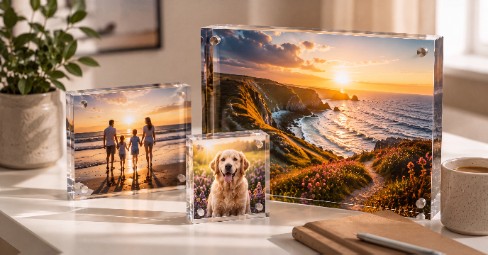
Some blocks come in two pieces held together by magnets, with a paper print sandwiched between them, so you can change the photo whenever you like. You trade a little of the sealed-in depth effect for flexibility. Our snow globe photo frame works on a similar swap-friendly idea: a 15 x 10cm print sits behind thick acrylic in a glitter-filled frame, and you can replace the photo with any other 10 x 15cm print whenever you fancy a change.
Photo blocks with text
Many printers, including us, let you add names, dates or a short message to the design in the online editor before ordering. Popular for wedding dates, new baby details and memorial keepsakes. The text is printed as part of the image, so proofread it carefully before you order.
Wooden photo blocks
The same free-standing idea, but printed directly onto a chunk of natural wood. The grain shows through the print for a warm, rustic look. Lovely in country-style rooms, though you lose the glassy depth effect that makes acrylic special.
Acrylic Block vs Acrylic Print vs Glass Block vs Photo Frame
These four products get mixed up constantly, so here is the clearest way to think about them.
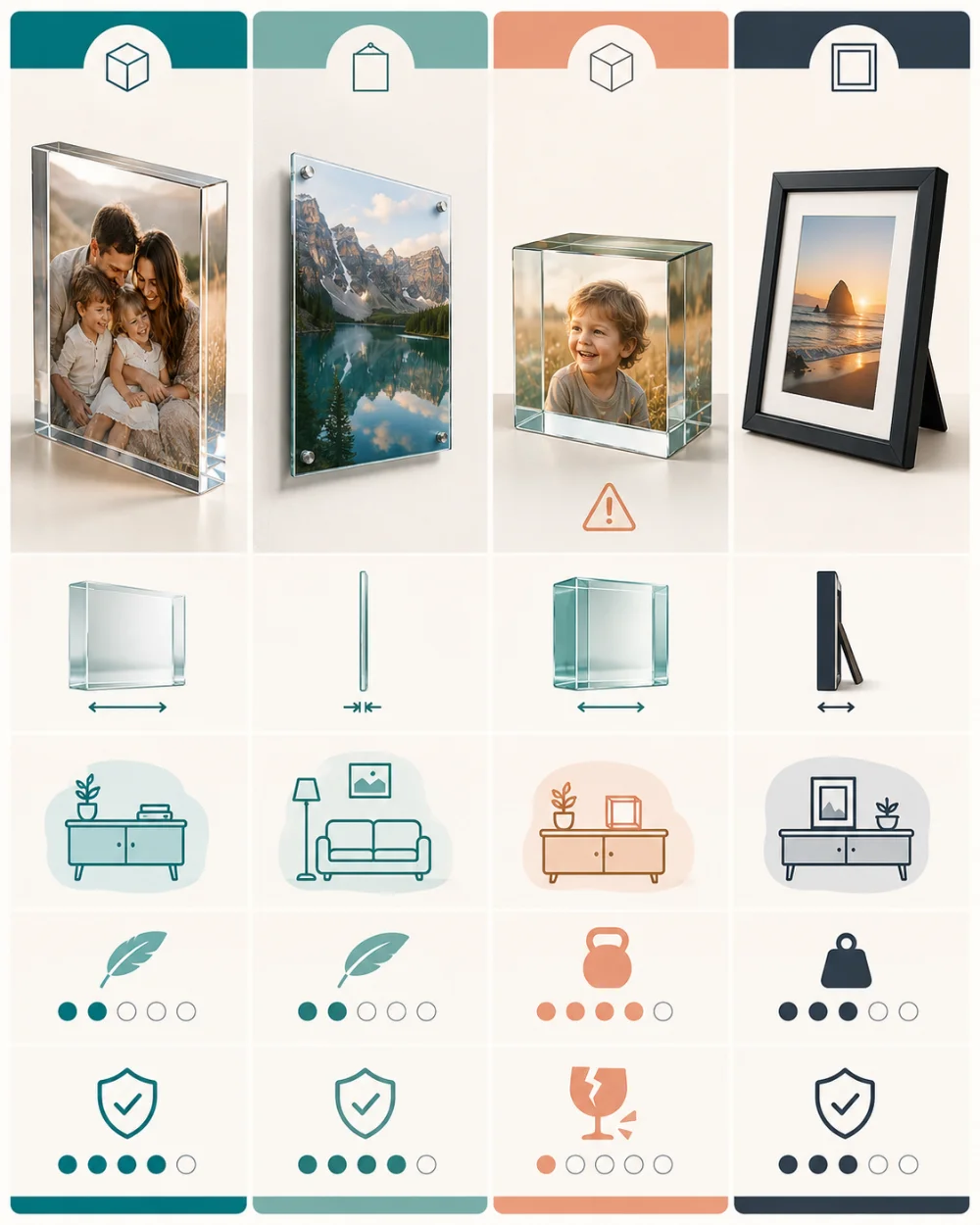
An acrylic photo block is thick (16 to 25mm) and free-standing. It lives on a desk, shelf or mantelpiece.
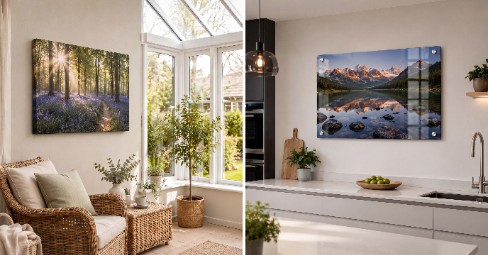
An acrylic print is thin, around 3mm, and hangs on the wall using a hidden fixing that makes it appear to float. Same glossy, glassy look, but it is wall art. If that is what you are after, our acrylic photo prints start from £13, and our blog post on what an acrylic print is explains the construction in detail.
A glass photo block looks almost identical to an acrylic block but is made from real glass. It is roughly twice the weight, and if it falls off a shelf it can shatter into sharp pieces.
A traditional photo frame holds a paper print behind a thin sheet of glass or plastic, with a border and a stand or hook. Cheapest option, and the only one where swapping the photo takes seconds.
Feature
Acrylic photo block
Acrylic print (wall)
Glass photo block
Photo frame
Where it goes
Desk, shelf, mantelpiece
Wall
Desk, shelf
Wall or desk
Thickness
16–25mm
About 3mm
15–25mm
Varies
Needs fixings?
No, free-standing
Yes, hidden hanger
No, free-standing
Hook or fold-out stand
Depth / 3D effect
Strong
Medium
Strong
None
Weight
Light for its size
Very light
Heavy
Light
Break risk
Very low
Low
High, can shatter
Glass front can smash
Swap the photo?
No, sealed in
No
No
Yes, in seconds
Typical UK price
£6–£34
£13 upwards
£15–£40
£5 upwards
Best for
Desk keepsakes, gifts
Statement wall art
Same look, more risk
Photos you change often
The short version: pick a block for a surface, pick a print for the wall, and pick acrylic over glass if weight and safety matter to you. If you love rotating your photos every few weeks, a frame still earns its place.
Acrylic Photo Block Sizes and Weights in the UK
UK blocks come in a sensible spread of sizes, from pocket-sized minis to a proper 20 x 20cm centrepiece. Here are the sizes we make, all in a full 25mm depth, along with the approximate weight of each, because a solid block has more heft than people expect.
Size
Shape
Approx. weight
Good for
5 x 5cm (MIXBLOX)
Square mini
Under 100g
Grouping several together
10 x 10cm
Square
About 300g
Desk or bedside table
15 x 10cm
Landscape or portrait
About 450g
A shelf or windowsill
20 x 15cm
Landscape or portrait
About 900g
Mantelpiece centrepiece
20 x 20cm
Large square
About 1.2kg
Statement desk or shelf piece
Across the wider UK market you will also see blocks sold in inches (4x4, 5x5, 6x4, 7x5, 8x6) and in A-sizes like A6 and A5. Thickness varies too: budget blocks are often 16mm, mid-range 20mm, and premium blocks 25mm. Thickness is worth checking before you buy, because it drives both the depth effect and how solid the block feels in the hand.
One thing to watch: a few products sold as "acrylic photo blocks" online are actually a thin 5mm acrylic pane that clips into a separate plastic stand. They are fine for the price, but they are not the solid block this guide describes, and they will not give you the depth effect. If the listing does not state the thickness, ask. For a wider look at how photo dimensions work in this country, our guide to standard photo sizes in the UK covers every common format in cm and inches.
Where to Display an Acrylic Photo Block (and How to Style It)
Because a block stands on its own, it works almost anywhere flat. These are the spots where blocks earn their keep in British homes.
A work desk. The classic spot. A block of the kids, your partner or the dog takes up less room than a framed photo because there is no stand leaning backwards, and it survives the occasional knock from a coffee mug.
A shelf or bookcase. Blocks sit happily among books and plants. Two or three different sizes together look far more natural than one on its own.
A mantelpiece. A single 20 x 20cm block makes a warm centrepiece. Pair it with a candle or a small vase rather than crowding it.
A bedside table. Small blocks are ideal here, and there is no glass to worry about if it gets knocked off in the dark.
A windowsill. Light passing through the polished edges looks beautiful. Just avoid a spot that gets harsh, direct sun all day, which protects the colours over the long term.
Three quick styling rules
Odd numbers look best. One statement block, or a group of three or five minis, reads as deliberate. Pairs can look like leftovers.
Vary the heights. If you group blocks with other objects, mix heights: block, small plant, stack of two books. Flat rows of same-height objects look stiff.
Give it breathing room. A block is a small object with a big presence. Leave a hand-width of empty surface around it and it will draw the eye far better than it would in clutter.
What Photo Resolution Do You Need?
Good news first: blocks are small, so you do not need a huge file. The printing rule of thumb is at least 150 dots per inch (DPI) for a sharp result at normal viewing distance, and 300 DPI if you want it perfect from close up. To work out the pixels needed, divide the size in centimetres by 2.54, then multiply by the DPI. We have done the maths for our sizes below, showing the longer edge.
Block size
Minimum (150 DPI)
Ideal (300 DPI)
In practice
5 x 5cm
About 300 px
About 590 px
Any phone photo ever taken
10 x 10cm
About 590 px
About 1,180 px
Any modern phone
15 x 10cm
About 890 px
About 1,770 px
Any modern phone
20 x 15cm
About 1,180 px
About 2,360 px
Any modern phone
20 x 20cm
About 1,180 px
About 2,360 px
Any 8-megapixel-plus phone
In real life, almost any photo taken on a phone in the last decade will print beautifully at block sizes. The pictures that let people down are heavily zoomed shots, screenshots, and images saved small from social media or WhatsApp, which compresses photos hard. Always go back to the original file if you can. The simple test: if it looks sharp on your phone screen when you zoom in a little, it will look sharp on the block.
How to Choose the Right Photo
A block rewards a bold, well-lit photo, so it is worth a minute of thought before you upload.
Go for colour and contrast. You are viewing the image through thick acrylic that amplifies richness, so punchy, well-lit photos shine. A golden-hour beach shot or a colourful portrait beats a dull, grey one.
Faces work brilliantly. The depth effect gives portraits a lovely presence. Close-up faces, in particular, seem to come alive.
Keep key details away from the edges. A small amount of the image sits close to the polished sides, so centre your subject rather than pushing faces to the corners.
Simple backgrounds win. At desk sizes, a busy background just becomes noise. A clean backdrop lets your subject take the stage.
Black and white looks superb. The glassy depth adds drama to a mono photo, and black and white sits comfortably in any room, whatever the colour scheme.
The Pros and Cons, Honestly
We make these for a living, but a block is not right for everyone, and pretending otherwise helps nobody. Here is the fair picture.
The good
Free-standing, so there is no frame to buy, no drilling and nothing to assemble.
A genuine 3D depth effect that flat prints and framed photos simply cannot match.
Acrylic is roughly half the weight of glass (its density is about 1.19 g/cm³ against roughly 2.5 g/cm³ for glass) and many times more impact-resistant, so it shrugs off the knocks of a busy home.
Safe around children and pets: if it does take a fall, it will not shatter into sharp shards the way glass can.
Colours look deeper and more vivid through clear acrylic, which transmits up to 92% of visible light, slightly more than standard window glass.
Copes with normal household humidity better than paper prints or canvas.
The trade-offs
Bare acrylic is softer than glass, so it scratches more easily if cleaned roughly. A quality block reduces the risk with a scratch-resistant laminate, but gentle cleaning is still the rule.
It costs more than a paper print or a basic frame, so it is a keepsake purchase rather than a way to print fifty holiday photos.
In most designs the photo is sealed in for good. If you like changing pictures every month, a frame or a swap-style block suits you better.
The glossy surface picks up fingerprints, and in very bright rooms you will see some reflection at certain angles.
Large blocks have real weight. A 20 x 20cm block at around 1.2kg is a solid object, so give it a stable spot.
How to Clean and Care for an Acrylic Photo Block
Acrylic is easy to keep gleaming, but it is not glass, so the window spray stays in the cupboard. Follow these rules and your block will stay crystal clear for years.
Do
Don't
Dust it regularly with a soft, dry microfibre cloth, using a light touch.
Never use glass cleaner, ammonia sprays, alcohol or solvent-based products. They can permanently cloud or craze acrylic.
For marks and fingerprints, use a damp microfibre cloth with lukewarm water, and a tiny drop of mild washing-up liquid if needed.
Never use paper towels, tissues or tea towels. Their fibres are abrasive enough to leave fine scratches over time.
Wipe gently and let the cloth do the work rather than pressing hard.
Never wipe a dry, dusty block, because dragged dust acts like sandpaper. Lift the dust off gently first.
Dry with a second clean microfibre cloth to avoid water spots on the polished surface.
Keep the block away from radiators, steamy bathrooms and harsh all-day direct sunlight.
If a light scratch does appear on bare acrylic, a dedicated plastic polish will often buff it out, which is a repair you can never make on glass. The same gentle-cleaning rules apply to wall-hung acrylic too, and if you are hanging the wall version our step-by-step guide on how to hang acrylic prints walks through both fixing systems.
UK Pricing: What Should You Expect to Pay?
Prices vary widely, and most of the variation comes down to three things: size, thickness, and whether the block is direct-printed or face-mounted in a specialist lab. As a rough map of the UK market in 2026:
Mini blocks (around 5cm): from about £6 each.
Small blocks (around 10cm): from about £6.50 at high-street photo printers, though often in thinner 16mm acrylic.
Medium blocks (13–15cm): roughly £10 to £19 depending on thickness and printer.
Large blocks (20cm and up): roughly £20 to £34.
Premium face-mounted blocks: from around £23 upwards at specialist labs, rising quickly with size.
Here is our own price list for the full-size acrylic photo block, all in 25mm hand-polished acrylic with the scratch-resistant laminate. We show the typical Retail Price next to our Factory Price, which is what you pay when we deliver straight from our own production.
Size
Retail Price
Factory Price
10 x 10cm
£55.90
£14.00
15 x 10cm
£75.90
£19.00
20 x 15cm
£95.90
£24.00
20 x 20cm
£135.90
£34.00
Two tips for comparing prices anywhere. First, check the thickness: a cheaper block is often a thinner block, and thinner acrylic means less of the depth effect you are buying it for. Second, check delivery costs, because a low headline price can climb once postage is added. For reference, we ship free on UK orders over £49, and our Lowest Price Guarantee means that if you find the same product cheaper at another UK online shop, we beat that price by 5%.
Acrylic Photo Blocks as Gifts
Blocks have become one of the most-given photo gifts in the UK for a simple reason: they feel premium, they cost less than most premium-feeling gifts, and the person can enjoy them the moment the wrapping comes off. No hooks, no drilling, no finding a frame to fit.
The occasions where they work best:
Mother's Day and Mum's birthday. A block of the kids or grandkids is about as safe as gift-giving gets.
Anniversaries and Valentine's Day. The wedding day, or the place you met. Adding the date as printed text makes it feel properly made for the occasion.
New baby. First photos and tiny feet look gorgeous with that glassy depth. A lovely gift for new grandparents, too.
Father's Day. A block for the desk at work is the modern version of the photo in the wallet.
Graduations and leaving gifts. A team photo or a proud graduation shot, small enough for any desk.
Memorial keepsakes. A quiet, lasting way to keep a loved one, or a much-missed pet, close by.
Do Acrylic Photo Blocks Fade or Yellow?
A fair question, because everyone has seen old plastic turn yellow. The answer depends on the quality of the acrylic and the inks. Cheap, low-grade plastics can yellow with years of UV exposure. Quality cast acrylic is UV-stable, and modern UV-cured pigment inks are formulated to resist fading. Kept in normal indoor light, a well-made block will look the same in ten years as it does on day one.
You can protect any block, whoever makes it, with two habits: keep it out of harsh, all-day direct sunlight, and keep it away from constant heat sources like radiator shelves. Both rules apply to every printed photo product, from canvas to framed prints, and they cost nothing to follow.
On the environmental side, acrylic is a plastic, and it is fair to weigh that. It cannot go in your kerbside recycling bin, though PMMA is recyclable through specialist routes. The honest counterpoint is longevity: a block made to order, kept and displayed for decades, creates far less waste than cheap decor bought and binned every couple of years. Like all our products, our blocks are made to order, so nothing is printed that has not already found a home.
Acrylic photo blocks: quick facts
An acrylic photo block is a free-standing photo display made from solid clear acrylic (PMMA), typically 16 to 25mm thick.
Common UK sizes: 5 x 5cm, 10 x 10cm, 15 x 10cm, 20 x 15cm and 20 x 20cm.
Typical UK prices in 2026: about £6 for a 5cm mini block to about £34 for a 20 x 20cm premium block.
Acrylic transmits up to 92% of visible light, slightly more than standard glass, which is why colours look so vivid.
Acrylic is about half the weight of glass (roughly 1.19 g/cm³ vs 2.5 g/cm³) and many times more impact-resistant, but its bare surface scratches more easily.
Perspex and Plexiglas are brand names for the same material as acrylic.
A 20 x 20cm block at 25mm thickness weighs about 1.2kg; the same block in glass would weigh about 2.5kg.
Minimum recommended print resolution is 150 DPI, with 300 DPI ideal; a 20cm edge needs about 1,180 to 2,360 pixels.
Clean acrylic only with a soft damp microfibre cloth; glass cleaners and ammonia can permanently cloud it.
The Bottom Line
An acrylic photo block turns one favourite photo into a solid, glassy keepsake you will see every single day, with nothing to hang, frame or assemble. It is lighter and safer than glass, kinder to your photo than a cheap frame, and at £14 to £34 for a full-size block it sits comfortably in gift territory without breaking the bank.
Pick the size to suit the spot, choose a bright, sharp photo with the subject in the middle, and clean it with nothing rougher than a microfibre cloth. Do that, and it will still be earning its place on the desk long after most decor has come and gone. And if you fall for the acrylic look and want it bigger and on the wall, the wall-hung acrylic print is the same finish, sized up.
Frequently Asked Questions
What is an acrylic photo block?
An acrylic photo block is a thick, free-standing piece of clear acrylic with your photo printed on or behind it. It stands on a desk, shelf or mantelpiece with no frame, stand or fixings, and the chunky acrylic creates a glass-like depth effect that makes the image look almost three-dimensional.
What is the difference between an acrylic block and an acrylic print?
An acrylic block is thick, usually 16 to 25mm, and stands on its own on a flat surface. An acrylic print is thin, around 3mm, and hangs on the wall using a hidden floating fixing. They share the same glossy, glassy finish, but the block is a desk piece and the print is wall art.
Are acrylic photo blocks the same as glass photo blocks?
No. They look almost identical, but an acrylic block is made from clear PMMA plastic while a glass block is real glass. Acrylic is about half the weight, transmits slightly more light, and is far harder to break. Glass is heavier, feels colder, and can shatter into sharp pieces if dropped.
Is acrylic the same as Perspex or plexiglass?
Yes. Acrylic, Perspex and Plexiglas are all the same material, a clear plastic called PMMA. Perspex is a brand name commonly used in the UK, and Plexiglas is the equivalent brand name abroad. A Perspex photo block and an acrylic photo block are the same type of product.
Do acrylic photo blocks need a frame or a stand?
No, and that is the main appeal. The acrylic is thick enough for the block to stand securely on its own on any flat surface, so there is no frame, no fold-out stand and no hanging hardware. You take it out of the box, place it where you want it, and you are done.
How thick is an acrylic photo block?
Most UK acrylic photo blocks are between 16mm and 25mm thick. Budget blocks are often 16mm, mid-range blocks 20mm, and premium blocks 25mm. Ours are a full 25mm. Thickness matters because it drives the depth effect and how solid the block feels, so always check it before buying.
How heavy is an acrylic photo block?
It depends on the size. At 25mm thickness, a 10 x 10cm block weighs about 300g, a 20 x 15cm block about 900g, and a 20 x 20cm block about 1.2kg. That is roughly half what the same blocks would weigh in glass, but still solid enough to sit firmly without tipping.
How do you clean an acrylic photo block?
Dust it with a soft, dry microfibre cloth, and for marks use a damp microfibre cloth with lukewarm water and a drop of mild washing-up liquid. Never use glass cleaner, ammonia, alcohol or paper towels, as these can scratch the surface or permanently cloud the acrylic over time.
Do acrylic photo blocks scratch easily?
Bare acrylic is softer than glass, so it can pick up fine scratches if wiped roughly or cleaned while dusty. Good blocks add a scratch-resistant laminate over the print for protection. Treated gently with a microfibre cloth, a block stays clear for years, and light scratches on acrylic can often be polished out.
What size acrylic photo block should I get?
For a work desk or bedside table, 10 x 10cm or 15 x 10cm is ideal. For a mantelpiece or a statement spot on a shelf, choose 20 x 15cm or 20 x 20cm. If you want to display several photos together, 5 x 5cm mini blocks are designed to be grouped in rows or clusters.
What resolution photo do I need for an acrylic block?
Aim for at least 150 DPI at print size, with 300 DPI ideal. In pixels, that means roughly 590 to 1,180 pixels on the longer edge for a 10cm block, and 1,180 to 2,360 pixels for a 20cm block. Almost any photo from a modern phone comfortably clears these numbers.
Can you change the photo in an acrylic block?
Usually no. In a classic acrylic photo block the image is sealed to the acrylic permanently, so it cannot be swapped. If you want to change photos, choose a swap-friendly design instead, such as a magnetic two-piece block or a shaker-style acrylic frame where the print slides out and can be replaced.
Do acrylic photo blocks fade or turn yellow?
A well-made block should not. Quality cast acrylic is UV-stable and modern UV-cured inks resist fading, so a good block keeps its colour for many years indoors. Cheap, low-grade plastic can yellow over time. Whatever the block, keep it out of harsh all-day direct sunlight to protect it.
What is a 3D crystal photo block, and is it the same thing?
No, it is a different product. A 3D crystal block uses a laser to etch your photo as thousands of tiny white points inside solid glass, creating a ghostly engraved image with no colour. An acrylic photo block displays your actual photo in full colour with far more detail.
Are acrylic photo blocks a good gift?
Yes, they are among the most popular photo gifts in the UK because they feel premium, cost from around £6 to £34, and can be displayed the moment they are unwrapped. They suit birthdays, Mother's Day, anniversaries, new baby arrivals, graduations and memorial keepsakes equally well.
How long do acrylic photo blocks take to arrive in the UK?
It varies by printer. Our blocks are made to order, with production taking around two working days and UK delivery another three to six, so five to eight working days in total. Premium face-mounted blocks from specialist labs can take longer, so order early for a fixed date like Mother's Day.
Can an acrylic photo block go on the wall?
No. Blocks are made as free-standing pieces for desks and shelves, and they have no wall fixings, so there is nothing to hang them by. If you want the acrylic look on a wall, choose an acrylic print instead, which is thin, light and hangs from a hidden floating bracket.