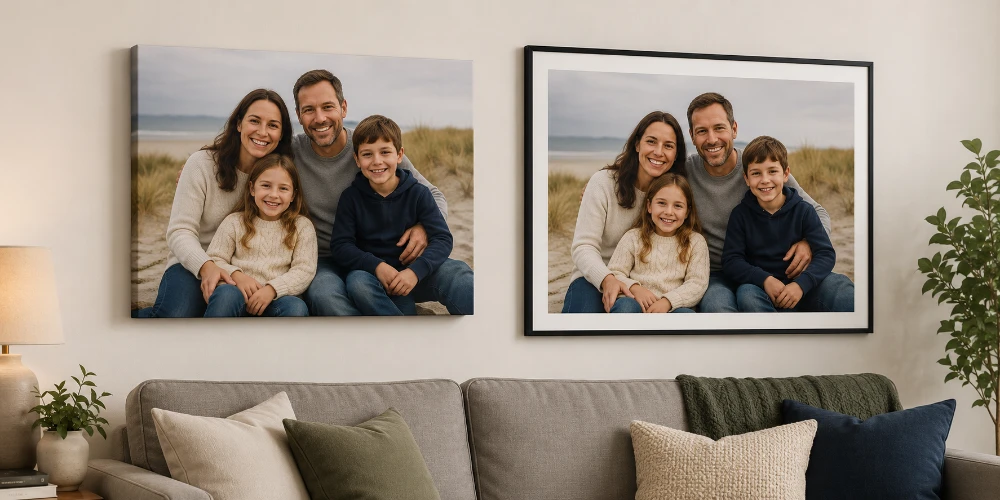
You have found the perfect photo. Now comes the question that catches almost everyone out: should it go on your wall as a canvas print or a poster? They can show exactly the same image, yet they look, feel, cost and last completely differently.
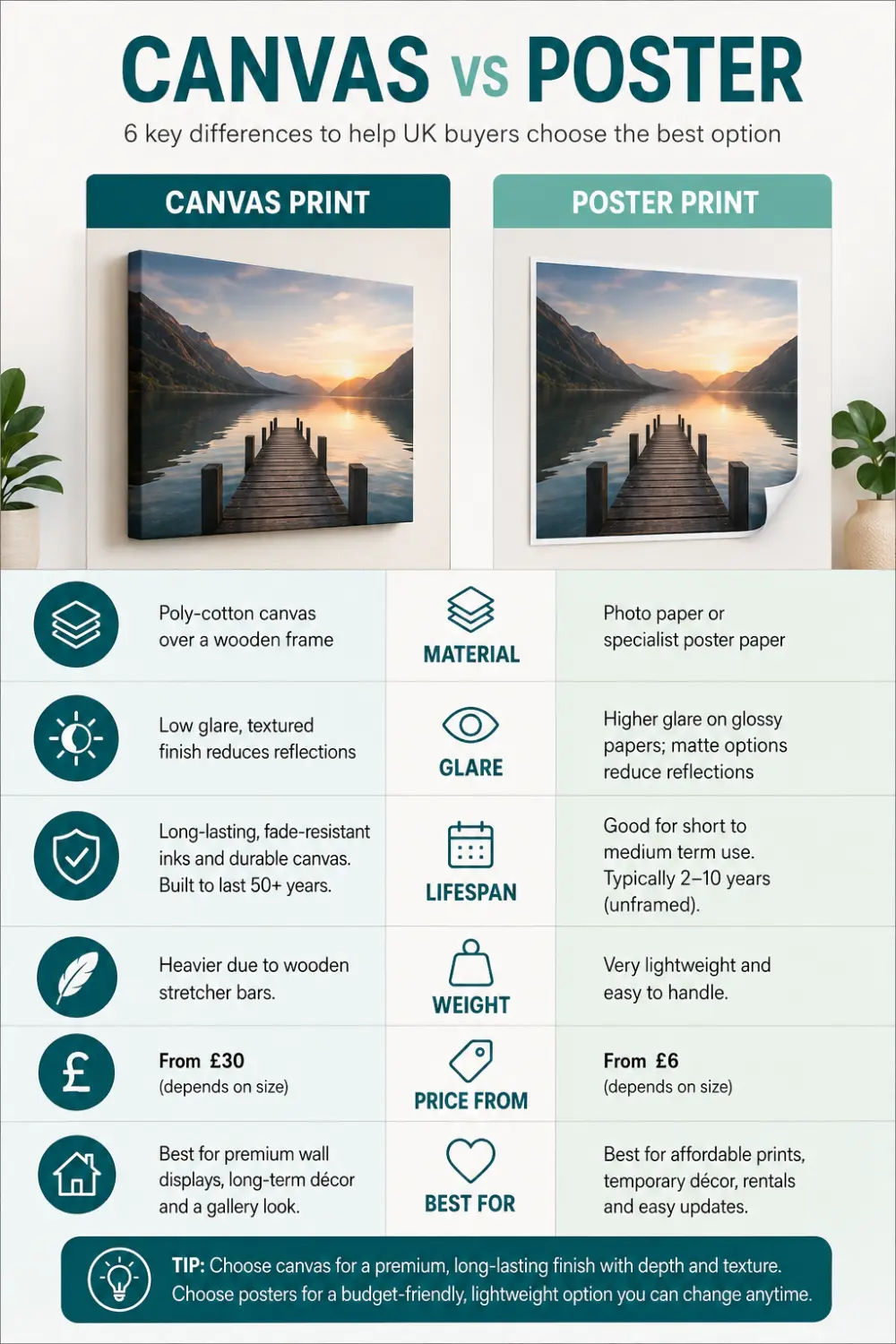
Here is the short answer. A canvas print is your photo printed on woven fabric and stretched over a wooden frame, so it arrives ready to hang with no extra framing needed. A poster is the same image printed on a flat sheet of photo paper. Canvas lasts far longer and looks finished on its own. Posters cost less and are easier to swap, move and store.
The rest of this guide unpacks that answer properly — with real UK prices, honest pros and cons for both, and a simple way to decide which one suits your wall.
Key Takeaways
Posters win on price and flexibility. Photo posters start from around £3, weigh almost nothing and are easy to swap or take with you when you move.
Canvas wins on lifespan and presence. Printed with HP Latex inks rated to resist fading for at least 75 years indoors, a canvas needs no frame and no glass.
The hidden cost is the frame. A poster usually needs one to look finished — and a decent wooden A1 frame (£40–£58 in the UK) can cost more than a canvas of the same size.
Glare is the difference you notice daily. Posters behind glass reflect windows and lamps. Canvas has a matte woven surface that stays clear from every angle.
There is no single winner. The right choice depends on the room, the image, your budget and how long you want it on the wall. The table below settles most decisions in ten seconds.
Canvas vs Poster at a Glance
Canvas print
Poster print
Material
Woven poly-cotton fabric stretched over a pine frame
Flat sheet of 275g/m² matt photo paper
Surface and glare
Matte, textured, no glare from any angle
Matt paper is low-glare; glass or gloss adds reflections
Frame needed?
No — gallery-wrapped and ready to hang
Usually yes, to look finished and stay flat
Typical lifespan
75+ years with HP Latex inks, out of direct sun
Around 2–5 years on display before fading or curling
Weight and hanging
Light (roughly 400g at 30×40cm) — one hook or adhesive strips
Nearly weightless bare; heavy once framed with glass
Price from (UK)
£4.50 (20×20cm)
£3.00 (30×20cm)
Best for
Family photos, statement walls, gifts, anything long-term
Renters, kids' rooms, film and gaming art, frequent changes
What Is a Canvas Print?
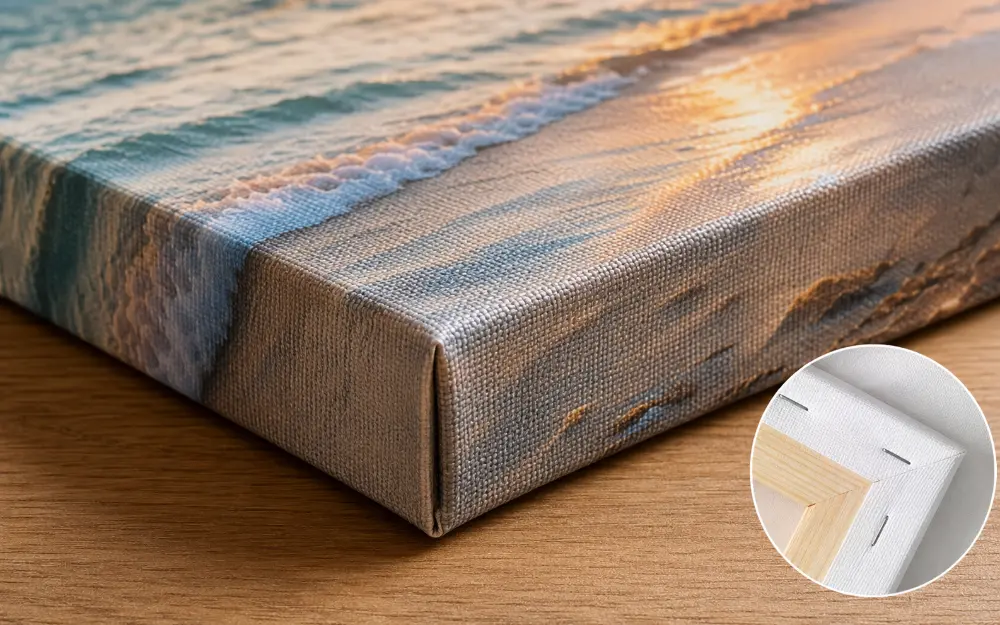
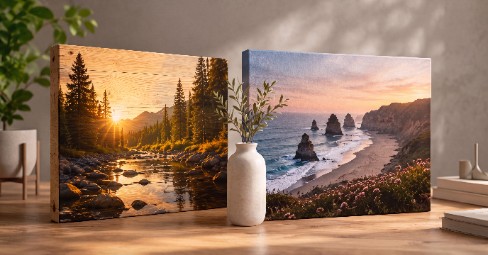
A canvas print is a photo printed directly onto woven fabric — usually a cotton and polyester blend — then hand-stretched over a wooden inner frame called a stretcher frame. The fabric wraps around the sides and fastens at the back, which is why this style is called gallery-wrapped. It looks finished from every angle, so there is nothing else to buy: no frame, no glass, no mount.
The weave is what gives canvas its character. It adds a soft texture that makes photos feel closer to paintings, and it scatters light instead of reflecting it. Our canvas prints are stretched on FSC-certified pine frames and printed with solvent-free HP Latex inks, in sizes from 20×20cm up to 120×80cm, with a choice of five edge designs — folded, mirrored, stretched, white or black.
Canvas prints: pros and cons
Pros:
Ready to hang out of the box — no frame, glass or mount to buy
HP Latex inks rated to resist fading for at least 75 years indoors
Matte woven surface with zero glare from any angle
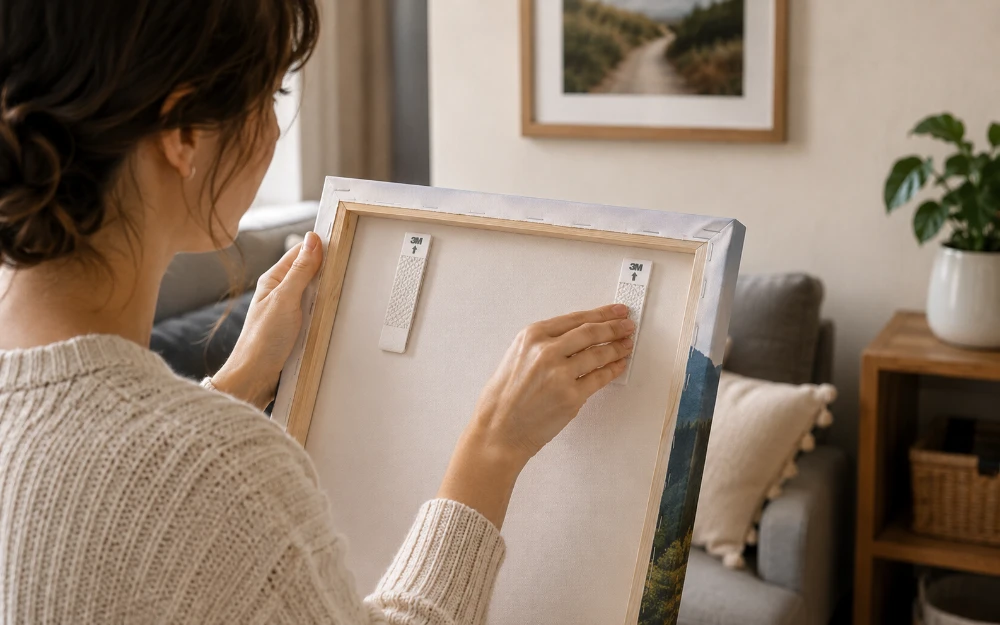
Light enough to hang on a single hook or adhesive strips
Texture flatters photos and hides minor softness in phone shots
Cons:
Costs more upfront than a bare poster
The weave slightly softens very fine detail and small text
Bulkier to store or transport than rolled paper
Not suited to steamy, unventilated rooms
What Is a Poster Print?
A poster print is your photo on a single flat sheet of paper. Simple — but paper quality varies enormously. Cheap shop posters are often printed on paper around 170g/m², which curls at the corners and feels flimsy in the hand. Many photo printers use paper in the 200–210g/m² range.
Our photo poster prints use a heavier 275g/m² matt photo paper, which hangs flatter and handles daily life better. There is also a self-adhesive version on 340g/m² paper that sticks straight to any smooth wall, peels off without a trace and can be repositioned — no frame, no nails, no drill.
The matt finish matters more than most people realise. Gloss paper makes colours pop but reflects every window and lamp in the room. Matt paper keeps colours accurate and cuts glare — which is why it has become the standard for wall posters.
Poster prints: pros and cons
Pros:
The cheapest way to get an image on a wall — from around £3
Nearly weightless, easy to swap, move, roll up and store
Smooth paper holds crisp detail, text and graphic art perfectly
Self-adhesive versions need no frame, nails or drill at all
Low-risk way to test an image or layout before committing
Cons:
Standard poster inks fade, yellow or curl within roughly 2–5 years
Looks casual and unfinished without a frame — which adds cost and weight
Vulnerable to tears, fingerprints, damp and Blu-Tack marks
Glass or gloss finishes reflect windows and lamps
Canvas vs Poster: Nine Differences That Actually Matter
1. Material and build
Canvas is a physical object with depth — fabric, wood, and a 2cm profile (4cm on XXL frames) that stands off the wall like a piece in a gallery. A poster is two-dimensional until you frame it. Neither is wrong; they simply do different jobs. Canvas brings texture and presence. Paper brings crisp flatness, which suits sharp graphic designs and text.
2. Surface and glare
This is the difference you will live with every day. A poster behind glass acts like a mirror: sit opposite a window and you will see the window, not the photo. Canvas fabric absorbs and scatters light, so the image stays clear from every seat in the room, under any lighting. If your wall faces a window or sits under spotlights, canvas solves a problem before it starts.
3. Durability and lifespan
Here the two formats are simply in different leagues. Standard poster inks have little resistance to UV light, so a displayed poster typically starts to fade, yellow or curl within 2–5 years. Canvas printed with HP Latex inks is a different story: HP's own permanence testing rates these prints to last over 60 years indoors away from direct sunlight, and our canvas prints are rated to resist fading for at least 75 years. Latex inks combine the stability of solvent-based inks while being non-toxic like water-based ones.
One practical note that applies to both: keep any print out of strong, direct sunlight. Even the toughest inks fade faster in a south-facing window.
4. Print quality, colour and resolution
Posters hold fine detail slightly better because paper is perfectly smooth — useful for text, maps and intricate line work. Canvas absorbs more ink into the weave, producing deeper, richer colour and hiding minor softness in a photo. That makes canvas the more forgiving choice for phone photos.
Forget the old "300 DPI" rule from magazine printing — wall art is viewed from a metre or two away, where 150 DPI looks sharp. Canvas is comfortable at 100–150 DPI because the texture masks soft edges. Here is what your camera can handle:
Print size
Poster (150 DPI)
Canvas (100–150 DPI)
Will a 12MP phone photo work?
30×20cm
~2 megapixels
~1 megapixel
Yes, easily
60×40cm
~8 megapixels
~4 megapixels
Yes, both formats
80×60cm
~13 megapixels
~6–8 megapixels
Tight on poster; fine on canvas
100×75cm
~21 megapixels
~8–12 megapixels
Canvas yes; poster needs a high-res camera
If you want to check a specific photo before ordering, our photo print resolution guide walks through it step by step.
5. Framing and hanging
A canvas arrives ready to hang — one picture hook and you are done. A poster involves decisions. Left bare, it needs poster clips, a hanger set or adhesive strips, and it will always read as casual. Framed, it looks far more finished, but the frame changes everything: a glass-fronted frame turns a weightless sheet of paper into something weighing 2–3kg that needs a proper wall fixing.
Glass itself is worth understanding. Standard picture glass blocks only around 45% of UV light, so a framed poster still fades — just more slowly. Conservation-grade glazing blocks up to 99%, but it costs serious money. If you want the finished, glazed look without the DIY, a framed photo print does the whole job in one — print, bevel-cut mount, acrylic glass and frame together, from £14.90.
6. Cost: the upfront price vs the real price
At first glance posters win on price without breaking a sweat: £3 vs £4.50 at entry level, and the gap widens with size. But the poster price is rarely the whole price. Add a frame and the sums often flip.
What you're buying
Poster route
Canvas route
60×40cm print
£7 poster
£24 canvas, ready to hang
Making it wall-ready
+ £10–£25 ready-made frame (or £40+ for a wooden frame)
+ £0
Realistic total
£17–£45+
£24
Cost over 10 years
Replace a faded poster 2–3 times
Still going strong — and for decades after
For big statement sizes the flip is even clearer. Wooden A1 frames typically cost £40–£58 in the UK before you have printed anything — more than an 80×60cm canvas at £38. Posters stay genuinely cheaper only if you skip the frame or use budget clip frames. That is a perfectly good choice for some rooms, as we cover below.
7. Look, feel and 2026 style
British walls are warming up in 2026. The big trends — texture, earthy tones, oversized single statement pieces — all play to canvas's strengths, and its painterly surface suits family portraits, landscapes and wedding photos beautifully. Posters own a different territory: film and music art, gaming prints, typography, botanical illustrations and the loose, layered gallery walls that are back in fashion. Photography leans canvas. Graphic art leans paper. That one line settles more decisions than any other.
8. Sustainability
Worth a thought in 2026, and a point almost no comparison covers. Our canvas frames use FSC-certified pine from responsibly managed forests, and HP Latex inks are water-based and solvent-free — no harsh chemical smell, safe for bedrooms and nurseries. Both formats are printed on demand rather than mass-produced for landfill, but longevity is the real green argument: a print that lasts 75 years replaces a dozen that last five.
9. Everyday care
Canvas needs almost nothing: a flick with a dry duster now and then. Avoid rubbing it with anything damp. Posters need more protection than care — fingerprints, Blu-Tack marks and corner tears are what shorten their lives, which is another argument for framing anything you want to keep.
Which to Choose, Room by Room
Living room
This is where guests look and where you spend your evenings, so it rewards the longer-term choice. A large canvas above the sofa — or a trio — gives the room a proper focal point with zero glare from the TV-watching seat. Posters work here too, but frame them; bare paper looks temporary in a room that is anything but.
Bedroom
Either works, and it depends on who sleeps there. For a calm adult bedroom, a canvas in soft tones above the headboard feels settled and permanent. For a teenager whose taste changes every school term, posters are the obvious answer — cheap to refresh, and self-adhesive versions leave the paintwork alone.
Kids' rooms and student rooms
Posters, almost every time. Interests change fast, walls take a beating, and at a few pounds each nobody minds when the dinosaur phase ends. Save the canvas for one photo that will outlast the phases — a newborn portrait or a family shot.
Home office
Think about your video-call background. A canvas or a neatly framed print reads as considered on camera, and a matte surface avoids the ring-light reflections that glass throws back. It is a small detail that colleagues notice more than you would think.
Kitchen and bathroom
Paper and steam are enemies — an unprotected poster in a bathroom will warp and spot within months. A coated canvas copes with a well-ventilated family bathroom, as we explain in our guide to hanging canvas prints in a bathroom, but keep it away from direct splashes. For genuinely humid rooms, an acrylic photo print is the safest bet of all — the sealed panel is moisture, scratch and UV resistant.
Renting? Read This Before You Choose
Nearly one in five households in England — around 4.7 million — rent privately, and most tenancy agreements frown on drilling. The good news: both formats can go up without a single hole in the wall.
Self-adhesive posters stick to any smooth wall, reposition easily and peel away without a trace when you move out. Nothing is more deposit-friendly.
Adhesive picture strips hold surprising weight: poster strips manage around 450g (plenty for bare paper), while large picture-hanging strips are rated to 7–9kg. A 30×40cm canvas weighs roughly 400g, so even a pair of small strips holds it with room to spare.
Moving day is easy too. Posters roll into a tube; a canvas is light enough to carry under one arm. Neither needs the bubble-wrap operation a glass frame demands.
The one to avoid is a big glass-framed poster — at 2–3kg it usually needs a proper fixing, which means a conversation with the landlord.
Rented homes are also more likely to have damp — it affects around one in ten privately rented properties — so paper posters in poorly ventilated rooms are a gamble. If a wall feels cold and the window drips in winter, choose canvas or acrylic for that spot.
What About Framed Prints and Acrylic?
Canvas and posters are the two ends of a spectrum, and there are two formats in between worth knowing. A framed print is essentially the "poster, finished for you" — crisp paper detail with the polish of a mount and frame, and the strongest choice for text-heavy or fine-detail images. Acrylic sits at the premium end: glossy, vivid, with a depth effect that suits bold colours and city shots. We compare the first pairing properly in our guide to canvas prints vs framed prints, if that is the decision you are really wrestling with.
Format
Character
From (UK)
Choose it when...
Canvas
Warm, textured, frameless
£4.50
You want longevity and presence with no glare
Poster
Flat, crisp, casual
£3.00
You want low cost and easy changes
Framed print
Sharp, formal, glazed
£14.90
You want paper detail with a finished look
Acrylic
Glossy, vivid, modern
£13.00
You want maximum punch, or art in a humid room
Getting the Size Right (Whichever You Choose)
Size mistakes are more common than format mistakes — and they apply equally to canvas and posters. Two rules solve nearly all of them.
The two-thirds rule: art above furniture should span roughly two-thirds of the furniture's width. Above a 180cm sofa, aim for around 120cm — one 100×75cm piece, or a trio of 40×30cm prints with gaps.
The 145cm rule: hang the centre of the artwork about 145cm from the floor — gallery-standard eye level. Most people hang art 15–20cm too high.
One format-specific note: a slightly-too-small canvas still looks deliberate because of its depth, while a too-small poster tends to look lost. If in doubt with a poster, go a size up or add a generous frame. And check your photo can handle the size using the resolution table above before ordering big.
The Verdict: A 30-Second Decision Checklist
Choose a canvas print if...
The photo matters — family, wedding, pets, travel memories you want on the wall for decades
The wall faces a window or sits under lamps, where glass would glare
You want it wall-ready out of the box, with nothing else to buy
It is a gift — a gallery-wrapped canvas arrives looking complete
Choose a poster print if...
Budget leads the decision, or you are covering a lot of wall for a little money
Tastes will change — kids' rooms, student rooms, seasonal swaps
The image is graphic art, typography or film-style artwork that suits crisp paper
You rent and want the lightest-touch option of all, especially self-adhesive
And if you are still torn: buy the poster now, live with the image for a few months, and print the keeper on canvas later. At these prices, testing an idea on paper first is a perfectly sensible strategy — it is what we would do.
One Photo, Two Very Different Walls
The same image can live on your wall as a five-pound experiment or a fifty-year fixture — and both are the right answer in the right room. Match the format to the job: paper for the walls that change, canvas for the photos that should not. Get that one decision right, and everything else about your wall art gets easier.
Why choose MY-PICTURE.CO.UK over other competitors?
Deciding between a textured canvas and a crisp poster print comes down to the look you want, but either way My-Picture.co.uk is the maker that does both justice. Both options carry our Lowest Price Guarantee, so if you find the same canvas or poster cheaper anywhere in the UK, we beat that price by 5%.
Whichever format wins you over, the finish stays first-rate. HP Latex printing gives our canvases and posters alike deep, true-to-life colour on materials chosen to last, which is a big part of why we top the Trustpilot rankings for UK photo-printing brands. Add speedy turnaround and support that responds properly, and the decision gets a lot easier.
*Ratings and prices correct as of August 2026. Prices exclude delivery; all brands run periodic promotions.
Frequently Asked Questions
What is the difference between a canvas print and a poster?
A canvas print is a photo printed on woven fabric and stretched over a wooden frame, so it hangs with no extra framing. A poster is the same image on a flat sheet of photo paper, which usually needs a frame, clips or adhesive strips to display well.
Is canvas better than a poster?
Canvas is better for longevity, glare-free viewing and a finished look straight out of the box. Posters are better for price, flexibility and graphic-style artwork. Neither is better outright — canvas suits photos you will keep for decades, while posters suit walls that change often.
Which lasts longer, a canvas or a poster?
Canvas lasts dramatically longer. Printed with HP Latex inks, a canvas kept out of direct sunlight is rated to resist fading for at least 75 years. A standard poster typically fades, yellows or curls within two to five years of display, faster in bright or damp rooms.
Do canvas prints look cheap?
A well-made canvas does not. Quality comes down to three things: a proper stretcher frame that keeps the fabric taut, fade-resistant inks, and a sharp source photo. Thin frames, watery inks and over-enlarged images are what make bargain canvases look cheap — not the format itself.
Is poster board the same as canvas?
No. Poster board is thick paper or card, used for lightweight prints and school projects. Canvas is woven fabric stretched over a wooden frame. They handle ink, light and time completely differently — canvas has texture and depth, while poster board stays flat and rigid but fades like paper.
Do posters need a frame?
Not strictly, but framing transforms them. A bare poster reads as casual and is vulnerable to tears, curling and fingerprints. A frame keeps it flat, protects the surface and makes it look intentional. Alternatives include poster clips, hanger sets and self-adhesive posters that need nothing at all.
Which is cheaper once you add a frame?
Often the canvas. A 60×40cm poster at £7 plus a £10–£25 ready-made frame totals £17–£32, while the same-size canvas costs £24 with nothing else to buy. At larger sizes wooden frames alone run £40–£58, more than many canvases. Posters stay cheaper only unframed.
Canvas or poster for a bedroom?
For a calm, settled adult bedroom, a canvas in soft tones above the headboard works beautifully and never glares under bedside lamps. For children's and teenagers' rooms, posters make more sense — they cost little, swap easily as tastes change, and self-adhesive versions protect the paintwork.
How long will a canvas print last?
Kept indoors and out of direct sunlight, a canvas printed with HP Latex inks is rated to resist fading for at least 75 years — HP's own permanence testing puts indoor life at over 60 years even without lamination. In practice, it will outlast most of the furniture around it.
Can I turn a poster into a canvas?
Not the physical poster itself — printed paper cannot be re-stretched as fabric. But if you have the original digital image, you can simply order it as a canvas print. If you only have the poster, a high-quality flat scan or photograph of it can work, though sharpness will drop.
What is a canvas poster?
It usually means a print on canvas fabric sold unstretched — rolled like a poster, without the wooden frame. It hangs with clips or magnetic rails for a relaxed look. It shares canvas texture but not the depth, tautness or ready-to-hang convenience of a gallery-wrapped canvas print.
What resolution do I need for a canvas vs a poster?
Wall art needs about 150 DPI at viewing distance, not the 300 DPI used for magazines. Posters need the full 150 DPI because smooth paper shows softness. Canvas is forgiving at 100–150 DPI, as the weave hides minor blur — so a 12-megapixel phone photo prints well up to around 100×75cm.
Can I hang a canvas or poster without drilling?
Yes, both. A lightweight canvas — roughly 400g at 30×40cm — hangs safely on adhesive picture strips rated well beyond that weight. Bare posters need only poster strips or clips, and self-adhesive posters stick straight to smooth walls and peel off cleanly. Heavy glass-framed posters are the exception.
Can I hang a canvas or a poster in a bathroom?
Posters are a poor fit — steam warps and spots unprotected paper within months. A coated canvas copes with a well-ventilated family bathroom if kept away from direct splashes. For genuinely steamy rooms or above a bath, a sealed acrylic print is the safest choice, being fully moisture resistant.
Is a matt or gloss poster better?
Matt is the safer choice for walls. It cuts glare from windows and lamps, hides fingerprints and gives colours a soft, accurate look from every angle. Gloss makes colours punchier but reflects light and marks easily, which is why matt photo paper has become the standard for displayed posters.
Do canvas prints look better framed or unframed?
A gallery-wrapped canvas is designed to hang unframed, and most look best that way — clean, modern and frameless. Adding a floating frame (also called a shadow-gap frame) suits traditional rooms and larger statement pieces, giving a subtle border without glass. It is a style choice, not a requirement.
What is the two-thirds rule for wall art?
The two-thirds rule says artwork above furniture should span roughly two-thirds of the furniture's width. Above a 180cm sofa, that means an arrangement about 120cm wide. It applies to canvas and posters alike, and stops art looking either lost on the wall or crammed above the sofa.
Are canvas prints or posters better for a gallery wall?
Both work, and mixing them adds depth. Posters keep large gallery walls affordable and easy to rearrange, while a canvas or two gives the display texture and an anchor point. Keep one thing consistent — colour treatment, theme or spacing — so the mix looks curated rather than random.