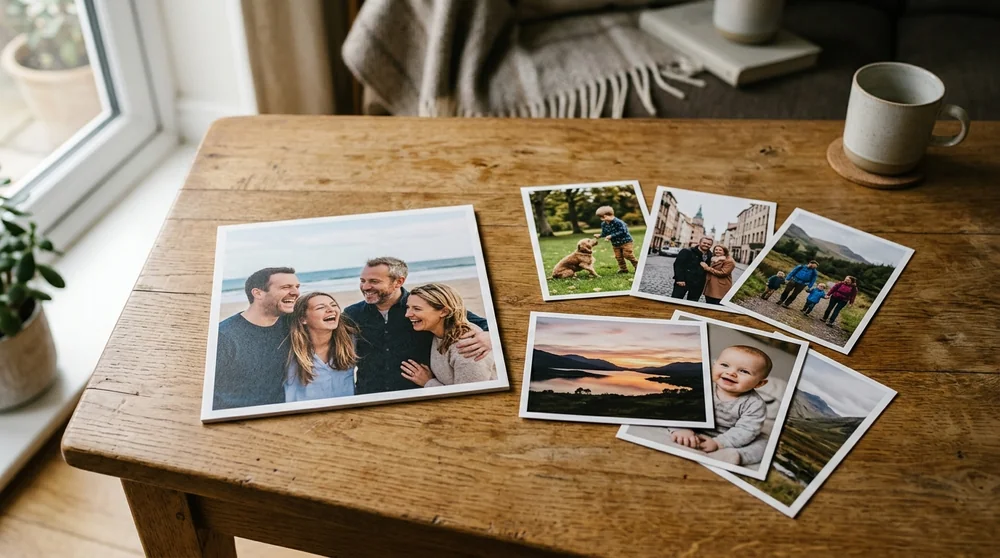
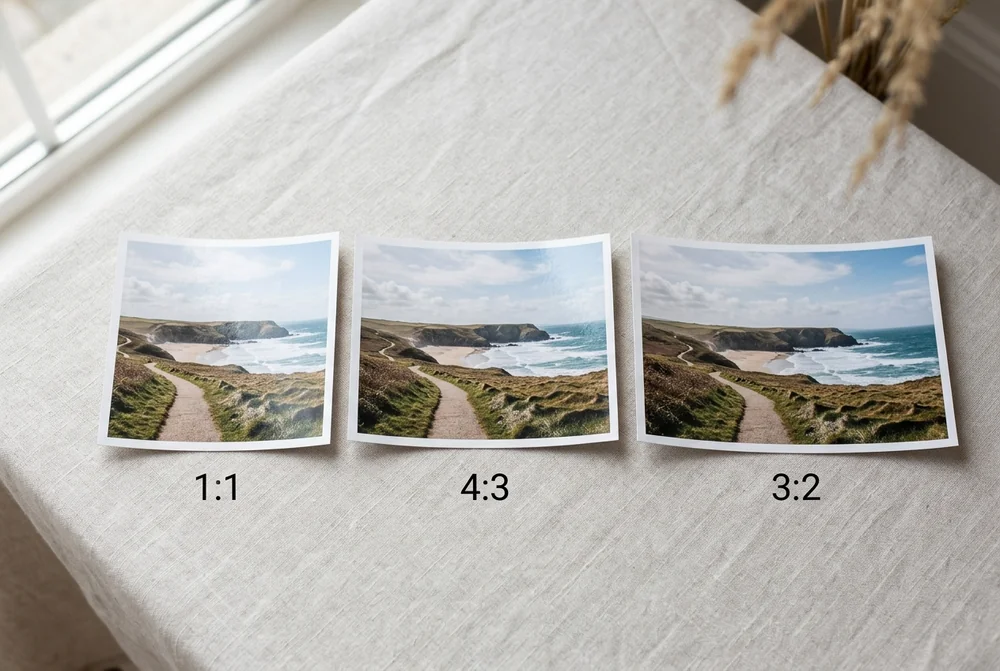
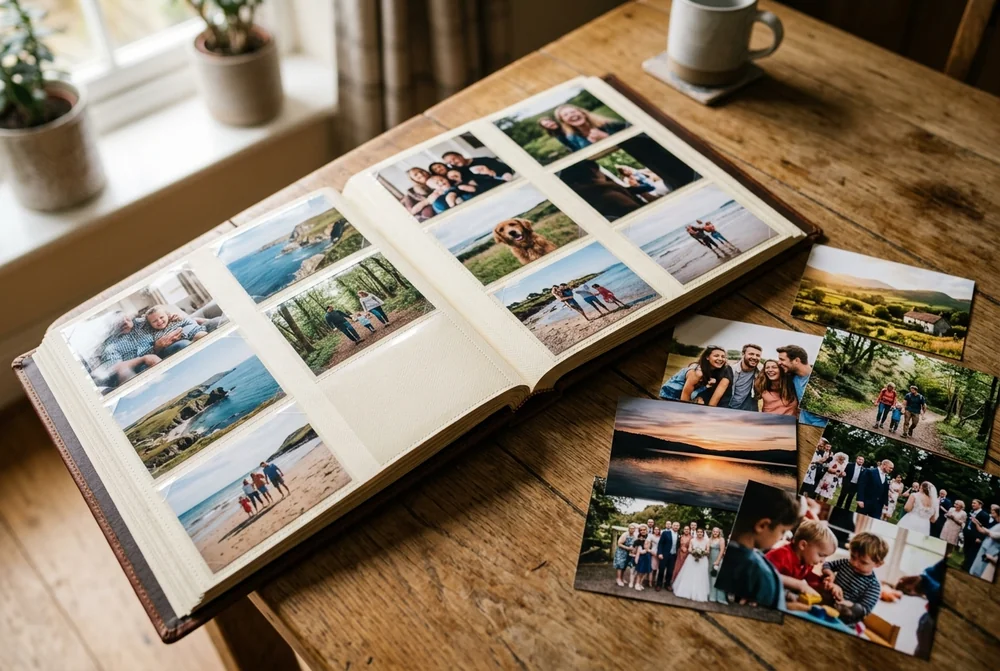
Choose a square print when the subject sits at the centre of the frame — portraits, pets, food, anything already cropped for Instagram — and a rectangular print when the composition needs room: landscapes, groups and full scenes. Most phone photos are rectangles, so the real decision is usually what a square crop would cut.
The shape question gets less attention than paper finish or size, yet it decides more. A rectangle keeps everything your camera captured; a square asks you to give something up in exchange for symmetry. Knowing which trade you are making — before the order, not after the envelope arrives — is the whole game.
This guide compares the two formats on what actually differs: what each shape does to a composition, what UK sizes exist in centimetres and inches, what each route costs, and how to run the crop check that catches most bad orders.
The short version
Square suits centred subjects. One focal point, symmetry, grids and Instagram-era photos. The square frame pulls the eye to the middle rather than side to side.
Rectangles protect the full frame. Phone cameras shoot 4:3 and dedicated cameras 3:2, so a rectangular print keeps the whole scene. Standard 10×15cm (6×4") prints start from £0.08 at MYPICTURE.
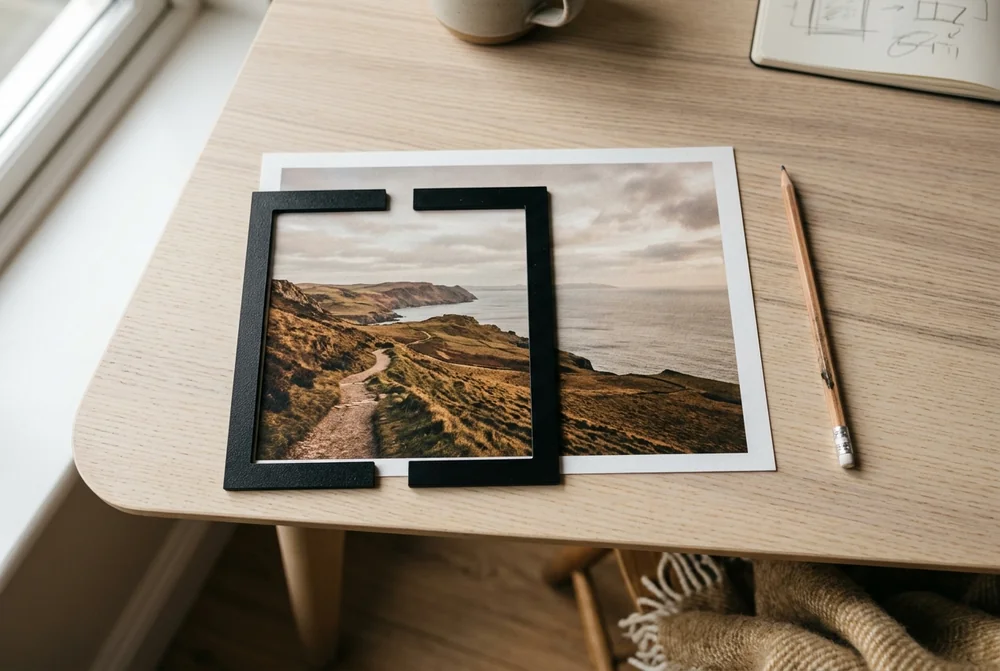
The crop decides it. Squaring a 4:3 photo removes about a quarter of the image; squaring a 3:2 photo removes about a third. If faces, hands or key detail live near the edges, stay rectangular.
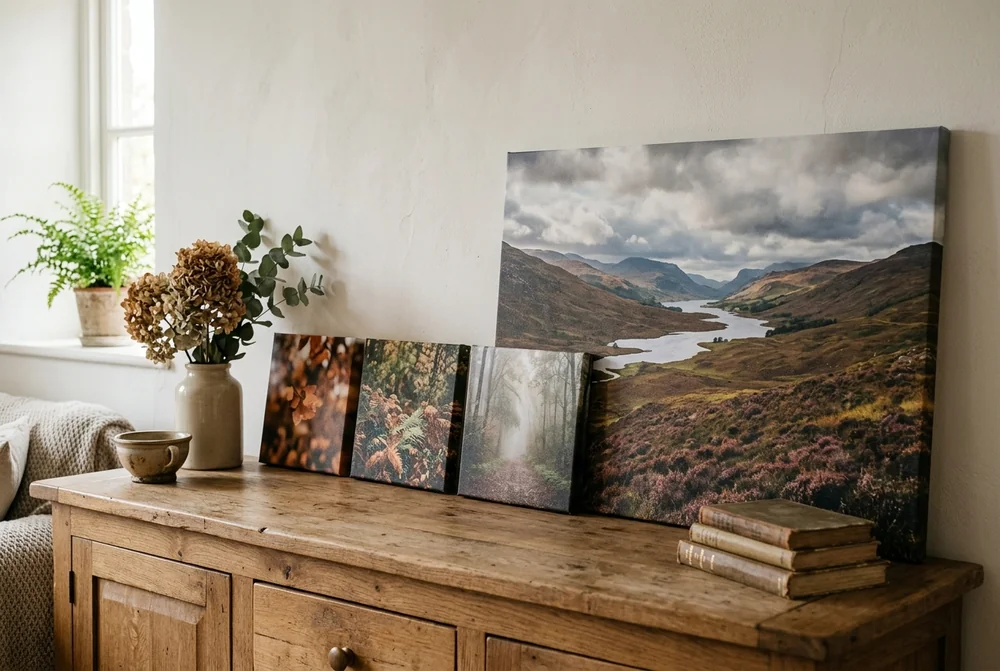
Squares are cheap to try on the wall. A 20×20cm square canvas is £4.50, a 40×40cm is £20.00, and MIXPIX® photo tiles start from £5.00 — low-risk ways to test the format before committing to a large piece.
Whichever you choose, save the square crop as a copy and keep the uncropped original. One intact file supports every future format; a cropped-over original supports none.
Why the shape of your print still matters
Every photo you take already has a shape. iPhones and most Android phones capture 4:3 by default, dedicated cameras capture 3:2, and the classic 10×15cm (6×4") print matches that 3:2 camera ratio almost exactly. The square is the outlier — it comes from medium-format film cameras and, more recently, from Instagram, which built its early feed entirely on 1:1 images.
The shape changes how a photo reads, not just how it fits a frame. In a rectangle the eye travels along the long edge; in a square it circles the centre, which is why square framing rewards a single, clearly placed subject. The photography press has made this case well — DPReview's guide to square format shows how architecture, still life and posed portraits thrive in a 1:1 frame while dynamic, directional scenes fight it.
The square is a deliberate minority choice rather than a default, which is exactly why deciding it photo by photo pays off.
None of that makes one shape better. It makes each shape better at different photos — which is a sorting problem, and the rest of this guide is the sort.
Square prints: what they do well, and where they struggle
First, the honest product picture. MYPICTURE does not sell a fixed small square print the way some rivals do — there is no 4×4" packet on the shelf. Squares happen two ways instead. On paper, the photo prints configurator offers variable formats with a fixed height of 9, 10, 11, 13 or 20cm and a width that follows your image's aspect ratio — upload a 1:1 image and you get a true 13×13cm or 20×20cm square. On the wall, square canvas prints run from 20×20cm at £4.50 through 40×40cm at £20.00 and 60×60cm at £36.00 up to 80×80cm at £48.00, hand-stretched on 2cm FSC-certified pine frames (4cm XXL for large sizes) and printed with solvent-free HP Latex inks.
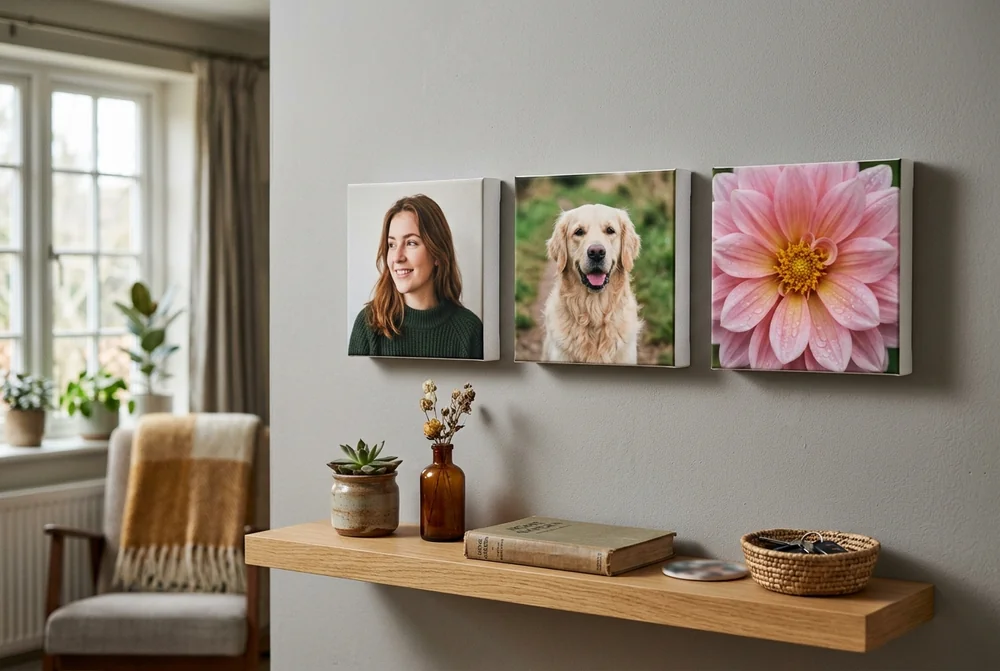
What squares do well: they have no orientation, so a set of them arranges itself. A grid of three 20×20cm canvases above a desk, a nine-tile MIXPIX® wall, a run of square prints along a picture ledge — every piece rotates and swaps without breaking the layout. They are also the native home of an Instagram archive: a 1:1 post prints edge to edge with nothing invented and nothing lost. And because the square frame centres attention, a single face, a pet, a plate of food or an architectural detail often looks stronger squared than it did in the original rectangle.
Where they struggle: everything that is not centred. A landscape squeezed into a square loses its horizon; a group photo loses the people at the ends; anything composed to lead the eye across the frame loses the lead. And if what you want is a stack of small fixed-size square prints for an album, rivals genuinely serve that better — Snapfish and Photobox both sell dedicated 4×4" and 5×5" square print products. We compare the main UK services honestly in our best online photo printing round-up.
Rectangular prints: what they do well, and where they struggle
Rectangles are the default for a reason: they are the shape your camera already chose. MYPICTURE's standard photo printing range covers 11 fixed formats from 9×12cm up to 20×30cm, on premium photo paper in matte or gloss at the same price, printed with 12-colour technology. Prices start at £0.07 for 9×12cm, £0.08 for the classic 10×15cm (6×4"), £0.13 for 13×18cm (7×5") and £0.44 for 20×30cm (8×12"). The minimum order is 20 prints, standard UK delivery is 3–5 working days including production, and delivery is free over £49.
What rectangles do well: they keep the whole composition. A 3:2 camera file drops into a 10×15cm print with essentially no crop, and the panorama-friendly variable widths handle wide scenes without cutting them. Albums, off-the-shelf frames and multi-aperture mounts are overwhelmingly built for rectangles, so a rectangular print slots into the display ecosystem the UK already owns. For groups, landscapes and storytelling scenes there is no contest.
Where they struggle: consistency. A shoebox of mixed portrait and landscape rectangles is harder to arrange into a clean grid than a stack of squares, and a wall of mismatched orientations needs planning that squares simply do not. A rectangle also carries dead weight when the subject is centred — empty sky and spare background that a square crop would have removed for free.
Square vs rectangular: side by side
Square
Rectangular
Price from
£4.50 (20×20cm canvas); paper squares via variable format
£0.07 per print (9×12cm); £0.08 for 10×15cm
UK sizes
13×13cm, 20×20cm paper; 20×20 to 80×80cm canvas
9×12cm to 20×30cm paper; canvas to 120×80cm
Crop risk
Cuts ~25% of a 4:3 photo, ~33% of a 3:2 photo
Little to none from phone or camera files
Display
Orientation-free; grids and tile walls arrange themselves
Read the table as a division of labour rather than a scoreboard. The rectangle is the safe default because it preserves what you shot; the square is the deliberate choice you make photo by photo, when the centre of the frame is the whole story. Most photo collections end up wanting both.
Which costs less? A worked example
Take 40 holiday photos. Printed rectangular at 10×15cm, the set costs 40 × £0.08 = £3.20 — the classic album-and-shoebox route, and comfortably over the 20-print minimum. Now suppose the three best shots deserve the wall instead. Three 20×20cm square canvases come to 3 × £4.50 = £13.50 as a ready-made grid, while a single rectangular 60×40cm canvas of the one standout photo is £24.00.
The interpretation: the shape barely moves the bill — the product does. Paper prints cost pennies in either shape, so print generously and edit on the table, not on the screen. Wall pieces cost pounds, so that is where the square-or-rectangle decision earns real money: a £13.50 square trio and a £24.00 rectangular statement piece are different answers to the same three photos, and the crop check in the next section tells you which one your photos can actually support.
The crop is the real decision: resolution and edge checks
Before any order, run two checks: what the crop removes, and what the pixels can support. The first is visual — preview the square and look at every edge for cut faces, hands, pet ears and signage. The second is arithmetic, and the table below does it for you. Photo paper wants 300 DPI; canvas weave forgives detail, so 150 DPI is the working rule there — which is why a standard phone photo holds up on surprisingly large canvases.
Print size
Inches
Ratio
Minimum pixels
10×15cm paper
6×4"
3:2
1,800 × 1,200 (300 DPI)
13×13cm paper (variable)
~5×5"
1:1
1,535 × 1,535 (300 DPI)
20×20cm paper (variable)
8×8"
1:1
2,362 × 2,362 (300 DPI)
20×30cm paper
8×12"
2:3
2,362 × 3,543 (300 DPI)
40×40cm canvas
16×16"
1:1
2,362 × 2,362 (150 DPI)
60×60cm canvas
24×24"
1:1
3,543 × 3,543 (150 DPI)
60×40cm canvas
24×16"
3:2
3,543 × 2,362 (150 DPI)
The phone-photo maths is reassuring: a 12-megapixel 4:3 file is 4,032 × 3,024 pixels, and its square crop is 3,024 × 3,024 — enough for a 50×50cm canvas at 150 DPI with room to spare. The habits that matter more than the numbers: duplicate before you crop, never overwrite the original, and let the configurator's resolution warning have the final word — it flags any image too small for the size you have picked. For crops that need more care than a quick square, our guide to resizing an image covers the tools, and the full chart of standard formats lives in our UK photo sizes guide.
A three-question test to settle it
Where does the eye land? If it lands in the middle — a face, a plate, a doorway — the photo will square well. If it travels across the frame, keep the rectangle.
What lives near the edges? Preview the 1:1 crop. If anything you would miss sits in the outer quarter of the image, the square costs too much.
Where will it go? A grid, a tile wall or an Instagram-style set favours squares; an album, a standard frame or a statement piece over the sofa favours rectangles.
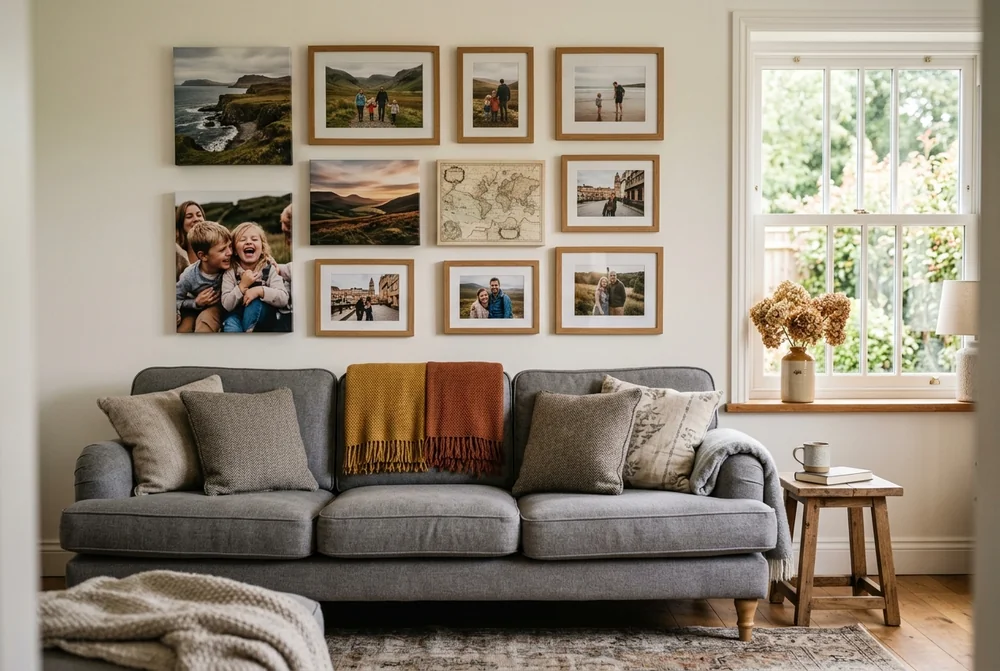
Split answers get a split solution: square the centred close-ups for a grid, and print the landscapes and groups rectangular for the album. The formats coexist better than most guides admit — one border style or one consistent frame colour is enough to make a mixed wall read as a set.
Why Choose MYPICTURE Over Other UK Photo Printing Services?
MYPICTURE competes on price and says so: the Lowest Price Guarantee beats any like-for-like UK online price by 5%, which means the comparison shopping is effectively done for you. Prints and canvases are produced in Europe with 12-colour printing on paper and HP Latex inks on canvas, canvases are dispatched within 24 hours, and delivery is free on orders over £49. The table compares the dimensions where MYPICTURE verifiably leads; the concessions above — rivals' dedicated small square print products among them — still stand.
Buyer's guide
MYPICTURE
Snapfish
Photobox
6×4" (9×15cm) prints from
£0.08
£0.20 (£0.10 on sale)
£0.15
Square canvas 20×20cm from
£4.50
£9.49
£14.99
Lowest Price Guarantee
Beats any like-for-like UK price by 5%
Not advertised
Not advertised
Customer rating
4.93/5, 170,882 reviews (Trusted Shops)
4.3/5, 172,255 reviews (Trustpilot)
4.1/5, 155,238 reviews (Trustpilot)
Frequently asked questions
Where can I get square photos printed in the UK?
Most major UK photo services print squares. At MYPICTURE, upload a square (1:1) image and choose a variable-format print with a fixed height of 13cm or 20cm — the width follows your image, giving a true 13×13cm or 20×20cm square. For the wall, square canvas prints run from 20×20cm at £4.50 up to 80×80cm at £48.00.
Can every rectangular photo be cropped to a square?
Technically yes, but a square crop removes about 25% of a standard 4:3 phone photo and about a third of a 3:2 camera photo. Portraits and centred subjects usually survive the cut; landscapes, group shots and anything with detail near the frame edges usually do not. Preview the crop before ordering and keep the uncropped original.
What size are Instagram photos when printed?
Classic Instagram posts are square (1:1), so they print cleanly at 13×13cm, 20×20cm or any square canvas size. Newer portrait posts are 4:5, which sits closer to a 20×25cm print than a square. A 1080×1080 pixel Instagram download is comfortable up to about 18×18cm on paper at 150 DPI — for larger sizes, print from the original camera file instead.
What resolution do I need for a 20×20cm square print?
On photo paper, aim for 300 DPI: about 2,360×2,360 pixels for 20×20cm. On canvas, the coarser weave makes 150 DPI the working rule, so roughly 1,180×1,180 pixels is enough at that size. A square crop from a standard 12-megapixel phone photo gives you about 3,024×3,024 pixels — comfortably enough for a 50×50cm canvas.
Are square prints more expensive than rectangular ones?
Not meaningfully, size for size. At MYPICTURE a rectangular 10×15cm print is from £0.08 and a 20×30cm is from £0.44, while a 20×20cm square canvas is £4.50 — the jump in price comes from the product type (paper versus canvas), not the shape. Where squares do cost more per photo is at rivals selling small fixed square prints as a separate premium product.