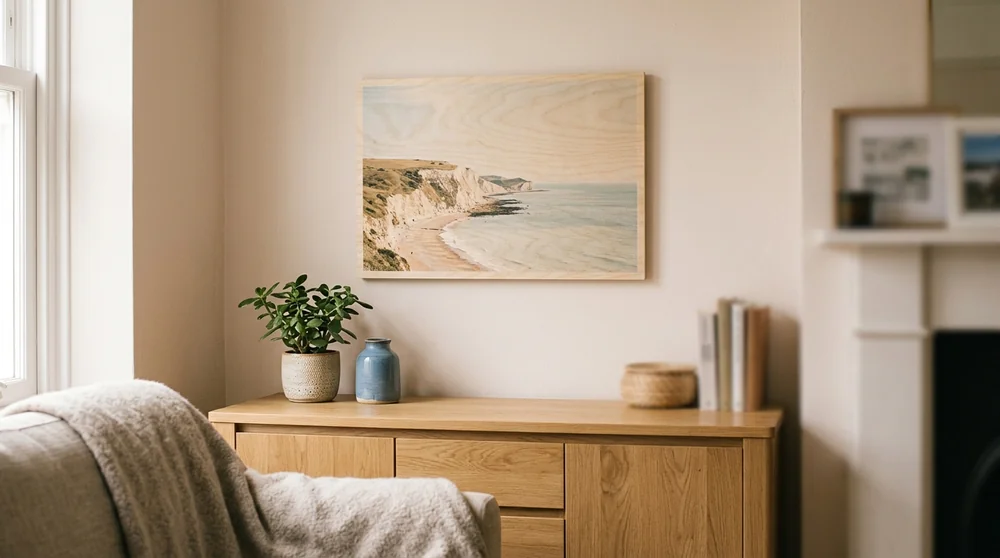
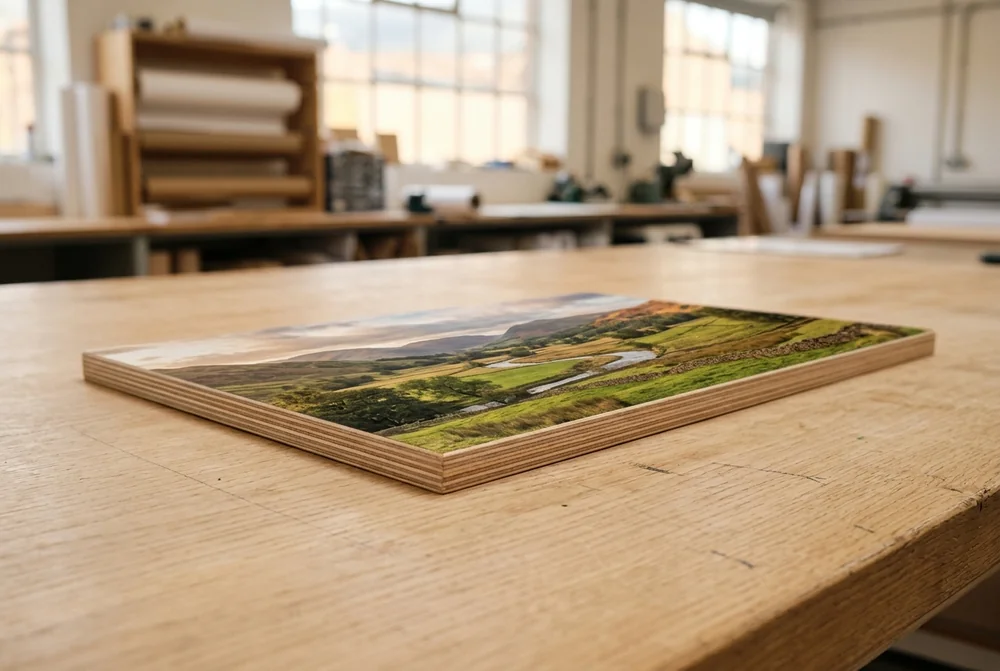
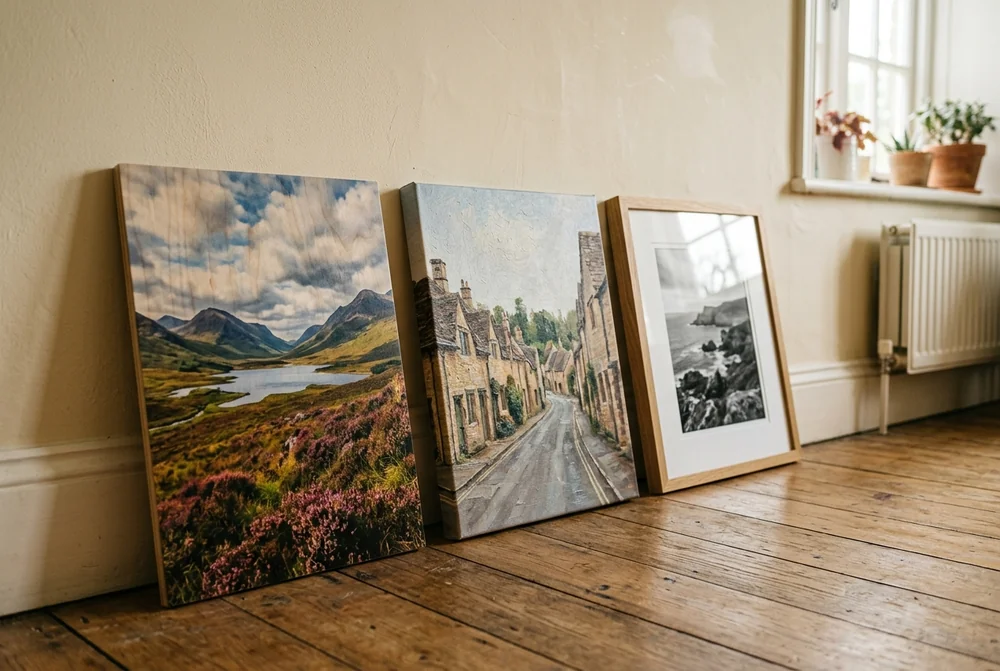
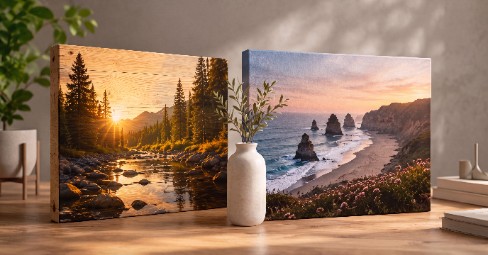
A wood print is a photograph printed directly onto a solid wooden panel, usually plywood or birch, rather than paper or canvas. The ink bonds with the timber so the natural grain stays subtly visible through the lighter parts of the image, giving each print a warm, matte, one-of-a-kind finish.
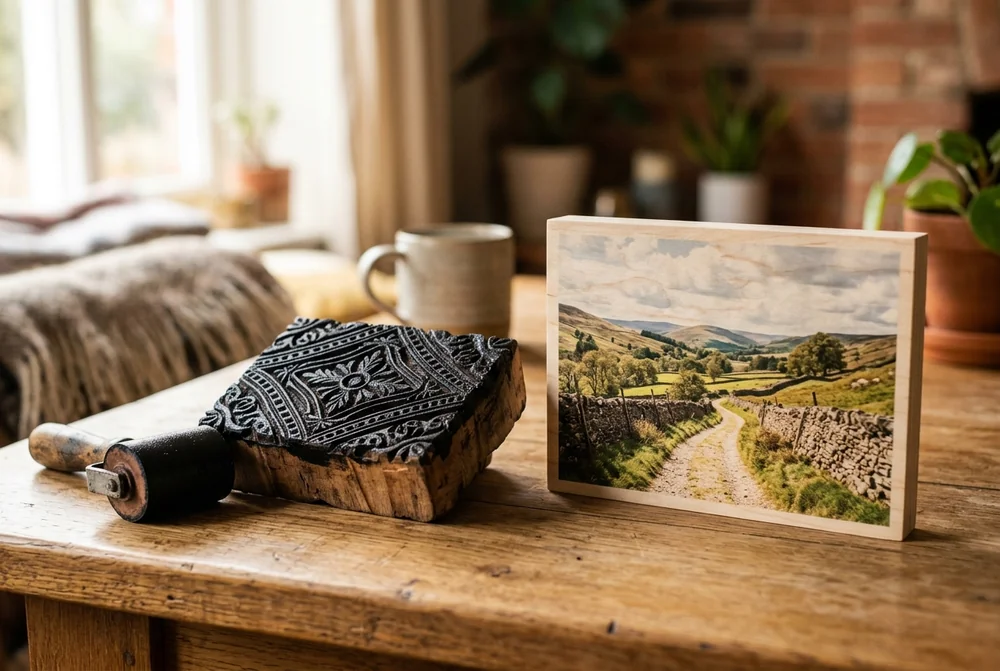
The phrase causes more confusion than almost any other in photo printing, because "wood print" also describes a centuries-old printmaking technique involving carved blocks and ink. If you searched for it, you probably meant the modern product: your own photo on a wooden panel. We will explain both meanings, show you exactly what the finished panel looks like, and — since we manufacture these ourselves — tell you which photos genuinely suit wood and which will disappoint you.
The short version
A wood print is your photo printed straight onto a wooden panel — at MYPICTURE, that means 10mm-thick plywood with precision-milled edges and a protective matte finish.
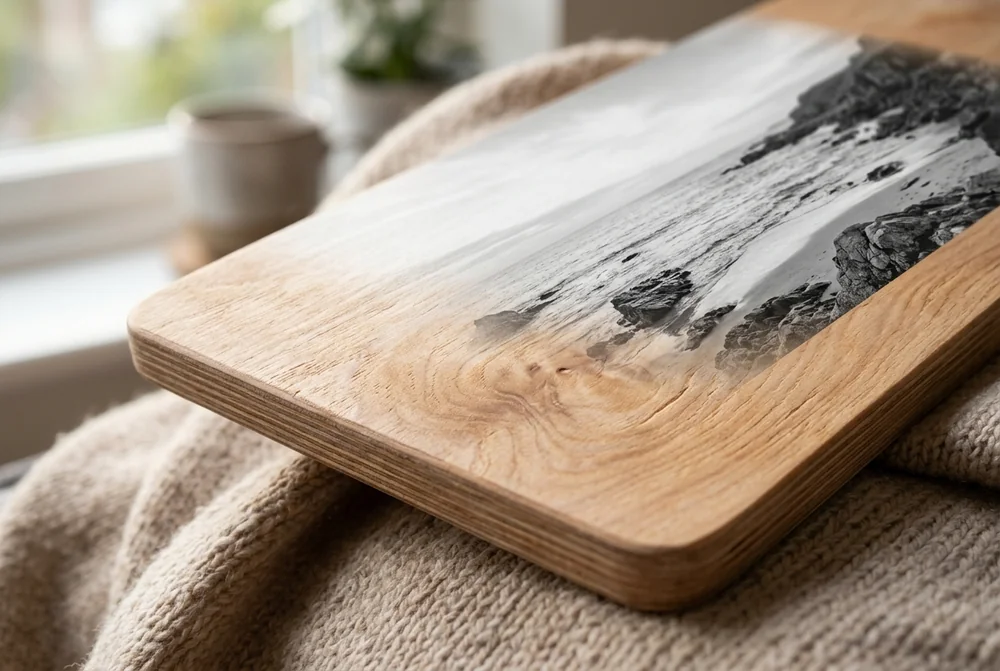
The grain shows through the light areas. White and pale tones are not printed; the bare timber does that work, which is why bright, high-contrast photos look best.
Prices run from £7.90 for a 20×20cm panel to £54.90 for 80×60cm at MYPICTURE, checked August 2026. Premium birch and solid-oak specialists charge considerably more for a thicker object.
It is not a woodblock print. The art technique of carving and inking wood blocks is a different thing entirely; we untangle the two below.
Matte means no glare. A wood print works opposite a window, where a glass-fronted frame would mirror the room back at you.
One universal tip: avoid dark, busy photos. Heavy shadow areas cover the grain, and the grain is the very thing you are paying for.
Wood print vs woodblock print: two very different things
Search results mix the two meanings freely, so it is worth thirty seconds to separate them. A woodblock print — also called a woodcut — is a relief printmaking technique. The artist carves a design into a block of wood, inks the raised surface and presses it onto paper; the wood is the tool, and the paper is the artwork. Tate's art-term glossary has a good short account, and Japanese ukiyo-e works such as Hokusai's Great Wave are the form's most famous examples.
A wood photo print is the reverse. Nothing is carved. The image is printed onto the wood, and the panel itself is the finished artwork you hang. If you see "wood print" next to words like Japanese, edition or artist's proof, you are reading about the art form. Next to words like personalised, photo or wall art, it is the product this guide covers.
What does a wood print look like?
Up close, the first thing you notice is the grain. Because printers do not lay down white ink, every white or pale area in your photo is simply bare, sealed timber — the swirls and figure of the wood become part of the sky, the wedding dress, the snow. No two panels share the same grain pattern, so even two prints of the same photo are not identical.
The second thing is warmth. Timber has a natural warm cast, and it pulls the whole image gently towards honey tones, a little like a soft sepia filter you did not have to apply. Our photo prints on wood add a subtle fade-out effect at the edges of the image, so the photo dissolves into the timber rather than stopping at a hard border — a deliberately vintage look.
The finish is matte. A protective coating guards against fingerprints and, unlike glass or acrylic, reflects almost nothing, which is why wood suits bright rooms and hallways facing windows. The honest trade-off: colours sit softer on wood than on acrylic or aluminium. If you want maximum saturation and pin-sharp blacks, wood is the wrong material for that photo — choose it for character, not punch.
At MYPICTURE the panel is a slender 10mm of plywood with precision-milled edges, light enough to hang from a single hook, and every panel ships with a free hanger set.
How wood prints are made
Commercial wood prints are produced in two main ways, and knowing which one you are buying tells you a lot about how the finished panel will look.
Direct UV printing is the method we use at MYPICTURE. The photo is printed straight onto the milled panel using a 12-colour print process, then sealed with the protective matte finish. Twelve colours means smoother gradients and more accurate skin tones than the four-colour process used for everyday paper printing, and because no white ink is laid down, the timber shows through exactly where the image is palest.
Dye sublimation is common among premium labs, particularly in the US. The image is printed in reverse onto transfer paper, then a heat press turns the dye to gas and drives it into the surface of the wood, where it re-solidifies. The result fuses image and grain very deeply; it is a slower, costlier process.
The panel matters as much as the method. Our panels are 10mm plywood in a natural tone — deliberately slim and light. Pixum prints on 18mm birch, and specialist UK workshops offer 25mm solid oak that can stand on a shelf like a piece of furniture. Those thicker panels are lovely objects and cost accordingly; paying much less should make you ask what has been cut, and paying much more should buy you visibly more timber.
Whoever you buy from, check four things: panel thickness, printing method, edge finishing and whether a protective coating is applied. If you would like the ordering steps in detail, our guide to how to print on wood walks through the whole process screen by screen.
Can you print on wood at home?
Craft methods exist, and they are honestly good fun. The most common is the transfer technique: print your photo mirrored on a laser printer, press it face down onto sanded timber with gel medium or acetone, and rub the paper away once dry. The results are unpredictable — patchy transfer is part of the aesthetic — and colours shift markedly. Treat it as a craft project rather than a way to decorate a wall: by the time you have bought the medium, the brayer and a few sheets of sacrificial plywood, a professionally printed 20×20cm panel at £7.90 has cost you less and will still look right in ten years.
Wood print sizes and prices in the UK
MYPICTURE offers ten formats, square and landscape (every landscape size can be ordered in portrait orientation by rotating your photo). These are the live prices, checked 5 August 2026; we discount constantly, so treat any printed figure as a starting point.
Format
Shape
MYPICTURE price
20 × 20cm
Square
£7.90
30 × 20cm
Landscape
£12.90
30 × 30cm
Square
£18.90
40 × 30cm
Landscape
£19.90
40 × 40cm
Square
£26.90
60 × 40cm
Landscape
£29.90
60 × 60cm
Square
£44.90
75 × 50cm
Landscape
£49.90
80 × 40cm
Landscape
£39.90
80 × 60cm
Landscape
£54.90
Aspect ratio deserves a moment before you choose. Phone photos come off the camera at 4:3, which crops cleanly into 40×30cm and 80×60cm; the classic 3:2 of most dedicated cameras maps onto 30×20cm and 60×40cm without losing the edges of the frame. Square formats ask you to crop deliberately — and, in our experience, a stronger picture usually comes out of that than the original framing.
Resolution is rarely the problem people fear: at the 150 DPI standard for wall art viewed at arm's length, a standard phone photo is fine up to 80×60cm. If you need larger than that, CEWE's range runs to an 80×80cm square — a genuine point in their favour. Delivery is £6 to the UK mainland, free over £49, and the panel arrives in 5–8 working days. For desk-sized versions of the same idea, wooden photo blocks start smaller and stand up on their own.
Wood print vs canvas vs framed print: side by side
Wood print
Canvas print
Framed print
Price from
£7.90 (20×20cm)
£4.50 (small formats)
£14.90
Surface
Timber grain visible through light areas, matte seal
Woven fabric texture, printed edge-to-edge
Photo paper behind acrylic glass with a mount
Glare
None
Very little
Some, from the glazing
Profile on the wall
10mm, slim and light
2cm stretcher frame (4cm on large sizes)
Depends on frame moulding
Best for
Bright, high-contrast photos; rustic and natural interiors
Large statement pieces on a budget
Formal display; photos you want exactly as shot
The table is a division of labour, not a ranking. Canvas prints remain the cheapest way to fill a large wall; framed photo prints reproduce the photo most faithfully because nothing shows through the paper; wood sits between them, trading a little colour fidelity for texture and character no other material has.
Which costs less? A worked example
Take one photo at 60×40cm — a sensible size above a sideboard or desk. On wood it costs £29.90. A medium canvas of comparable size sits in the £12–£30 band depending on the current promotion, and a framed print starts from £14.90 at entry sizes but climbs past both once you reach 60×40cm with glazing and a mount.
Delivery changes the sums more than people expect. One 60×40cm wood panel ships for £6, so £35.90 lands at your door. Order two — one to keep, one as a gift — and the £59.80 basket clears the £49 free-delivery threshold, making the second panel effectively £23.90 delivered. The price difference between wood and canvas buys you the grain, the matte no-glare surface and a panel that needs no frame; only you can decide whether that suits the photo in question.
Where a wood print works in the home
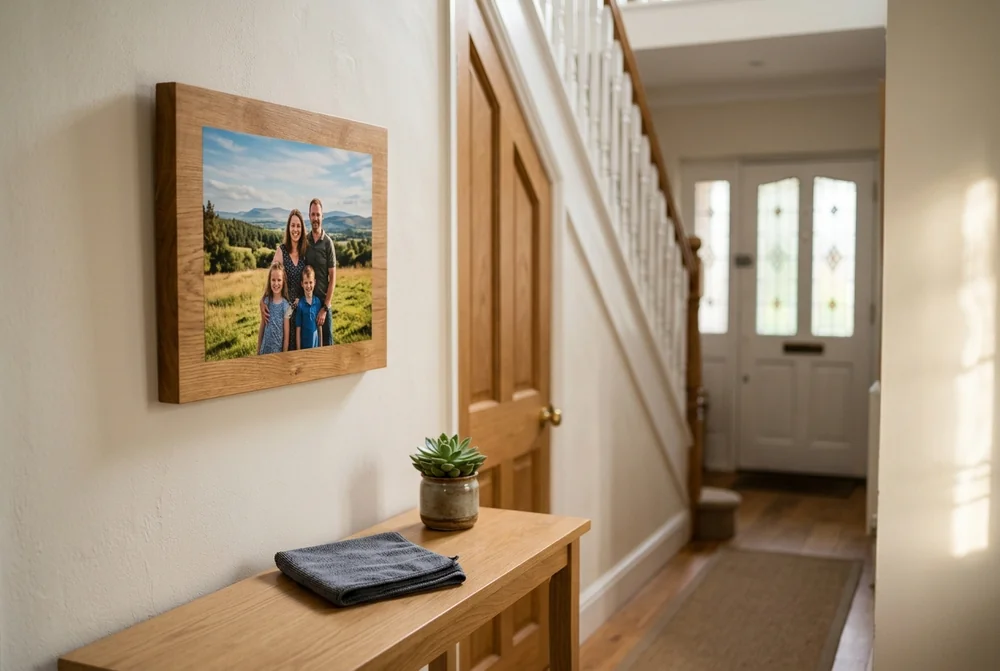
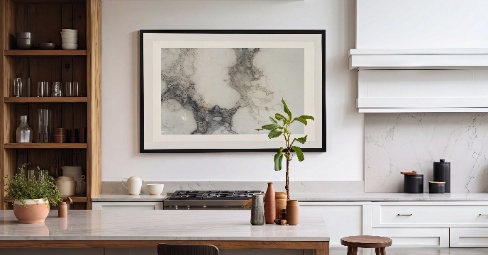
The matte surface decides most placements. A hallway or landing facing a window is the classic spot, because a glass-fronted frame there shows you the window and a wood print shows you the photo. In the living room, a 60×40cm panel suits the wall above a sideboard or desk, while 80×60cm holds its own above a two-seater sofa. Go one size larger than instinct suggests: a slim 10mm panel with faded edges reads smaller on the wall than a framed print of the same dimensions.
Bedrooms suit wood particularly well — the warm cast is gentle in low evening light where high-gloss formats look hard. Kitchens are fine as long as the panel hangs away from the hob, since the sealed surface wipes clean. The two places to avoid are the bathroom and the wall directly above a radiator, for the humidity reasons covered in the care section below.
Best photos for wood prints
One production fact decides everything here: wood printing lays down no white ink. Wherever your photo is white or pale, the panel stays bare and the grain does the talking. Choose photos that use that, rather than fight it.
Landscapes and nature shots
The fine-grained texture of the panel flatters exactly the subjects people photograph outdoors: skies, water, sand and snow all read as grain-filled areas, and the timber's warmth suits woodland, beaches and golden-hour light. This is the single most reliable pairing.
Black and white photos
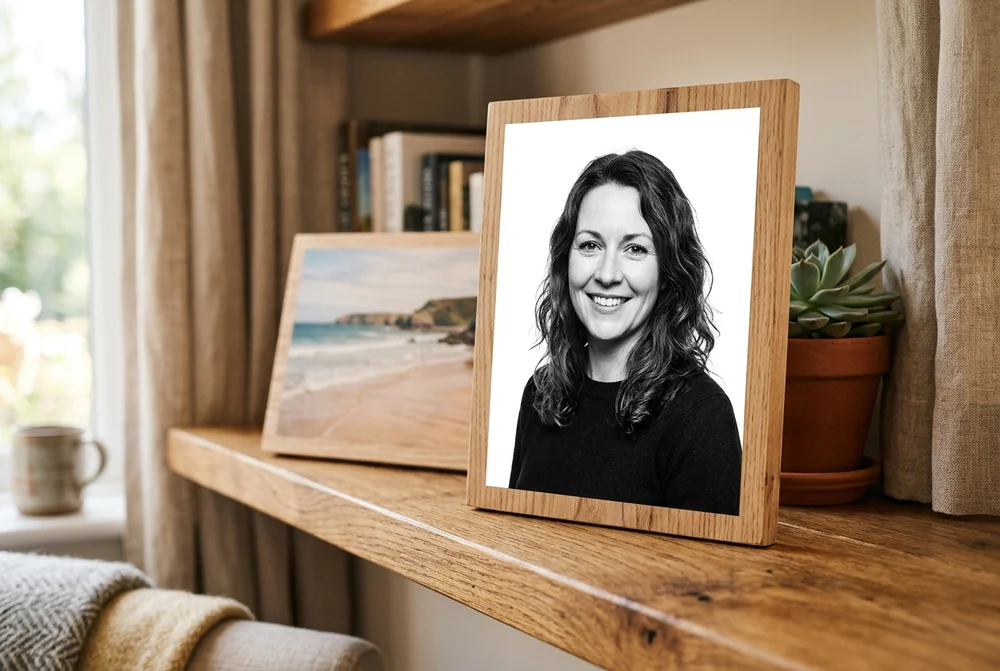
High-contrast monochrome on warm timber produces a vintage feel without any editing. The blacks print dense, the whites become wood, and the fade-out edge finishes the effect. Wedding photography in black and white is the classic order.
Portraits with pale backgrounds
Shoot or crop your subject against a white wall, bright sky or overexposed background, and on wood the subject appears to float directly on the grain — the closest a photo print gets to looking hand-made.
Photos for gifts
Wood suits gifting because the object feels made rather than produced. The reliable choices are a black-and-white wedding photo for an anniversary, a doorstep photo of a first home for a housewarming, and a bright holiday photo for grandparents — all light-toned subjects that let the grain through. A 30×20cm panel at £12.90 is the sweet spot: substantial in the hand, light enough to post on to the recipient, and inexpensive enough to order one for yourself in the same basket and clear the free-delivery threshold.
What to avoid
Dark, low-key images bury the grain under ink and lose the material's point. Busy frames with detail in every corner leave the eye nowhere to rest. Night shots suffer twice: heavy shadow plus the warm cast shifts them muddy. And check resolution before you fall in love with a crop — the upload tool will warn you if the file cannot carry the size you have chosen.
Caring for a wood print
Wood asks very little. Dust it with a dry or barely damp cloth; the matte seal shrugs off fingerprints. Keep it out of prolonged direct sunlight if you want the colours unchanged for decades — the same advice as for any print. The one genuine caution is moisture: timber moves with steam and humidity, so a bathroom or the wall directly above a radiator is the wrong home for it. Hang it anywhere else with the hanger set included in the box, or see our guide to hanging pictures without nails for rented homes.
A three-question test to settle it
Is the photo bright and high in contrast? Yes — wood will flatter it. No — a canvas or framed print will serve it better.
Will it hang opposite a window or lamp? Yes — the matte panel beats anything behind glass.
Do you want the material to be part of the picture? Yes — wood is the only format where the surface joins in. If you want the photo reproduced exactly as shot, choose a framed print instead.
Two or three yes answers and the decision has made itself. One or none, and the honest advice from a company that sells wood prints is: this photo belongs on a different material.
Why Choose MYPICTURE Over Other UK Photo Printing Services?
MYPICTURE competes on price without hiding it. Wood prints start at £7.90, every panel ships with a free hanger set, production is in Europe, and the Lowest Price Guarantee means a like-for-like UK offer found cheaper is beaten by 5% — a company willing to do that is effectively doing the comparison shopping for you. The scoped comparison below shows where we verifiably lead; as conceded above, rivals win on other dimensions, such as CEWE's larger 80×80cm format and the thicker panels sold by premium birch and oak specialists.
Buyer's guide
MYPICTURE
Pixum
CEWE
Wood print from
£7.90 (20×20cm)
£29.99
£19.99
Panel
10mm plywood, precision-milled edges
18mm birch
18mm FSC-certified wood
Largest size
80×60cm
80×80cm
80×80cm
Hanger
Free hanger set included
Embedded wall mount included
Wall fixings optional add-on
Lowest Price Guarantee
Beats any like-for-like UK price by 5%
Not advertised
Not advertised
Prices checked August 2026; every service in this market discounts constantly, so treat all figures as starting points.
If the grain, the warmth and the no-glare finish sound like the right home for your photo, upload it to our wood print configurator and the panel will be on your wall within 5–8 working days.
Frequently asked questions
What does wood print mean?
In photo printing, a wood print means a photograph printed directly onto a wooden panel, so the timber grain stays visible through the lighter parts of the image. In art, the same phrase can refer to a woodblock print, an impression on paper taken from a hand-carved, inked block of wood.
What do wood prints look like?
A wood print has a warm, matte, natural finish. The photo appears slightly softer than on paper, with the grain of the timber showing through white and pale areas. At MYPICTURE the panel is 10mm thick with precision-milled edges and a gentle fade-out effect at the borders.
What is a wood print used for?
Most people order wood prints as wall art for living rooms, hallways and bedrooms, or as personalised gifts for weddings, anniversaries and new homes. The matte surface makes them practical in bright rooms where glass frames would reflect, and the 10mm panel is light enough to hang from a single hook.
How do you make a wood print?
Commercial wood prints are made by printing the image directly onto a prepared wooden panel with UV-cured inks, or by infusing dye into the surface with heat in a process called sublimation. Ordering one takes a few minutes: upload a photo, pick a size, and the panel arrives ready to hang.
What is a wood print in art?
In art, a wood print usually means a woodcut or woodblock print: a relief printmaking technique in which the artist carves a design into a block of wood, inks the raised surface and presses it onto paper. Japanese ukiyo-e works such as Hokusai's Great Wave are the most famous examples.
What makes a woodcut print valuable?
A woodcut print's value depends on the artist, the age and rarity of the impression, the edition size, its condition and its provenance. That market is entirely separate from photo wood prints, which are valued as personalised décor rather than collectable editions.