You have found the perfect photo. A shot from a holiday, a portrait of the kids, a landscape you have meant to print for years. Then comes the question everyone gets stuck on: what size do you actually order?
A4, A3 and A2 are three of the most popular print sizes in Britain. They are familiar, they fit frames you can buy almost anywhere, and they cover everything from a small desk piece to a proper statement on the wall. But the names alone tell you very little. How big is A2 in real life? Will your phone photo look sharp blown up that large? And which size actually suits the wall you have in mind?
This guide answers all of it. You will find every measurement in centimetres, millimetres, inches and pixels, the exact resolution each size needs, the cropping catch nobody warns you about, and clear advice on finishes, framing and placement. It is written for printing photos, not filing office paper — which is where most size guides stop short.
Key Takeaways
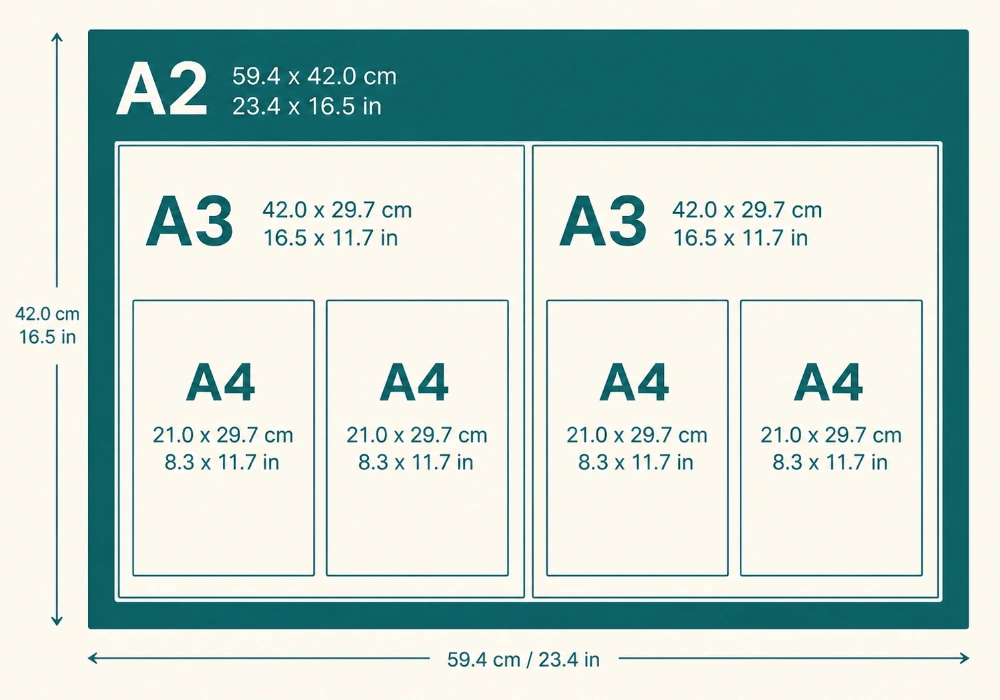
A4 = 21 × 29.7 cm, A3 = 29.7 × 42 cm, A2 = 42 × 59.4 cm. Each size is exactly double the area of the one before it.
All A-sizes share the same 1:1.41 shape, so a photo scales cleanly from A4 to A2 with no re-cropping.
Aim for 300 PPI for close-up sharpness: roughly 9 MP for A4, 18 MP for A3 and 35 MP for A2 — though large prints viewed from a distance forgive far less.
A4 suits desks and gallery walls, A3 is the sweet spot for a single framed photo, A2 is a bold statement for a large wall.
A-sizes do NOT match the classic 6×4 or 10×8 inch photo shape, so a snapshot needs cropping to fill them — check before you frame.
A4, A3 and A2 sizes at a glance
If you are in a hurry, here are the exact dimensions for all three sizes. These are international standard (ISO 216) sizes, so they are identical wherever you order in the UK.
Size
Centimetres
Millimetres
Inches
A4
21 × 29.7 cm
210 × 297 mm
8.3 × 11.7 in
A3
29.7 × 42 cm
297 × 420 mm
11.7 × 16.5 in
A2
42 × 59.4 cm
420 × 594 mm
16.5 × 23.4 in
The neat trick with A-sizes: each one is exactly twice the area of the next size down. Fold an A2 print in half and you get A3. Fold that in half and you get A4. That is why the shape never changes as you move up or down the scale — and why a design laid out at A4 enlarges perfectly to A2.
The full A-series, for context
A4, A3 and A2 sit in the middle of a bigger family. Seeing the whole ladder helps you judge how big each one really is — and where the popular 6×4 snapshot would roughly fall (between A6 and A5).
Size
Millimetres
Centimetres
Inches
Typical photo use
A0
841 × 1189 mm
84.1 × 118.9 cm
33.1 × 46.8 in
Huge feature wall pieces
A1
594 × 841 mm
59.4 × 84.1 cm
23.4 × 33.1 in
Oversized posters, panoramas
A2
420 × 594 mm
42 × 59.4 cm
16.5 × 23.4 in
Statement wall art
A3
297 × 420 mm
29.7 × 42 cm
11.7 × 16.5 in
Single framed photo
A4
210 × 297 mm
21 × 29.7 cm
8.3 × 11.7 in
Desk prints, gallery walls
A5
148 × 210 mm
14.8 × 21 cm
5.8 × 8.3 in
Small frames, cards
A6
105 × 148 mm
10.5 × 14.8 cm
4.1 × 5.8 in
Postcards, mini prints
Why photo prints come in A-sizes at all
You might wonder why prints use letters and numbers instead of plain inch measurements. The A-series was designed in the early 20th century around one clever idea: every size keeps the same proportions, roughly 1 to 1.41. That ratio is the square root of two, and it means you can halve or double a sheet without ever changing its shape.
For you, that has a genuinely useful payoff. Design a poster or lay out a photo at A4, and you can have it printed at A3 or A2 with no awkward cropping or white gaps — it simply scales. Try that with inch-based sizes and you quickly hit trouble, because their proportions differ from one size to the next.
A-sizes are also the default for frames sold on the British high street. Walk into any homeware shop and you will find A4, A3 and A2 frames ready to go. That makes these sizes a safe, no-fuss choice when you want a print on the wall without ordering a custom frame.
A4 photo prints: the everyday favourite
Dimensions: 21 × 29.7 cm · 210 × 297 mm · 8.3 × 11.7 inches
A4 is the size most of us picture instantly, because it matches a standard sheet of printer paper. That familiarity is exactly why it works so well as a photo print. It is big enough to show real detail, small enough to sit comfortably almost anywhere, and it drops into frames that cost a few pounds.
What A4 is great for
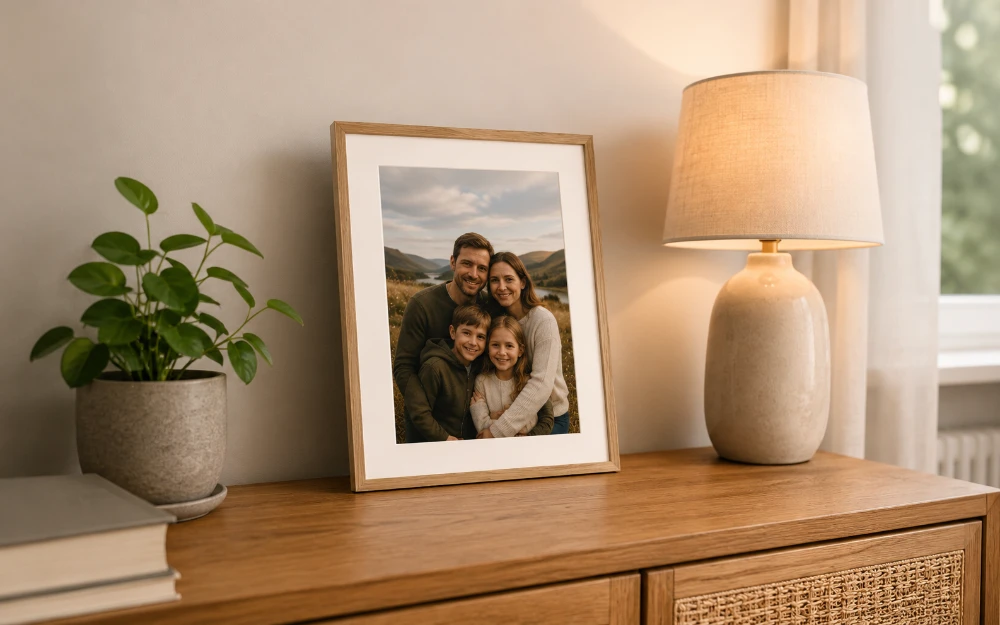
A single framed photo on a desk, shelf, mantelpiece or bedside table
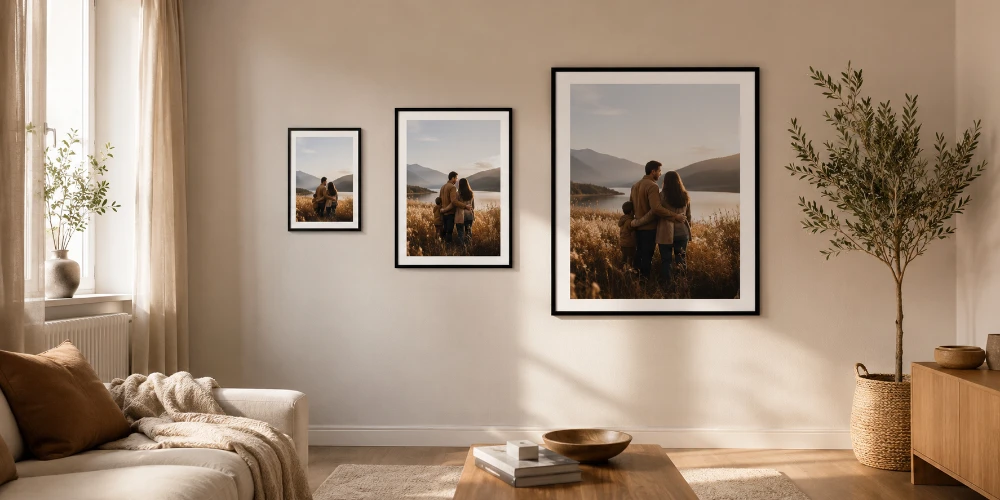
One tile in a multi-size gallery wall, mixed with A3 and smaller frames
Portrait shots of family, a pet, or the wedding party
Hallways, landings and smaller rooms where a large print would feel cramped
Things to watch with A4
A4 is portrait-tall by default (taller than it is wide). A landscape photo will sit in the top portion of an A4 frame with space below unless you order it landscape or crop to suit. And because A4 is on the smaller side, it can look lost on a big empty wall — there, treat it as part of a group rather than a solo piece.
If you want a clean, ready-to-frame A4 print on premium paper, our photo poster prints come in A-format sizes and slot straight into a standard frame. Because the proportions match exactly, the same image will also enlarge cleanly later if you decide you want it bigger.
A3 photo prints: the wall-art sweet spot
Dimensions: 29.7 × 42 cm · 297 × 420 mm · 11.7 × 16.5 inches
Double the size of A4, A3 is where a photo stops being a tabletop piece and becomes proper wall art. It is large enough to anchor a wall on its own, yet not so big that it overwhelms a normal British room. For a lot of people, this is the size that hits the mark — which is why A3 photo frames are among the most searched-for sizes in the UK.
What A3 is great for
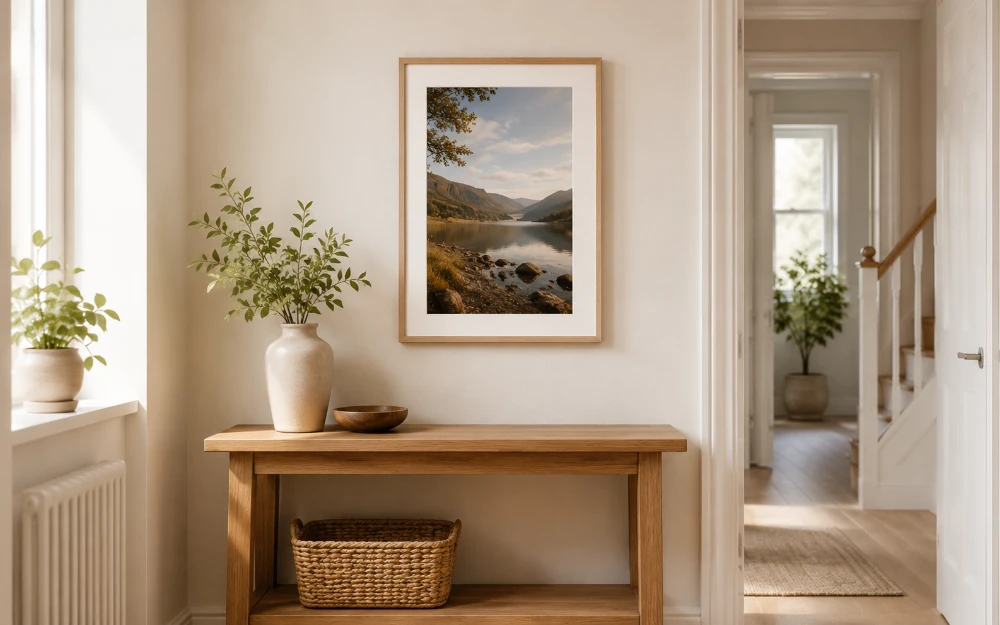
A standout single photo above a console table, sideboard or in a hallway
The anchor piece in a gallery wall, ringed by smaller A4 frames
Landscape and travel shots that deserve room to breathe
Children's bedrooms, home offices and studies
Why A3 is the safe choice
If you are unsure whether to go A3 or A2, A3 is the lower-risk pick. It makes an impact without dominating, it needs less wall space, and it is more forgiving of photo resolution than A2. A 12-megapixel phone photo, for instance, holds up comfortably at A3.
If you would rather skip the trip to the shops, our ready-framed photo prints arrive fitted with a pure-white mount and an acrylic glass cover, so an A3 image comes finished and ready to hang. For matching a print to the right frame size, our guide to UK photo frame sizes walks through every standard format.
A2 photo prints: the bold statement
Dimensions: 42 × 59.4 cm · 420 × 594 mm · 16.5 × 23.4 inches
A2 is large-format territory. At nearly 60 cm tall, it commands attention and turns a single photo into the focal point of a room. This is the size for the image you are proudest of: the panoramic landscape, the striking portrait, the once-in-a-lifetime travel shot.
Because it is so big, A2 rewards a little planning. It suits a large, fairly empty wall where it has space to breathe, and it works best from a high-quality original, since any blur or noise becomes more visible the larger you print.
What A2 is great for
A single statement piece above a sofa, bed or fireplace
Rooms with high ceilings or wide, open walls
Panoramic landscapes and dramatic, high-contrast images
Replacing tired shop-bought art with something personal
Common A2 mistakes to avoid
Hanging it on a narrow wall, where it feels crammed in
Printing from a heavily zoomed or low-light photo, which exposes softness
Surrounding it with lots of other prints — A2 wants to be the star
At this scale, the printing surface really matters. A glossy acrylic photo print gives an A2 image serious depth and colour punch, while a classic poster print keeps things light and easy to hang. Whichever you pick, treat A2 as the piece you build a wall around rather than one of many.
Will your photo look sharp? The resolution question, properly explained
This is the part that catches people out, and where most paper-size guides go quiet. A photo that looks perfect on your phone can come out soft once it is blown up to A2. The bigger the print, the more detail (pixels) it needs to stay crisp.
What PPI and DPI actually mean
PPI (pixels per inch) describes how many pixels from your image are packed into each inch of the print. DPI (dots per inch) is the printer's side of the same idea — the dots of ink it lays down. In everyday use the two terms get swapped around, and for ordering prints you can treat them as the same thing: more is sharper, up to a point.
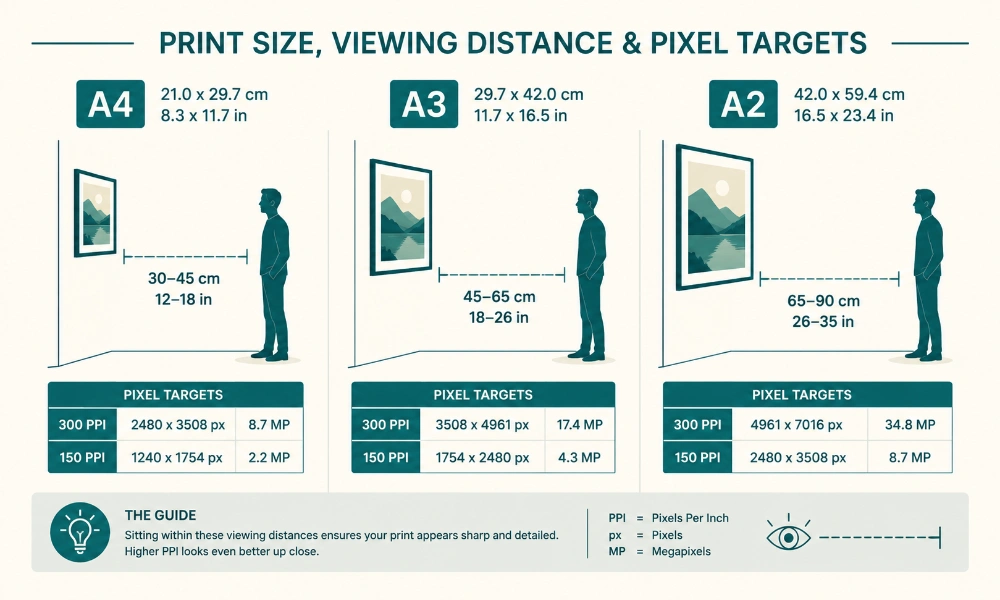
The widely accepted standard for crisp, hold-it-in-your-hand printing is 300 PPI. For large wall prints viewed from a distance, 150 PPI is often perfectly acceptable — your eye simply cannot resolve individual pixels from across a room.
Pixels needed for each size
Here is the table no paper guide gives you: the exact pixel dimensions each print size needs, at both the gold-standard 300 PPI and the more relaxed 150 PPI used for larger wall art.
Size
Pixels at 300 PPI
Pixels at 150 PPI
Rough megapixels (300 PPI)
A4
2480 × 3508 px
1240 × 1754 px
~9 MP
A3
3508 × 4961 px
1754 × 2480 px
~18 MP
A2
4961 × 7016 px
2480 × 3508 px
~35 MP
The reassuring reality: You almost never view a large print from up close. Stand back from an A2 on the wall and, from a normal viewing distance, your eye cannot pick out individual pixels. So a modern 12-megapixel phone photo will look excellent at A4, very good at A3, and can still hold up well at A2 if the original is sharp and well-lit. The 300 PPI figures above are the ideal for arm's-length viewing — not a hard cut-off for the wall.
How big can my camera or phone print?
As a rough rule of thumb, here is the largest A-size each common device handles comfortably at good quality.
Camera / phone
Typical resolution
Comfortable max size (300 PPI)
Fine on the wall up to
Older phone (8 MP)
3264 × 2448
A4
A3
Modern phone (12 MP)
4032 × 3024
A4–A3
A2
Recent phone (48 MP)
8000 × 6000
A2
A1+
DSLR / mirrorless (24 MP)
6000 × 4000
A2
A1+
Simple checks before you order a large print
Open the photo on a computer and view it at full size. If it looks sharp there, it will print well.
Avoid heavily zoomed shots — digital zoom throws away detail you cannot get back.
Steer clear of screenshots and images saved from social media; they are usually too low-resolution.
Remember that good lighting and focus in the original matter more than raw megapixels for how a print actually looks.
A handy safeguard: when you upload an image to our photo print configurator, the system checks its resolution and only offers the sizes the image can handle. If a photo is too small for A2, it simply will not let you choose it — so you cannot accidentally order a blurry print.
The cropping catch: A-sizes versus inch photos
Here is the single most useful thing in this guide, and the thing almost no competitor explains. A-sizes and the traditional inch-based photo sizes do not share the same shape. Their proportions differ, so a photo set up for one will not fill the other without cropping.
Your phone most likely shoots in 4:3 (or 3:2 on many cameras). An A-size is 1:1.41. Those do not match. So when you print a phone photo at A4, A3 or A2, a thin strip is trimmed from two edges to make it fit — usually no problem, but worth knowing if something important sits right at the edge of the frame.
How the common shapes compare
Format
Size (cm)
Aspect ratio
Shape vs A-size
6×4 inch
15.2 × 10.2
3:2
Wider / shorter than A
7×5 inch
17.8 × 12.7
7:5
Slightly squarer
10×8 inch
25.4 × 20.3
5:4
Noticeably squarer
A4 / A3 / A2
see above
1:1.41
Taller, narrower
What this means in practice
Cropping: a standard 6×4 snapshot printed at A4 needs a little trimmed top and bottom, or it leaves thin white strips at the sides.
Framing: a frame sold as "A4" will not fit a 10×8 inch print, and vice versa, even though they look similar at a glance.
The fix: decide early whether a project is in A-sizes or inch sizes, and keep everything — prints, mounts, frames — in that one system.
Most good print services, including ours, let you preview and adjust the crop before you order, so you control exactly what stays in frame. If you mostly print in the classic inch sizes, our full UK photo sizes guide breaks those down in the same detail.
Paper, finish and format: getting the look right
Size is only half the decision. The surface your photo is printed on changes how it looks just as much. Here is how the main choices compare at A4, A3 and A2.
Matte versus gloss paper
Matte has a soft, non-reflective surface. It is the safe choice for framing, because it avoids glare under lights and behind glass, and it hides fingerprints.
Gloss is vivid and high-contrast, making colours pop. It suits albums and prints displayed without glass, but it can reflect light awkwardly on a bright wall.
Print formats compared
Format
Best for
At A2 it looks…
Poster print (paper)
Budget, easy framing, swapping out
Light, classic, frame-ready
Framed print
A finished, ready-to-hang piece
Polished, gallery-style with a mount
Acrylic print
Maximum colour and depth
Glossy, premium, modern
Canvas
A soft, textured, frameless look
Warm, gallery-wrapped, no glare
For a frameless, textured alternative at any of these sizes, canvas and other wall art formats are worth a look — gallery-wrapped canvas in particular gives a large photo a soft, glare-free finish that suits living rooms well.
How to choose the right size for your wall
Dimensions on a page are one thing. Knowing how a size will feel on your actual wall is another. A few rules of thumb make the choice much easier.
The two-thirds rule
A print, or a group of prints, should fill roughly two-thirds of the wall or furniture it sits above. Above a sofa or sideboard, that usually rules A4 out as a solo piece and points you to A3 or A2. On a narrow stretch of wall, a single A4 or a neat pair can be just right.
Match the size to the room
Spot in the home
Suggested size
Why
Desk / shelf / bedside
A4
Close-up viewing, compact footprint
Hallway / landing
A4 or A3
Seen up close, in passing
Above a sideboard
A3
Anchors the furniture without crowding
Above a sofa or bed
A2 (or a pair of A3)
Fills a wide wall, makes a statement
Large feature wall
A2 or larger
Needs scale to hold the space
The paper-template trick
Before you commit, cut sheets of paper or newspaper to A4, A3 and A2 size and tape them to the wall. Live with them for a day. It costs nothing and instantly shows which size feels right in the room, with the furniture and light you actually have.
And if you are planning several prints together rather than one, our guide to arranging photos on a wall covers spacing, layout and how to mix sizes so the whole display looks considered rather than random.
Framing and hanging your A-size prints
Once your print arrives, getting it on the wall well comes down to a few small details.
To mount or not to mount
A mount — the white border between the photo and the frame — gives a print a gallery finish and draws the eye to the image. If you want a mount, buy a frame one or two sizes larger than your print. An A3 photo, for example, looks smart in an A2 frame with a mount around it. (In the UK this border is called a mount; in the US it is a mat.)
Hang at eye level
The most common mistake is hanging prints too high. Aim for the centre of the print to sit around 145 cm from the floor — roughly eye level for most people. For a row of prints, measure up from the floor rather than down from the ceiling, since British floors tend to be more level than ceilings.
Match the fixing to the weight
A4 and A3 prints in light frames need nothing more than a single picture hook.
A larger A2 piece, especially framed behind glass, is heavier — use proper wall plugs and screws, and a cavity fixing if you are hanging onto plasterboard (common in new-builds).
Renting? Adhesive strips hold lighter A4 and A3 prints without drilling, and picture rails (common in older UK homes) take prints with no wall damage at all.
The bottom line
A4, A3 and A2 give you a simple, flexible ladder of sizes: a familiar everyday print, a versatile piece of wall art, and a bold statement, all sharing the same neat proportions. Measure your space, check your photo looks sharp at the size you want, mind the cropping if it started life as a phone snap, and pick the finish that suits the room.
When you are ready, you can explore the full range of formats — from paper photo prints to framed, acrylic and canvas wall art — and let the configurator steer you to the sizes your image can handle. The hardest part really is just choosing the photo.
Frequently Asked Questions
Is A3 bigger than A4?
Yes. A3 is exactly twice the area of A4. A4 is 21 × 29.7 cm and A3 is 29.7 × 42 cm. Put simply, two A4 sheets placed side by side make one A3.
How big is A2 compared to A4?
A2 is four times the area of A4. Two A4s make an A3, and two A3s make an A2. So an A2 print is genuinely large — about 42 cm wide and 59.4 cm tall — while A4 is the size of a sheet of printer paper.
Is A3 or A2 better for a single photo on the wall?
It depends on the wall. A3 (29.7 × 42 cm) is the all-rounder that suits most rooms and looks great standalone above a sideboard or in a hallway. A2 (42 × 59.4 cm) is for larger, emptier walls where you want a real statement. If your wall is on the small side, A3 is the safer choice.
Can I use a phone photo for an A2 print?
Often, yes. A modern 12-megapixel phone photo will not hit the textbook 300 PPI target for A2, but you almost never view a large print from up close. From a normal distance across a room, a sharp, well-lit phone photo can look great at A2. Avoid zoomed-in shots, screenshots and dark or blurry images.
What resolution do I need for A4, A3 and A2?
At the 300 PPI print standard, A4 needs around 2480 × 3508 pixels (about 9 MP), A3 needs around 3508 × 4961 pixels (about 18 MP), and A2 needs around 4961 × 7016 pixels (about 35 MP). For large prints viewed from a distance, half those pixel counts (150 PPI) is usually fine.
Will an A4 photo fit a standard A4 frame?
Yes. A4 frames are made to fit A4 prints exactly — one of the big advantages of A-sizes. Just note that an A4 frame will not fit a 10×8 inch print, as the two have different shapes despite looking similar.
Do A-sizes match standard 6×4 photos?
No. The A-series and the inch-based photo sizes have different proportions. A 6×4 photo printed at A4 needs a little cropping, or it leaves white strips at the edges. Pick one system — A-sizes or inches — and stick to it for a tidy result.
What is the difference between matte and gloss?
Matte has a soft, non-reflective surface that avoids glare and suits framing. Gloss is vivid and punchy, ideal for albums and prints shown without glass. Both use the same premium photo paper; only the finish differs.
How many pixels is A4 in print?
At 300 PPI, A4 is 2480 × 3508 pixels. At 150 PPI it is 1240 × 1754 pixels. The higher figure gives crisp results when the print is viewed close up.
Which A-size is best for a gallery wall?
Most gallery walls mix sizes. A reliable approach is one larger anchor piece in A3 or A2, surrounded by several A4 prints. The variety in scale is what makes a gallery wall feel relaxed and personal rather than rigid.