What to Write in a Sympathy Card: Comforting Messages for Every Situation
byJonathan Vincent– 15+ years of experience in photography, printing & personalised products18 minutes
Few things feel as awkward as a blank sympathy card. You want to say something kind. You want the person to feel less alone. And yet the pen just hovers there, because nothing you think of seems good enough.
Here is the thing worth knowing before you write a single word: there is no perfect message. The people who receive these cards rarely remember the exact wording. What they remember is that you took the time to reach out at all. Grief can be a deeply lonely experience, and a simple handwritten note is one of the most direct ways to remind someone they are not facing it on their own.
This guide is built to take the pressure off completely. You will find more than a hundred real, usable examples — sorted by relationship, by type of loss, and by situation, from a sudden death to a long illness. We have also covered the practical etiquette people quietly worry about: when to send the card, who to address it to, and whether a text is ever okay. Pick the lines that feel like you, change them to fit, and trust that your effort will mean far more than you think.
Key Takeaways
Keep it simple and sincere. A short, honest message beats a long, flowery one every time.
Use the name. Mentioning the person who died, by name, brings real comfort — it confirms they mattered.
Offer something specific. "I'll bring dinner round on Tuesday" helps more than "let me know if you need anything."
Avoid clichés. Skip lines like "they're in a better place" unless you know the person shares that belief.
Match the relationship. What you write for a best friend differs from what you write for your boss — and that's fine.
Late is fine. A card weeks or months on is often more comforting, not less, because the rush has passed.
When in doubt, say less. "Thinking of you. I'm so sorry." is a complete and lovely message.
1. The Simple Structure of a Sympathy Message
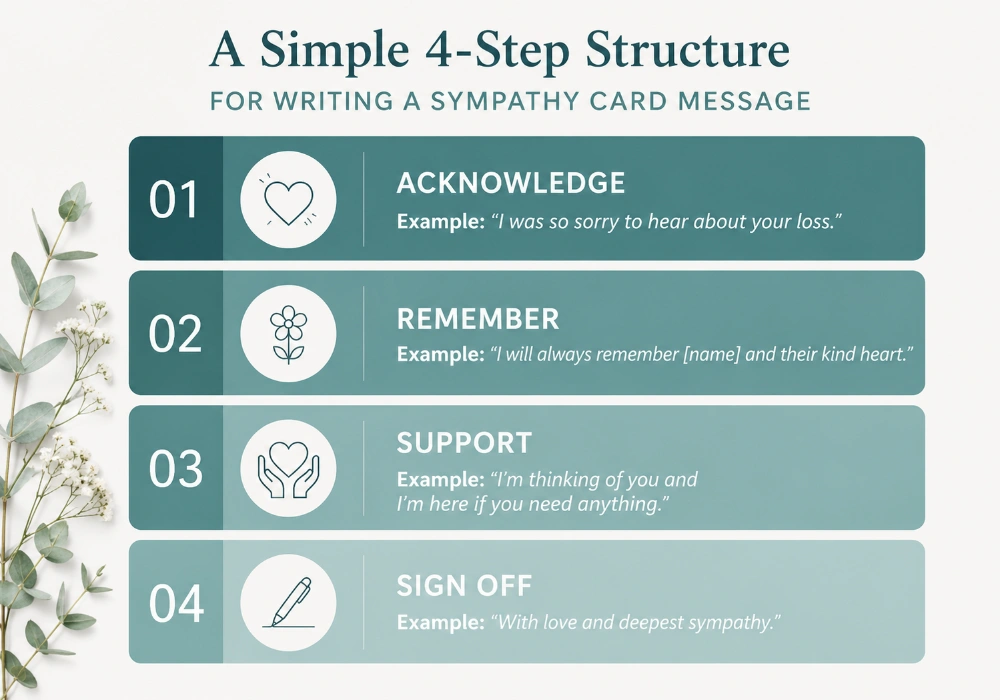
If you are staring at the card with no idea where to start, this little structure takes the pressure off. You do not need every part — even two of these make a warm, complete message.
Acknowledge the loss. "I was so sorry to hear about your dad."
Honour the person. A quality or a small memory: "He always made me laugh at the school gates."
Offer comfort or support. "I'm here whenever you fancy a chat or a walk."
Sign off warmly. "With love" or "Thinking of you both."
Put together, that reads: "I was so sorry to hear about your dad. He always made me laugh at the school gates. I'm here whenever you fancy a chat or a walk. With love, Sarah." Simple, honest, done. If even that feels like too much, two lines will do the job beautifully.
2. Sympathy Card Etiquette: When, Who and How
Most of the worry around sympathy cards isn't really about the words — it's about getting the small things right. Here are clear answers to the questions people quietly fret over.
When should you send a sympathy card?
Aim to send it within a week or two of hearing the news, while it's fresh. But there is no real deadline, and a late card is never wrong. In fact, a message that lands a few weeks on — once the funeral is over and the visitors have gone home — often means more, because that quiet stretch is when grief tends to bite hardest. If you've missed the early window, don't let embarrassment stop you. A simple "I've been thinking of you and wanted you to know" is all it takes.
Who should you address it to?
As a rule, send the card to the closest relative — a widow, widower, or the eldest child. If you knew the person who died but not their family well, address it to the next of kin and mention your connection. If you know the grieving person but never met the one who died, simply address it to your friend or acquaintance. When a whole family is grieving, "To all the family" or "Dear Johnson family" works perfectly.
Handwritten or printed?
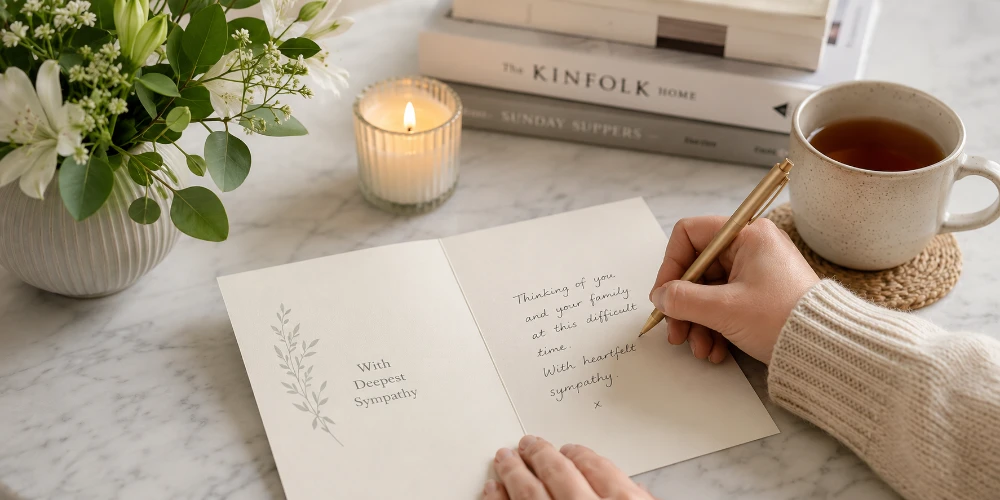
A handwritten note almost always feels warmer than a typed one. It shows you sat down and thought about it, rather than reaching for a pre-printed line. Even if the card already has a lovely message inside, adding a sentence or two in your own hand makes it personal. Don't worry about neat handwriting — sincerity matters far more than penmanship.
Is a text or message ever okay?
Yes, especially as a first response or for younger friends who live on their phones. A quick "I just heard about your mum — I'm so sorry, thinking of you" is genuinely kind and better than silence while you find a card. Many people send a text straight away and follow up with a written card a few days later. Both are thoughtful; one doesn't cancel out the other.
How long should the message be?
Two to five lines is plenty unless you're very close to the person. A short card respects someone's limited emotional energy — they don't have to wade through paragraphs to feel your care. Length is never the measure of a good message. Honesty is.
3. General Sympathy Messages That Always Work
Not sure how close to pitch it? These middle-ground messages suit almost any relationship and any kind of loss. They are a safe, kind place to start.
"I am so sorry for your loss. Please know I'm thinking of you."
"Sending you so much love during this heartbreaking time."
"There are no right words, but please know how deeply I care."
"Holding you close in my thoughts and wishing you strength."
"So sorry to hear your sad news. You're in my heart."
"Thinking of you and your family. Take all the time you need."
"My heart goes out to you. I'm here whenever you need me."
"Wishing you comfort and peace in the difficult days ahead."
A quick note on tone: warm and plain is better than grand and poetic. You are writing to a person who is hurting, not entering a writing competition.
4. Short Sympathy Messages (When Less Is More)
Sometimes the printed card already says most of what you want to say, and you just need to add a personal line. Sometimes you simply do not know the person well. Short is never wrong.
"With deepest sympathy."
"Thinking of you all."
"So very sorry. Sending love."
"Here for you, always."
"With heartfelt condolences."
"My thoughts are with you."
"Sharing in your sadness."
"With love and sympathy to all the family."
"There are just no words. So sorry for your loss."
If everything you try to write feels clumsy, this is your get-out. You can even be honest about it: "It's hard to know what to say, but I'm sending you my deepest sympathy." A signed card that simply says "thinking of you" still tells someone they were on your mind — and that matters.
5. What to Write Based on Your Relationship
The right words shift depending on who you are writing to and how well you knew the person who died. Here is what tends to land well in each case.
For a Close Friend
With a good friend you can be more open and personal. Mention shared memories and be honest about your own feelings.
"I keep thinking about all the daft times the four of us had together. I'm so sorry, and I'm not going anywhere — lean on me as much as you need."
"There's nothing I can say to make this easier, but I'm here. Day or night, I'll pick up the phone."
"My heart is breaking for you. Sending love and hugs and wishing I lived closer."
For a Family Member
When the loss is shared within the family, your card can acknowledge that you are grieving too, while still putting their feelings first.
"We're all going to miss Grandad so much. I'm so glad we have each other to get through this together."
"As we say goodbye to Mum, I'm so grateful I have you to talk to and turn to. I'm always here for you too."
"Thinking of you every single day. We'll keep her memory alive together."
For a Colleague or Boss
At work, warmth still matters, but the tone is usually a little more measured. Keep it sincere and avoid being overly familiar if you don't know them well.
"I was very sorry to hear of your loss. Please don't worry about anything here — take whatever time you need. Thinking of you."
"On behalf of the whole team, we're sending our heartfelt condolences. We're here to support you however we can."
"So sorry for your loss. Work can wait — look after yourself and your family first."
For When You Knew the Person Who Died
If you knew the person who passed away, the family will take real comfort in hearing how much they meant to others. Be specific. A small, true memory is a gift.
"Your mum was so kind to me when I first moved in next door. I'll always remember her cheery wave over the fence."
"I was lucky to work alongside your dad for fifteen years. He had a way of making everyone feel welcome, and he'll be so missed."
"I'll never forget our trip to the coast for Kath's birthday — so much laughter. One of many memories I'll treasure."
Helpful tip: if the family doesn't know you, briefly mention how you knew their loved one — through work, a club, an old friendship — so your words land with context.
For an Acquaintance or Distant Connection
If you didn't know the person who died, or you don't know the recipient well, a brief and gracious message is exactly right. You don't need to pretend to a closeness that isn't there — keep the focus on the person you do know.
"I was saddened to hear your news. My thoughts are with you and your family."
"Although I never had the chance to meet your wife, I could tell how much she meant to you from the way you spoke of her. So sorry for your loss."
6. Messages for Specific Losses
Some losses call for particular care. The examples below are written with the specific relationship in mind — borrow a line and make it your own.
Loss of a Mother
"Your mum was such a warm, generous soul, and she clearly raised an equally lovely person. Sending you all my love."
"There's no love quite like a mother's. I'm so deeply sorry she's gone."
"Remembering your wonderful mum and wishing you comfort in the days ahead."
Loss of a Father
"Your dad was one of the good ones — kind, funny and always up for a chat. He'll be so missed."
"I'm thinking of you as you remember your father and everything he gave you."
"So sorry to hear about your dad. What a lovely man, and what a loss."
Loss of a Husband, Wife or Partner
"I can't imagine how much you're hurting right now. He adored you, and that love doesn't go anywhere. I'm here."
"The two of you were a wonderful team. Sending you strength and so much love."
"I know how deeply you loved her. I'm keeping you close in my thoughts."
Loss of a Grandparent
"Grandparents leave the loveliest mark on us. I hope your happy memories of her bring some comfort."
"What a life well lived. So sorry you've lost someone so special."
Loss of a Sibling
"A brother is one of a kind, and I'm so sorry you've lost yours. Thinking of you and all the family."
"The bond between sisters is something else. My heart aches for you."
Loss of a Child
This is the hardest card anyone ever has to write. Keep it gentle, name the child if you can, and never suggest they should be "moving on" or finding a silver lining. Your steady presence matters far more than your words.
"There are no words for a loss this big. We are holding you close and we're here, for as long as it takes."
"[Name] was so loved, and always will be. We're thinking of you every moment."
Loss of a Pet
Pets are family, and pet loss deserves to be taken seriously. Don't brush it off — acknowledge how much that animal meant.
"Bella was such a character and brought you so much joy. It's a real loss, and I'm so sorry."
"Sending love to you all. The house must feel so quiet without him."
If you're close to someone who has lost a beloved animal, a small keepsake can be a gentle way to show you understand the loss is real. A favourite photo turned into a framed photo print, with its pure-white mount and clean finish, gives them a quiet, lasting place to remember their companion — something to keep on the shelf long after the cards are put away.
7. Messages for Difficult Situations
The circumstances of a death change what feels right to say. Here is how to handle the harder ones with care.
After a Sudden or Unexpected Death
A sudden loss — an accident, a heart attack, someone gone far too young — brings shock on top of grief. Acknowledge that without dwelling on the details.
"We were so shocked and saddened to hear about Dave. He was such a lovely man, and we're going to miss him terribly."
"I'm so sorry you didn't get the chance to say goodbye. My heart goes out to you all."
"It's so hard to make sense of losing someone so wonderful, so suddenly. We're thinking of you."
After a Long Illness
When someone has been ill for a long time, the grieving person may also be exhausted from caring for them. Recognise both the loss and the long road they've travelled.
"You cared for your mum so devotedly these last months. I hope, in time, that brings you some comfort."
"I'm so sorry. The days ahead will be a big adjustment after everything you've given — please look after yourself too."
"May it help, just a little, to know she's at peace now. Thinking of you."
For the Loss of a Baby or Through Miscarriage
This is profoundly delicate. Acknowledge the loss as real, never minimise it, and avoid anything that begins with "at least." Sometimes the kindest thing is simply to be present.
"I'm so deeply sorry. There are no words for this kind of loss — just know we're here, holding you close."
"Thinking of you both with so much love. We're here for whatever you need, whenever you need it."
When You Share the Same Loss
If you and the recipient are both grieving the same person — a parent, a mutual friend — reaching out can comfort you both. Sharing the sadness can make it a fraction lighter.
"Life won't ever be the same, but I'm glad we'll always share the stories and the memories. Love you."
"Somehow this feels a little more bearable because we have each other to lean on. So grateful for you."
When You Can't Attend the Funeral
If you're unable to be there, a short apology in your card is gracious. You don't need to over-explain.
"I'm so sorry I can't be there to say goodbye to your dad in person, but I'll be thinking of you all and remembering him fondly."
8. Religious and Non-Religious Messages
Whether to mention faith depends entirely on the beliefs of the person you're writing to — not your own. A note of condolence should reflect the mourner's worldview. If you're unsure, a neutral message is always the safer choice.
If They Are People of Faith
"May God's love surround you and give you peace in the days ahead."
"Praying for you and your family, and trusting they are now at rest."
"May you feel held by your faith and your community at this time."
If You're Not Sure, or They Aren't Religious
"May the love of everyone around you carry you through this."
"Wishing you peace, comfort and gentle days ahead."
"Her memory will live on in everyone who loved her."
"Someone so much a part of us can never really be gone."
9. What to Write on Funeral Flowers
A flower card is tiny, so a few words are all you need — the flowers do much of the talking. Keep it short, warm and signed. If donations are requested in lieu of flowers, follow that cue and keep a note simple: "A donation has been made in [Name]'s memory. Holding you close."
Short messages for funeral flowers
"In our hearts, always and forever."
"Gone but never forgotten."
"Rest in peace."
"With heartfelt condolences."
"Forever in our thoughts."
"Until we meet again."
"A beautiful soul, deeply missed."
"With love and sympathy, from all at number 12."
10. Short Quotes You Can Add
A brief quote can be a lovely finishing touch, especially if you struggle to put feelings into your own words. Keep it short and follow it with a personal line so the card still feels like it came from you.
"What we have once enjoyed we can never lose."
"Those we love don't go away, they walk beside us every day."
"Grief is just love with nowhere to go."
"To live in hearts we leave behind is not to die."
"What is grief, if not love persevering."
One word of caution: a quote should never replace your own message entirely. A card that's only a borrowed line can feel a little impersonal, however beautiful the words.
11. A Bank of Words to Describe Someone
Stuck on how to describe the person who died? Reaching for "special" every time can feel flat. Here are warmer, more specific words to draw on — pick the one that truly fits.
Warm
Strong
Joyful
kind-hearted
hardworking
fun-loving
generous
well-respected
funny
caring
dependable
full of life
gentle
one-of-a-kind
one-in-a-million
loving
talented
warm-hearted
12. What to Avoid Writing
Most unhelpful phrases come from a good place — we say them because we want to make things better. But certain lines can sting more than soothe. Here is what to leave out, and why.
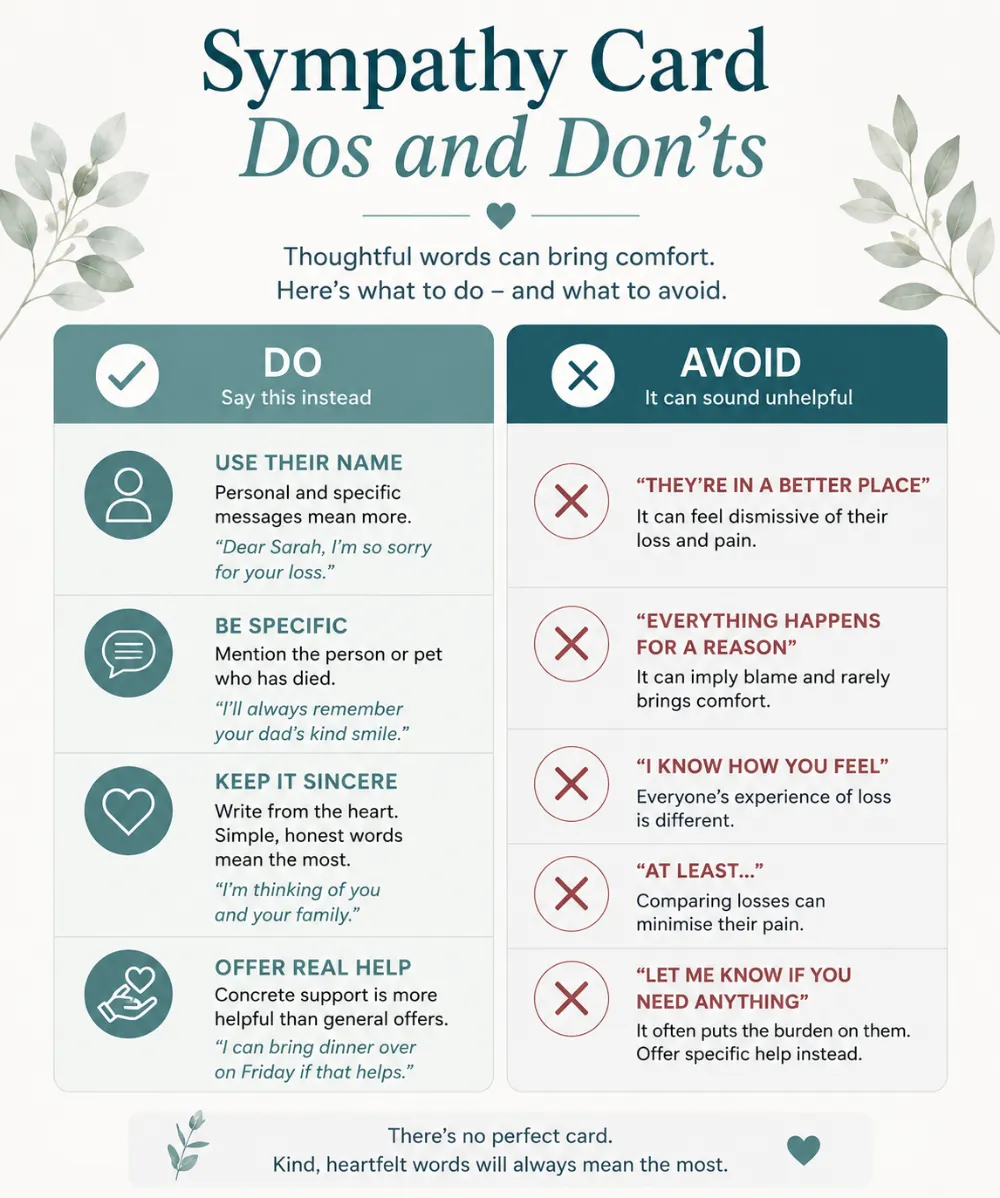
"They're in a better place." Only comforting if you're certain the person shares that belief. Otherwise it can feel dismissive.
"Everything happens for a reason." To a grieving person, this can sound like their loss was somehow meant to be.
"I know exactly how you feel." You can't, really — every loss is different. "I can't imagine how hard this is" works better.
"At least they lived a long life." "At least" rarely helps. It nudges someone to feel grateful when they're heartbroken.
"Time heals all wounds" or "give it time." There's no set timescale for grief, and this can feel like pressure.
"You'll get over it." People don't "get over" losing someone. They learn to carry it.
"Let me know if you need anything." Well meant, but it puts the work on them. Offer something specific instead.
Unsolicited advice. Resist the urge to tell them how to feel or what to do. Acknowledge the pain rather than trying to fix it.
13. How to Sign Off a Sympathy Card
The sign-off should match how close you are to the person. Here is a quick guide so you don't second-guess that final line.
Relationship
Sign-off ideas
Close friend or family
With love • All my love • Love always • Thinking of you both
Friend
With sympathy • Thinking of you • With love and strength
Colleague
With heartfelt condolences • With deepest sympathy • Sincerely
Formal or distant
With deepest sympathy • Yours sincerely • With sincere condolences
14. Beyond the Card: Gentle Ways to Help Later On
Cards arrive in a flood in the first week or two, then everything goes quiet — and that quiet is often when grief hits hardest. Some of the kindest things you can do come weeks or months later.
Mark the dates. A short message on the first birthday, anniversary or Christmas shows you haven't forgotten.
Keep checking in. A simple "thinking of you today" text can mean the world months down the line.
Offer practical help. A cooked meal, a lift, an afternoon of childcare — small, concrete acts ease real pressure.
Share a memory. Telling them a story about their loved one, or sending a photo they may not have seen, is a real gift.
That last point is worth dwelling on. Photographs become precious in a new way after someone dies. If you have lovely pictures of the person who has gone, gathering them into a small photo book can be one of the most meaningful gifts you ever give. A photo book can be a personal tribute to a single person — a quiet record of a life, with room for short captions and stories alongside the images.
If you'd like a little guidance on putting one together thoughtfully, our photo album ideas guide walks through arranging photos in a way that tells a story, including chronological timelines and family-tree style layouts that suit a memorial keepsake.
For something simpler, a single favourite image makes a beautiful keepsake on its own. A small set of photo prints tucked into a card, or one warm photo on a personalised mug they'll reach for with their morning cup of tea, can quietly say "I remember them too" — long after the words on the card have faded.
And if you're curious about the difference between a quick photo album and a proper bound keepsake before you start, this short explainer on what a photobook is covers the basics in a couple of minutes.
15. A Final Thought
You will never find the "right" words, because they don't exist. But warm, plain and honest will carry someone through a hard day far better than perfect ever could. Write from the heart, sign your name, and send it. That's enough.