There is a moment most pet owners reach. You have hundreds of photos of your dog or cat on your phone. A handful of them are properly lovely — the kind of shot you accidentally took on a quiet Sunday morning, with the light hitting them just right. And there they sit, scrolled past, never seen by anyone.
A pet portrait on the wall fixes that. It takes one of those photos out of your phone and turns it into something you actually live with. A canvas above the sofa. A framed print on a hallway wall. An acrylic block on the office shelf. Whichever direction you go, it does the same thing: it tells everyone who walks in that this animal matters to you.
The good news is that pet portraits in the UK have changed completely in the last few years. You no longer need to commission an artist for £400, wait three months, and hope for the best. You can have a brilliant portrait of your dog — painted-style, photographic, line-drawing, whatever you fancy — printed on canvas and on your wall in under a week. Often for under £30.
This guide walks you through the lot: how to choose between the styles, how to take a photo that actually works, what size to print, where to hang it, and how to handle the trickier conversations like memorial portraits. Whether you have one ageing labrador, three rescue cats or a small zoo, you will find your answers here.
Pet Portraits Are Having a Moment in UK Homes
Walk around any furniture shop, garden centre or independent gift shop in Britain in 2026 and you will spot pet art everywhere. Cushions with cartoon spaniels, framed terrier prints, pop-art Dachshunds. The British have always loved their pets, but treating them as serious decor subjects is a relatively new development.
A few things have shifted at once:
Phone cameras got brilliant. Modern iPhones and Samsung Galaxy phones produce images that print beautifully even at large sizes. The barrier to a quality portrait is no longer technical.
AI art tools matured. You can now turn a phone photo of your cat into a painted-style portrait in under a minute, then have it printed on canvas the same week.
Pets became family. UK households spent £10 billion on their pets last year. People who treat their dog like a child are happy to put their face on the wall.
Personal beats generic. The trend in British interiors right now is away from mass-produced art and towards genuinely personal pieces. Your own dog beats a Dunelm canvas every time.
Add it together and you have the right conditions for a category boom. Pet portraits are no longer something only eccentric Edwardians did with their spaniels. They are mainstream, affordable and easy.
The Five Styles of Pet Portrait — Which One Suits You?
Before you do anything else, decide what kind of portrait you want. "Pet portrait" covers a much wider range of looks than people realise, and a Labrador in pop-art style sits in a completely different room than a soft watercolour Cocker. Here are the five main directions, with what each one is good for.
1. Photographic — The Honest One
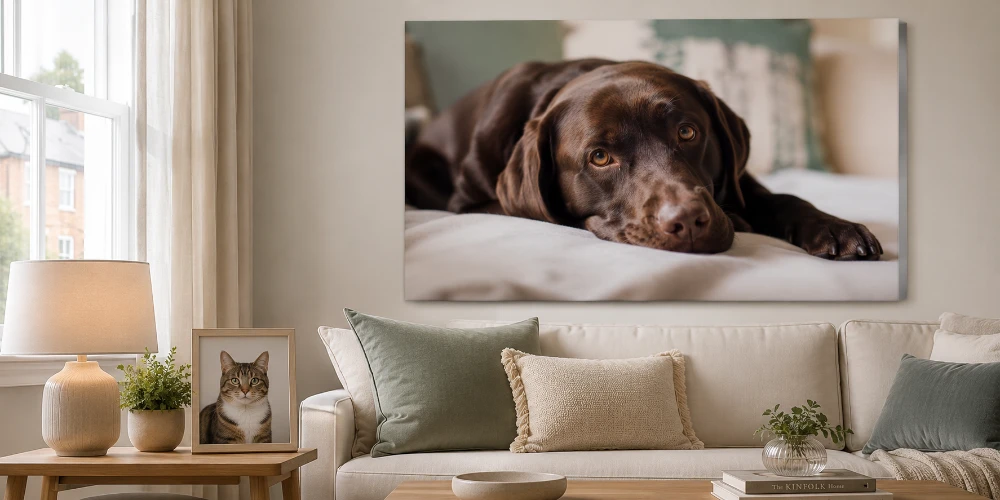
Your photo, printed straight onto canvas or behind acrylic glass, with no artistic filter applied. This is the simplest and often the most powerful option. A great photo of your pet, blown up to 60×40cm and gallery-wrapped, captures something a stylised portrait cannot — the actual look in their eyes.
Photographic portraits work best when:
You have at least one really good photo with sharp focus and good light
Your room style leans modern, minimalist or contemporary
You want something timeless that will not look dated in ten years
The pet is no longer with you and the actual photo matters more than any artistic interpretation
This is the most popular style in our experience, and the one most people end up with. It is also the easiest to get right. If your photo is good, the portrait will be good.
2. AI Artistic Portrait — The Painted Look Without the Wait
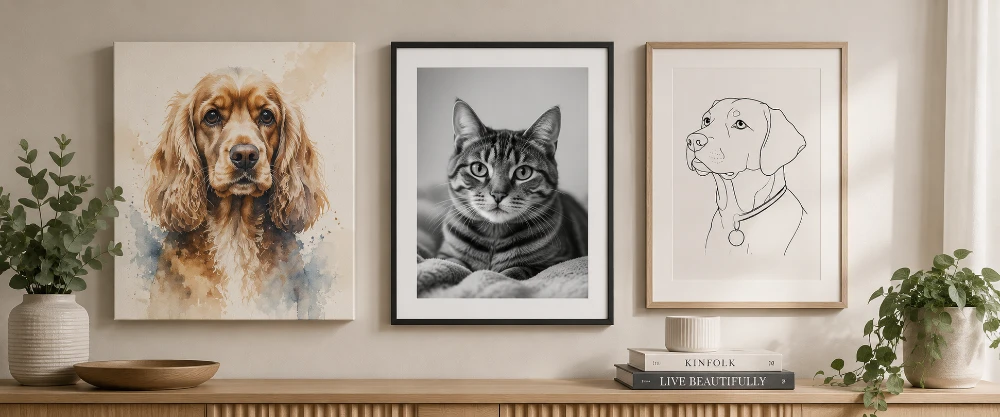
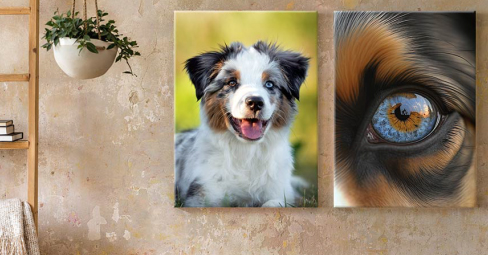
Upload a phone photo of your pet and an AI art tool turns it into something that looks like a hand-painted portrait. Watercolour, oil painting, sketch, ink — different filters give you different finishes, all generated in seconds and ready to print on canvas, framed print or poster.
The change in quality here over the last two years has been extraordinary. Five years ago, AI pet portraits looked like an enthusiastic child with a smudgy paintbrush. Today, the better tools produce results genuinely indistinguishable from a £200 commission — except they cost a fraction of that and arrive in days.
This is the route to take if you want something that looks artistic but you do not want to wait three months. Our AI pet portrait generator lets you upload a photo, try different art filters, and preview the result on canvas, framed print or poster — for free, before you decide whether to order. It works with cats and dogs only, but the range of styles is broad enough to suit almost any room.
3. Hand-Painted Commission — The Traditional Way
A real artist paints your pet, usually from a photo you send. Watercolour, acrylic or oil. You commission, you wait, you receive a one-off original artwork. It is the most expensive option, the slowest, and the one that produces the most genuinely unique result.
This is the route to take if money is no object, you have months to wait, and you want something that nobody else in the world has. There are wonderful UK pet portrait artists working at every price point from £75 to £2,000+. Etsy is full of them; so are Instagram and the Saturday craft markets.
For most pet owners, this is overkill. A printed portrait will do everything you actually need at a tenth of the price. But if you want the traditional craft of an oil-on-canvas painting of your spaniel, nothing else will do.
4. Line Drawing — The Minimalist
A single-line or simple ink illustration of your pet, often paired with their name in elegant type. This style has exploded in popularity over the last few years, particularly among younger UK pet owners who like the Scandi-modern aesthetic.
Line drawings work brilliantly because:
They suit modern, minimalist and Scandi-style interiors perfectly
They photograph well for social media — clean lines, white background
They forgive a less-than-perfect source photo, since the AI or artist is simplifying anyway
They look striking in a small format, so you do not need much wall space
Pair a line-drawing print of each of your pets, framed in matching white frames, and you have one of the most stylish pet displays going. A 30×40cm framed line drawing on a hallway wall is hard to beat for quiet impact.
5. Pop Art and Renaissance — The Conversation Starter
Your dog as Henry VIII. Your cat as a Warhol print. Your hamster in a ruff collar. The novelty pet portrait category has a sense of humour that the others lack, and at its best it is genuinely brilliant. At its worst it looks like a Christmas cracker prize.
These work in eclectic, maximalist and bohemian rooms where they have permission to be a bit silly. They do not work above a serious dining table or in a minimalist sitting room — the joke wears thin fast in the wrong setting.
If you fancy this kind of portrait, treat it as one piece in a varied gallery rather than the centrepiece of a wall. A renaissance-style oil painting of your terrier sitting next to a black-and-white photo of your kids and a coastal landscape works much better than the same renaissance terrier all alone above the fireplace.
How to Take a Pet Photo That Actually Works on a Wall
This is the bit most guides skip and it matters more than anything else. The best canvas in the world will not save a bad photo. Spend twenty minutes getting a really good shot of your pet and the rest of the process becomes easy.
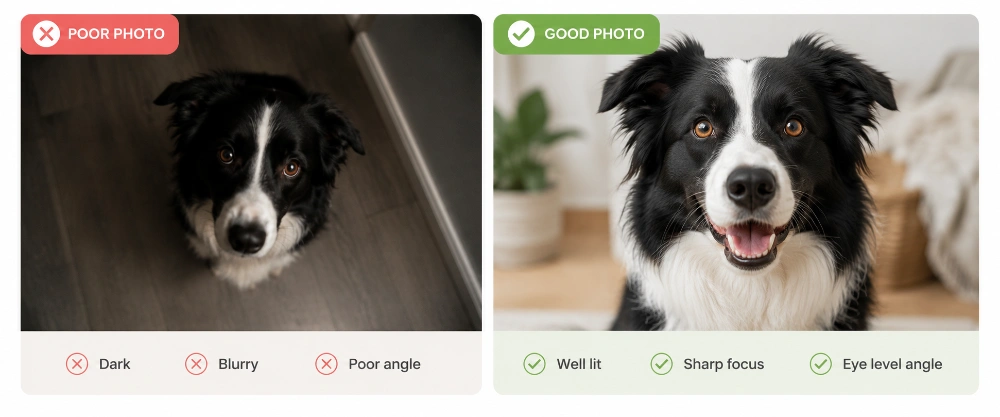
Get down to their eye level
The single biggest mistake people make is photographing pets from standing height, looking down at them. The result always looks distant and odd — you see the top of their head and very little of their face.
Get on the floor. Sit, kneel or lie down. Your phone should be at the same level as their eyes, looking straight at them. Suddenly they look like the subject of a portrait rather than something you spotted from above.
Use natural daylight, indoors near a window
Bright direct sunlight outdoors creates harsh shadows. Dim indoor light makes phone photos blurry and grainy. The sweet spot is indoors, in a room with a big window, with the pet positioned so the daylight is hitting them softly from the side or front.
North-facing windows give you beautiful even light all day. South-facing windows are great in the morning but harsh by midday. If your pet is dark coloured (a black labrador, a black cat), get them as close to the window as possible — dark fur eats light and you need plenty of it to capture detail.
Get them to look at you
You want eye contact. A photo where your dog or cat is looking directly at the camera has far more emotional pull than one where they are looking off into the distance. Get a treat in your free hand, hold it just above the phone, and they will lock eyes with you for long enough to capture the shot.
For cats, who do not always cooperate on demand, try a crinkly toy or a feather wand. The split second they look directly at it is the moment you tap the shutter.
Fill the frame with the face
Resist the temptation to take the photo from too far away with their whole body in shot. For a portrait, you want their face to fill at least half the frame. Move closer or zoom in optically — but do not use digital zoom, which destroys image quality.
If you are getting a head-and-shoulders portrait, frame so their ears and the top of their chest are just inside the edge. If you are getting a body shot, frame loosely so there is some breathing space around them.
Take a hundred photos
Pet photography is a numbers game. Most photos of dogs and cats are blurry, awkward, mid-blink or otherwise unusable. The way to get one brilliant shot is to take a hundred and pick the best three.
Use burst mode if your phone has it. Press and hold the shutter button and your phone takes ten or twenty rapid-fire shots. One of them will probably be the one. Pet photographers do exactly this — they just charge you £200 for the privilege.
Resolution: what is enough
If your photo looks sharp on your phone screen at full zoom, it will print beautifully up to 60×40cm or so. For larger formats, here is a rough guide:
30×20cm: almost any phone photo from the last decade will work
40×60cm: any modern smartphone photo will be fine
60×80cm: use the highest-quality setting your phone offers and avoid heavy zoom
80×60cm and above: you want a recent iPhone or Samsung Galaxy photo, taken in good light, full quality
If you have older photos of a pet who is no longer with you, do not let imperfect resolution stop you. A slightly soft 30×40cm canvas of a dog you loved is worth far more than a pin-sharp 80×60cm of a stranger's pet. Print at the size the photo can support.
Choosing the Right Print Format for Your Pet Portrait
Once you have your photo and your style, the next decision is what to print it on. The four main choices in UK pet portrait wall art each have a different look and a different price point. Here is what they actually do.
Canvas Print — The Default Choice
A canvas print is your photo printed onto premium canvas fabric and gallery-wrapped over a wooden stretcher frame, like a traditional painting. No outer frame needed. This is the most popular format for pet portraits in UK homes and it is the one we sell most of, by some distance.
Why canvas works so well for pets:
The texture of the canvas softens the image slightly, which suits both photographic and AI-painted portraits beautifully
There is no glass, so no reflective glare — important when the canvas is going on a wall opposite a window
Gallery-wrapped means it looks finished from every angle, with no cheap-looking outer frame
Canvas absorbs ink in a way that gives colours real depth and richness
It is lightweight, so a single picture hook holds it
Our canvas prints are printed with HP latex inks on premium quality canvas and backed by a 75-year fade guarantee — meaning a portrait of your dog made today will still look vibrant when their grandchildren are old. Sizes start at 20×20cm and go up to a sizeable 120×80cm. You can see the full size range and Factory Prices on our canvas prints page.
Framed Photo Print — The Classic
Your photo printed on premium photo paper, set behind acrylic glass, with a pure-white bevel-cut mount and a slim decor frame. This is the more traditional, gallery-style finish and it suits formal rooms, period properties and anyone who wants a slightly more polished look than canvas.
Framed prints work particularly well for:
Black-and-white pet portraits, where the white mount frames the image elegantly
Smaller portraits in studies, hallways and bedrooms
Period homes — Victorian, Edwardian and Georgian properties suit framed prints better than canvas
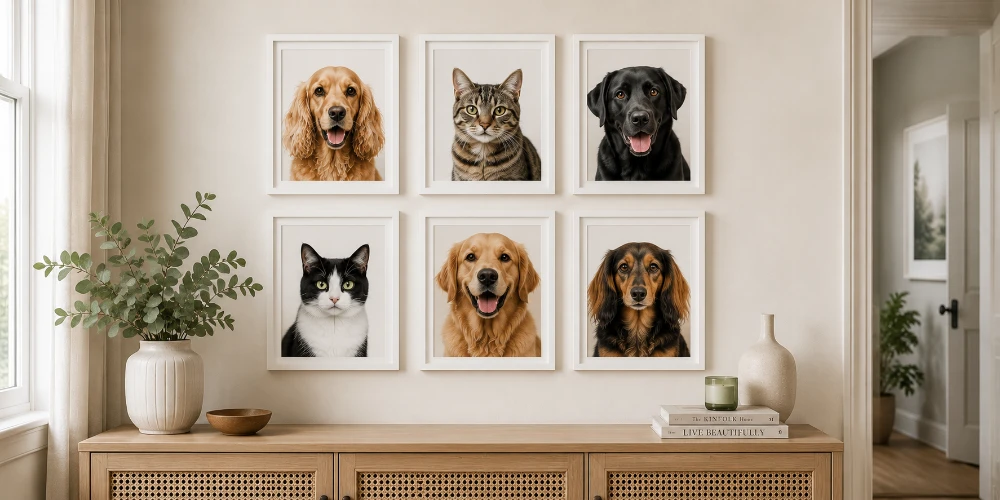
Multi-pet displays where you want consistency — five matching framed prints in a row look properly considered
The bevel-cut mount is one of those details that makes a real difference. The 45-degree cut on the inner edge of the mount catches the light and avoids the flat, shadow-heavy look of cheaper frames. Our framed photo prints come ready to hang and we offer the frame in five finishes including classic black, white, silver and warm wood tones.
Acrylic Photo Print — The Statement
Your photo printed and placed behind crystal-clear acrylic glass, with a frameless design that creates a striking depth effect. The colours look almost three-dimensional and the photo appears to float against the wall when hung with the optional hidden hanger system.
Acrylic is the right choice when:
You want a really modern, gallery-grade finish
The portrait will be a single dramatic statement piece, not part of a gallery wall
Your room is contemporary or industrial and canvas would feel too soft
The original photo has rich colours that you want to maximise — acrylic intensifies colour saturation more than any other format
It is the most premium option and priced accordingly, but for a hero photo of your pet — the kind you want everyone to notice the moment they walk in — nothing else looks quite as impressive. Our acrylic photo prints come in sizes up to 100×75cm, with hanging system included.
Photo Poster — The Affordable Refresh
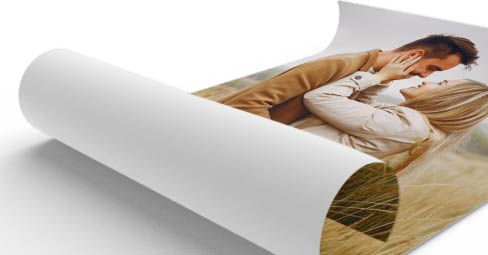
Your photo printed on premium photo paper, available with or without an optional decor frame. Posters are the most affordable wall art format and they work brilliantly when you want to display several portraits without breaking the bank — for example, three different pets in three matching posters along a hallway.
Worth knowing: paper posters do not have the longevity of canvas. They are also less robust against bumps and scuffs. For a long-term feature piece, canvas or framed is the better choice. For a budget-friendly refresh, a quick gift, or a piece you might want to swap out in a year or two, a poster is hard to beat.
Our photo poster prints come in 14 sizes from 30×20cm to 120×80cm and start from £3 at our Factory Price.
A Quick Comparison
Choosing between formats comes down to three things: the look you want, the room it is going in, and what you can spend.
Most popular all-rounder: canvas print, 50×70cm, gallery-wrapped
Best for traditional homes: framed photo print, 40×30cm with white mount
Best for a statement: acrylic photo print, 80×60cm
Best on a budget: photo poster print, 50×70cm with optional decor frame
Best for swappable, multi-pet display: photo tiles or small posters that can be rearranged
Pet Portrait Sizing: Get It Right First Time
Sizing is the bit people get most wrong. Almost everyone goes too small. A 30×20cm canvas of your dog above a three-seater sofa looks like an apology. Here is how to size your pet portrait to actually look intentional.
The Two-Thirds Rule
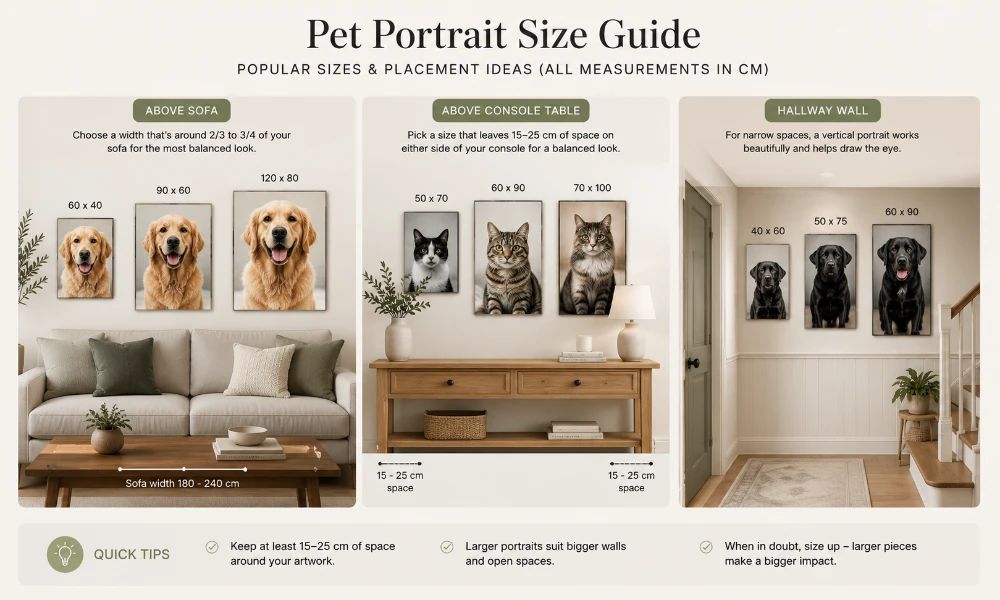
Whatever furniture sits below your portrait — a sofa, a console table, a sideboard — your portrait should be about two-thirds as wide as that piece of furniture. Sometimes a touch more, never much less.
Quick reference for common UK furniture:
Two-seater sofa (140cm wide): portrait or arrangement should be around 95–100cm wide. A 60×40cm canvas, a triptych of three 30×40cm canvases, or a single 80×60cm portrait all work.
Three-seater sofa (200cm wide): you are aiming for around 130–140cm of width. A single 100×75cm canvas is the easiest answer; alternatively, three matching 50×70cm portraits side by side.
Console table (110cm wide): a 60×40cm or 70×50cm portrait sits perfectly above this.
Sideboard (160cm wide): a 100×75cm canvas, or two matching 50×70cm portraits hung side by side.
Standalone hallway wall: a single 50×70cm or 60×80cm portrait centred at eye level looks brilliant. Smaller pieces get lost.
Crop and Aspect Ratio: Important for Pet Photos
Pet portraits have a particular sizing challenge that landscape and family photos do not: the subject is one face, not a wide scene. That means you need to think carefully about cropping before you commit.
If your photo is a tight head-and-shoulders shot of your cat, a square format (40×40cm, 60×60cm) usually works better than a wide landscape. If your photo is your dog mid-run on a beach, a landscape format (80×60cm, 90×60cm) gives the action room to breathe. A standing portrait of a tall dog suits a portrait orientation (40×60cm, 50×70cm).
Match the format to the photo, not the wall. You can always find a wall that suits the canvas you have made; you cannot rescue a beautiful close-up portrait that has been forced into a panoramic crop.
If sizing is the bit you find most stressful, our complete wall art size guide walks through the maths in more detail, including a four-step method for measuring the right size for any wall in any room.
Hanging Height — The 145cm Rule
The centre of your pet portrait should sit roughly 145cm above the floor. This is gallery standard and it works for most rooms with most ceiling heights. If the portrait is hanging above a sofa or console, prioritise the gap between the furniture and the bottom of the frame: aim for 15–25cm of breathing space.
Hang too high and the portrait floats awkwardly. Hang too low and it looks like you ran out of confidence halfway through the job. The 145cm rule is the easiest way to avoid both problems.
Pet Portrait Ideas Room by Room
Where the portrait goes makes as much difference as what is on it. Different rooms have different demands and different opportunities.
Living Room — The Statement Wall
The living room is where most pet portraits end up, and rightly so. It is where you spend time with your pet, where guests visit, and where a good portrait does the most work.
Three approaches that consistently work in UK living rooms:
The single statement: one large portrait (60×80cm or bigger) above the sofa. Bold, simple, hard to get wrong. Best as a photographic or AI-painted canvas.
The matching pair: two portraits of two pets side by side, or two portraits of the same pet at different stages. Works particularly well in symmetrical rooms with a chimney breast.
Pet alongside the family: your pet portrait integrated into a family gallery wall with kids, weddings and travel shots. The pet earns its place rather than being isolated.
If your living room has a chimney breast, that is the natural home for the statement portrait. If it has alcoves on either side, those work beautifully for a matched pair. For more inspiration on living room layouts and wall arrangements, our living room canvas ideas guide covers the full range of placements with measurements.
Hallway — The Quiet Win
Hallways are often forgotten and they are one of the best places for a pet portrait. You walk past them every day. Guests see them as soon as they arrive. And the wall space is usually unbroken, which suits a single tall portrait perfectly.
A 50×70cm portrait-orientation canvas, centred on the longest wall, eye-level — that is the move. If you have multiple pets, three matching portraits in a horizontal row above a console table is the classic alternative and it always looks good.
Kitchen — Be Realistic
Kitchens are tricky. The walls are interrupted by units, the steam from cooking is no friend to wall art, and the subjects on the walls are usually competing with the toaster for attention. But there is one spot that works: the wall above the dining area or breakfast bar, away from the cooker and sink.
Smaller framed prints work better here than large canvases — say 30×40cm with a wipeable acrylic glass cover. A single portrait of the dog who sits under the table at every meal is genuinely lovely.
Bedroom — Calm and Quiet
If you want a pet portrait in your bedroom, keep it gentle. Soft tones, smaller scale, peaceful expressions on the pet rather than mid-action shots. A black-and-white framed print of a sleeping cat above a chest of drawers is exactly the right energy for a bedroom; a colour pop-art Spaniel in mid-bark is not.
Smaller sizes (40×30cm or 50×40cm) work well above bedside tables. A single landscape canvas of your pet asleep — taken on the soft morning light, in colour but muted — above the bed is one of the most underrated pet portrait placements going.
Home Office — The Working Companion
More UK homes have a dedicated home office or working corner than ever before, and a small pet portrait at desk level is a quietly brilliant addition. Either an acrylic photo print or a small framed print works well — both are easy to clean and look smart on video calls.
Size is the trick: 30×20cm or 40×30cm. Big enough to enjoy, small enough to stay out of the way of everything else on the desk.
Multi-Pet Households: Display Ideas That Actually Work
Many of us have more than one pet — sometimes considerably more. Two cats. Three dogs. The cat, the dog and the rabbit. The challenge with multi-pet displays is making them feel like a single thoughtful arrangement rather than a slightly cluttered tribute.
Three principles tend to make the difference.
Match the format
If you are doing a portrait of each pet, use the same format for all of them. Three matching canvases at 40×30cm look like a deliberate set; two canvases plus a framed print plus an acrylic block looks like an accident.
Same size, same orientation, same finish. The eye reads them as a series. The pets are the variation; everything else stays consistent.
Match the photo treatment
Beyond format, treat all the photos the same way. All in colour, or all in black-and-white, or all in the same AI art filter. A black-and-white cat next to a colour dog next to a watercolour-style hamster looks chaotic. Pick a treatment and stick to it across the set.
Black-and-white is the safest bet for multi-pet displays. It tones down differences in lighting, fur colour and photo quality between shots taken at different times. And it ages well — a B&W set you make today will not look dated in five years.
Pick a coherent layout
There are three layouts that consistently work for multi-pet portraits:
The horizontal row: three or four matching portraits in a single line, evenly spaced. Spacing of 5–7cm between them. Works above a sofa, console or sideboard.
The grid: four, six or nine portraits arranged in a 2×2, 3×2 or 3×3 grid. Cleanest and most modern look, particularly with white framed prints.
The cluster: one larger portrait of your most photogenic pet (or the head of the household) flanked by smaller portraits of the others. Asymmetric but anchored.
For households with three or more pets, a grid arrangement is hard to beat. If you would rather not commit to a permanent layout, our MIXPIX® photo tiles use a magnetic plus adhesive hanging system, so you can rearrange them as your pet family changes — useful when a new puppy arrives or you adopt a third cat. They come in 20×20cm tiles, perfect for individual pet portraits.
If you fancy a larger gallery wall mixing pet portraits with family photos, travel shots and other personal pieces, our gallery wall ideas guide covers layouts and spacing in more detail.
Memorial Pet Portraits: A Sensitive Note
This is a section we wrote carefully, because it is one of the more meaningful uses of a pet portrait — and one of the more emotionally loaded ones.
If your pet has recently died, a portrait can be one of the hardest things to commission and one of the most healing things to live with. There is no "right" time. Some people order a portrait the week of the loss; others wait six months until they feel ready. Both are fine.
Choosing the photo
Most people instinctively reach for a recent photo. That is not always the right choice. A photo from the last few weeks of an older pet's life can sometimes be more painful than helpful to look at every day.
Often the best memorial photos are the ones from your pet's middle years — not too young to feel unfamiliar, not too late to feel sad. The photo of your dog on a beach holiday two summers ago. The picture of your cat curled up on the windowsill in better days. The image you would want to remember them by.
If the photo quality is not perfect, do not worry. Print it at the size it can support. A slightly soft 30×40cm canvas of a pet you loved, on a wall where you can see it every day, is worth more than a flawless image of one you barely knew.
Style choice for memorial portraits
Watercolour-style and soft AI-painted finishes tend to feel gentler than sharp photographic prints for memorial purposes. The slight artistic interpretation creates a small emotional distance that some people find easier to live with day-to-day. Black-and-white photographic portraits can also work beautifully — there is something timeless about a B&W image that suits remembering a life.
Pop art and novelty styles are usually not the right call for a memorial. Save the renaissance dog and the Warhol cat for a pet who is still around to enjoy the joke.
Where to hang it
Some people want the memorial portrait somewhere prominent — the hallway wall, above the sofa, the most-visited spot in the house. Others prefer somewhere quieter — a study, a bedside table, a corner of the home office. Both are valid responses.
There is no rule here. The portrait should be where you want to see it. If that is the kitchen because that is where they always sat, the kitchen is correct. If it is a small framed print on a windowsill in your bedroom, that is correct too.
One quietly lovely tradition: include the memorial portrait in your family gallery wall alongside photos of family members, holidays and other meaningful moments. The pet stays part of the family story rather than becoming a separate, isolated tribute. Many of our customers tell us this is what they end up doing.
How Much Do Pet Portraits Cost in the UK?
There is no single answer because the price varies massively by route. Here is the realistic 2026 picture for a UK customer.
Hand-painted commission from an artist
Small (20×30cm watercolour or sketch): £75–£200
Medium (40×30cm acrylic or oil): £150–£400
Large (60×40cm or above, oil on canvas): £300–£1,500
Premium artists with waiting lists: £1,000–£5,000
Add 4–12 weeks for the work to be done. The price reflects the time, skill and materials of a working artist.
Printed photographic portrait
Small (20×30cm canvas): from £4.50 at our Factory Price
Medium (40×60cm canvas): from around £15–£25
Large (60×80cm canvas): from around £30–£45
Extra large (100×75cm canvas): from around £40–£60
Framed prints and acrylic prints typically run 20–40% higher than canvas at equivalent sizes
Add 5–8 working days for production and delivery in the UK. The price reflects the production cost rather than artistic time, which is why it is so much lower than a commissioned painting.
AI-generated artistic portrait, then printed
AI generation: free to preview at most providers, including ours
Printed canvas at 40×30cm: from around £12–£20
Printed canvas at 60×80cm: from around £30–£45
This is the route to take for the best ratio of "painted look" to total cost. You get a portrait that looks artistic for the price of a print, and you can preview the result before paying anything.
What about commission marketplaces (Etsy, Not on the High Street)?
Etsy and Not on the High Street sit between commissioned art and printed portraits. You will typically pay £40–£250 for a digital file or printed product, with delivery taking anywhere from 1–6 weeks depending on the seller. Quality varies enormously — some Etsy artists are extraordinary, others are using the same AI tools you could use yourself for free.
If you go the Etsy route, look for sellers with hundreds of reviews and clear before-and-after examples of their work. The cheapest listings (under £20) are almost always AI-generated outputs presented as bespoke art.
Common Pet Portrait Mistakes (And How to Avoid Them)
Most pet portrait disappointments come down to one of these. Sidestep them and you are most of the way to a result you genuinely love.
Going too small. A 20×30cm portrait of your dog above a three-seater sofa looks lost. When in doubt, size up.
Using a low-resolution photo at a large size. Phone screenshots, heavily zoomed shots and old scanned photos do not enlarge well. Match the print size to what your photo can support.
Taking the photo from standing height. Top-down photos almost never make good portraits. Get on the floor.
Centering the pet too small in the frame. Fill the frame with the face. If the pet is a tiny dot in a wide background, no amount of printing fixes it.
Choosing a busy background photo. A garden full of toys behind your dog will compete with the dog. The best portrait photos have plain or softly blurred backgrounds.
Mixing styles in a multi-pet display. One canvas, one framed print and one acrylic look like an accident. Pick one format and commit.
Going pop-art for a memorial. The novelty styles work for living pets. They rarely feel right for remembering one.
Hanging too high. The centre of the portrait should be at 145cm. Most people instinctively go 15–20cm above that.
Skipping the preview. Always preview your photo on the actual product before ordering. Most providers (including us) let you do this for free.
The Short Version
If you skim-read everything above, here is the whole guide in eight sentences.
Take a hundred photos at your pet's eye level in natural daylight, then pick the best three.
Decide on a style: photographic, AI artistic, line-drawing, hand-painted commission, or pop-art.
Canvas is the safest and most popular format for UK homes; framed for traditional rooms; acrylic for modern statement pieces.
Size your portrait to roughly two-thirds the width of the furniture below it.
Hang the centre at 145cm above the floor with 15–25cm above any sofa or console.
For multi-pet households, match the format and the photo treatment.
Memorial portraits work best with mid-life photos and softer styles like watercolour or B&W.
Always preview your portrait on the product before ordering.
That is genuinely the lot. Pick a good photo, choose a style that suits your room, get the size right, and you will end up with a portrait you actually love.
Pet portraits are one of the few wall art categories that genuinely cannot disappoint when done thoughtfully. Your dog or cat is the only one of their kind. Putting their face on the wall is the simplest way to celebrate that — and to make sure the photo of them in the kitchen at golden hour two summers ago does not stay buried in your phone forever.
Frequently Asked Questions
How much does a pet portrait cost in the UK?
It depends entirely on the route. A printed photographic or AI-generated pet portrait on canvas starts from £4.50 at our Factory Price for the smallest size and runs up to around £60 for an extra-large 100×75cm canvas. A hand-painted commission from a UK artist starts at around £75 for a small watercolour and can run into thousands for a large oil painting. The middle ground — Etsy or Not on the High Street commissions — typically lands at £40–£250.
What size should a pet portrait be?
Match the size to the wall, not the pet. The portrait should cover roughly two-thirds of the width of the furniture below it. Above a three-seater sofa, that means a 100×75cm single canvas or a triptych of 50×70cm canvases. Above a console or sideboard, 60×40cm or 70×50cm. For a hallway wall, 50×70cm portrait orientation is the sweet spot.
Can I make a pet portrait from a phone photo?
Yes — and most of the pet portraits we print start as phone photos. Modern iPhones and Samsung Galaxy phones produce images sharp enough to print up to 60×80cm without any issue. For larger sizes, use the highest-resolution setting your phone offers, take the photo in good light, and avoid digital zoom.
How do I take a good photo of my pet for a portrait?
Get down to their eye level. Use natural daylight from a big window. Get them to look directly at the camera with a treat or toy held just above the lens. Fill the frame with their face. Take a hundred shots in burst mode and pick the best one. The photo prep makes more difference to the final result than any other single factor.
Should I choose canvas, framed or acrylic?
Canvas is the most popular and most forgiving choice — the texture suits both photographic and painted-style portraits, there is no reflective glare, and the gallery-wrapped finish looks polished without an outer frame. Framed prints suit traditional and period homes. Acrylic suits modern, minimalist rooms where you want maximum impact and colour saturation. For most UK homes, canvas is the safest and most popular pick.
What is an AI pet portrait and is it any good?
An AI pet portrait is generated by an AI tool that takes your phone photo and reinterprets it in a chosen art style — watercolour, oil painting, sketch, ink. The technology has improved dramatically in the last two years. The better tools now produce results genuinely indistinguishable from a £200 commissioned painting. They are best for people who want a painted look without the cost or wait of a hand-painted commission.
Can I put more than one pet on the same portrait?
Yes, if you have a photo with both pets in it, that photo can be printed as a single portrait. The challenge is usually getting two pets to pose together — most multi-pet households end up with separate portraits of each pet, displayed as a matching pair or set. This often looks better anyway, since each pet gets their own moment.
How long does it take to receive a printed pet portrait?
From us, 5–8 working days from order to delivery in most cases (production is 2 working days; shipping adds 3–6 days depending on size and destination). Hand-painted commissions from artists typically take 4–12 weeks. Etsy and marketplace timings vary by seller — always check the lead time before ordering.
What is the best photo background for a pet portrait?
Plain or softly blurred. A garden full of toys, a busy patterned rug or a cluttered kitchen will all compete with your pet for attention. The best portrait photos have either a plain wall, a soft natural background like grass or sky, or a deliberately blurred background that draws focus to the pet. If your photo has a busy background, most printers (including us) can offer to remove it before printing.
Are pet portraits a good gift?
Probably the best gift you can give a serious pet owner. A printed canvas of someone's dog or cat consistently outperforms more expensive purchases — it is personal, lasting and gets used (well, looked at) every day. The trick is getting hold of a good photo without giving the surprise away. Most people manage this by asking the recipient's partner to send them their best photo of the pet.
Can I have a portrait made of a pet who has died?
Yes, and many of our pet portrait orders fall into this category. There is no "right" time to do it — some people order in the first week of the loss, others wait months. The best memorial portraits often use photos from the pet's middle years rather than their final months, since recent photos can sometimes feel painful to look at every day. Watercolour-style or black-and-white treatments tend to feel gentler than sharp colour photos for memorial purposes.
What kinds of pets work for portraits?
Cats and dogs are the most popular subjects, but any pet can work — rabbits, guinea pigs, horses, hamsters, parrots, fish, even reptiles. The same rules apply regardless of species: clear focus, eye-level perspective, plain background and a face that fills the frame. Our AI pet portrait generator currently works with cat and dog photos only, but our standard print formats accept any pet image.
Can I see what my pet portrait will look like before I order?
Yes — every product on our site shows you a real-time preview of your photo on the chosen format, in your chosen size, before you commit. For AI-generated portraits, you can preview multiple art filters for free before deciding which (if any) to print. Always preview before ordering — it is the single best way to avoid disappointment.
Will my canvas pet portrait fade over time?
Not for a long time. Our canvas prints are made with HP latex inks on premium quality canvas and we guarantee they will stay vibrant for 75 years. Direct sunlight and high humidity will shorten the life of any wall art, so avoid hanging in the line of strong direct sun or in steamy bathrooms. In a normal living room, your pet portrait will outlast most of the furniture in the house.