How to Choose the Right Canvas Print Size: A UK Size Guide (2026)
byJonathan Vincent– 15+ years of experience in photography, printing & personalised products15 minutes
Choosing the photo is the easy part. Choosing the size is where almost everyone hesitates — and for good reason. A canvas that looks enormous on your phone can vanish above the sofa, and one that seemed sensible at the checkout can swamp a small wall the moment it goes up.
Sizing is the single most common mistake people make with wall art. Get the proportions right and even a simple photo looks deliberate and expensive. Get them wrong and the whole room feels slightly off, even if you can't say why.
This guide fixes that. It is built around real UK furniture measurements and real canvas formats, with every number in centimetres so there is nothing to convert. By the end you will be able to pick the correct size for any room in about five minutes, with a tape measure and the two rules designers actually use.
For broader styling and layout inspiration across the home, our wall art size guide is the wider companion piece. This one is the focused, measure-it-yourself manual.
Key Takeaways
Use the two-thirds rule above furniture: your canvas, or the whole arrangement, should be about two-thirds the width of the sofa, bed or sideboard below it.
Use the 60–75% rule on empty walls: with no furniture beneath, fill 60 to 75 per cent of the wall's width.
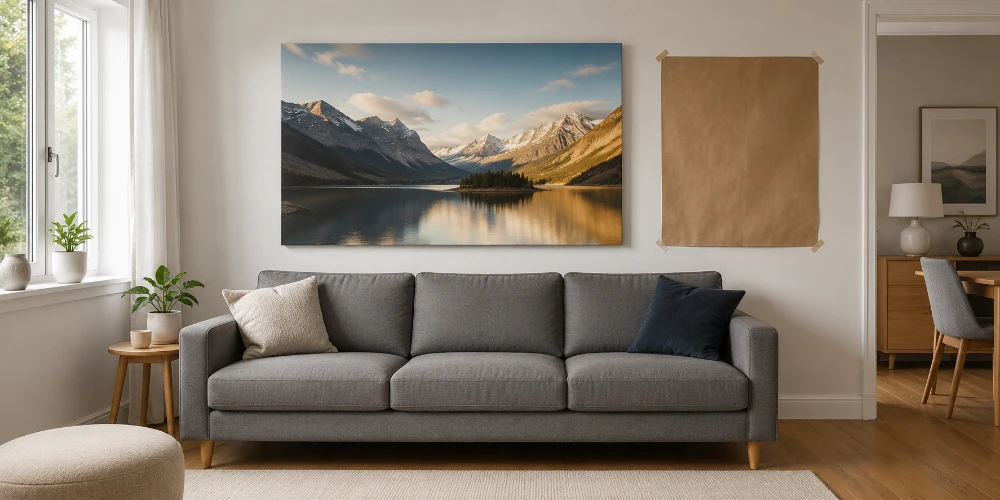
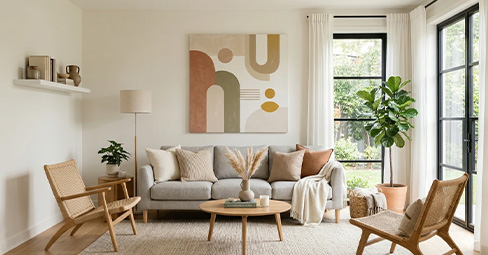
Above a standard UK three-seater sofa (190–220 cm), aim for roughly 120 cm of canvas — a single 120×80 cm, or a trio of 50×70 cm panels.
Hang the centre of the canvas at about 145 cm from the floor, leaving 15–25 cm between the top of the furniture and the bottom of the canvas.
When you are between two sizes, size up. Slightly too big looks confident; too small looks like an afterthought.
Bigger prints need bigger files. Check your photo has enough pixels before ordering a large canvas.
Start With the Wall, Not the Photo
It is natural to choose your favourite picture first and worry about size later. Turn that around. The wall and the furniture below it decide the size; the photo simply fills it.
Before anything else, take two measurements: the width of the furniture the canvas will hang above (or the width of the clear wall, if there is no furniture), and the height of the empty space you have to work with. Those two numbers do almost all the work from here.
The Two Rules Designers Actually Use
Nearly every professional sizing decision comes down to two simple proportion rules. Learn these and the rest is detail.
Rule 1: The Two-Thirds Rule (Art Above Furniture)
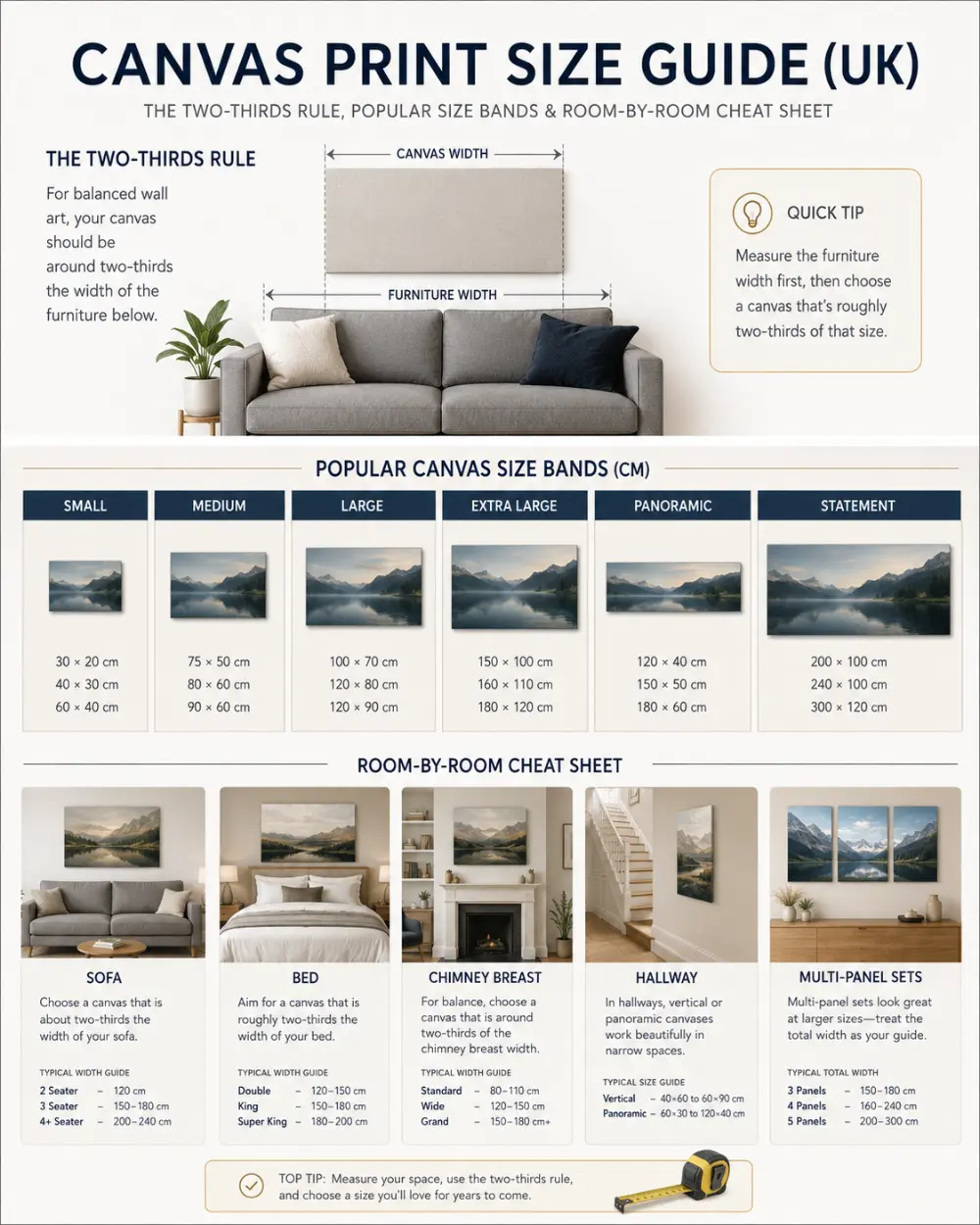
When a canvas hangs above a sofa, bed, console, sideboard or fireplace, it should span roughly two-thirds to three-quarters of that furniture's width. This is the rule designers check first, and the one that makes a room feel anchored.
The maths is quick: measure the furniture width in cm, then multiply by 0.66 (and, if you like, by 0.75) to get your target canvas-width range.
Quick answer: For a 180 cm sofa, 180 × 0.66 ≈ 120 cm. Choose a canvas around 120 cm wide (such as a single 120×80 cm landscape, or a trio of 50×70 cm panels). Go narrower than two-thirds and the art looks undersized and floating; go wider than the furniture itself and it feels unstable.
Rule 2: The 60–75% Rule (Empty Walls)
For a wall with no furniture beneath it — a hallway, a stairwell, an entrance, a dining-room wall — the guide shifts to the wall itself. Your canvas should fill about 60 to 75 per cent of the available wall width.
Measure the wall, multiply by 0.60 and 0.75, and you have your range. Below 60 per cent the wall looks unfinished; above 75 per cent the space starts to feel cramped.
Both rules point the same way: art that is a little generous reads as intentional. Our canvas prints come in 22 sizes across portrait, landscape and square, so there is almost always a format that lands close to your target.
Know Your UK Furniture Sizes First
The two-thirds rule only works if you know the width of the thing you are hanging above. British furniture sits in fairly predictable ranges, so here are the standard UK measurements to size against. Always check your own piece, but these are reliable starting points.
Standard UK sofa widths
Sofa type
Typical UK width
Target canvas width (×0.66)
2-seater (loveseat)
130–180 cm (often ~150 cm)
about 100 cm
3-seater
190–220 cm (often ~200 cm)
about 120–145 cm
4-seater / large
230–300 cm
about 150–200 cm (use a set)
Standard UK bed widths
Above a bed, size against the headboard or mattress width, not the wall.
Bed size
UK width
Target canvas width (×0.66)
Single
90 cm
about 60 cm
Small double
120 cm
about 80 cm
Double
135 cm
about 90 cm
King
150 cm
about 100 cm
Super king
180 cm
about 120 cm
Other useful UK widths: a sideboard or console is usually 100–150 cm, a fireplace mantel 100–140 cm, and a standard interior chimney breast around 90–120 cm wide. Apply the same ×0.66 maths to each.
Canvas Sizes Explained: Small to Extra Large
Canvas formats sort neatly into four bands. Knowing what each band is really for saves a lot of scrolling — and stops you ordering something that disappoints when it arrives.
Band
Typical cm
Best for
Small
20×20 to 30×40
Shelves, desks, narrow gaps, and individual pieces within a gallery wall.
Medium
40×60 to 60×40
The everyday sweet spot above most UK sofas, beds and consoles.
Large
70×50 to 90×60
A confident statement above a three-seater sofa or king-size bed.
Extra large
100×75 to 120×80
Big rooms, high ceilings and open-plan feature walls that need real presence.
On our canvas prints, the range runs from 20×20 cm right up to 120×80 cm (landscape), 80×120 cm (portrait) and 100×100 cm (square) — 22 sizes in all, starting from £4.50. So whatever your target width works out to be, there is a format close to it.
A quick word on A-sizes (A1, A2 and so on). They come from paper sizing, not photo sizing, so their shape rarely matches a phone photo. For personal photos, choosing by centimetres and orientation gives a far better result than chasing an A-number. (If you do want the paper-size reference, our photo frame sizes guide covers it.)
The Above-the-Sofa Size Chart
The wall above the sofa is the most-looked-at surface in most British homes, so it is worth getting exactly right. Measure your sofa arm to arm, then read across.
Sofa width
Target canvas width
Sizes that work
150 cm (2-seater)
~100 cm
One 100×75 cm, or two 50×70 cm side by side
180 cm
~120 cm
One 120×80 cm, or a trio of 40×60 cm
200 cm (3-seater)
~130 cm
One 120×80 cm centred, or a trio of 50×70 cm
220 cm
~145 cm
A trio of 50×70 cm, or a 120×80 cm with two small flanking pieces
260 cm+ (4-seater)
~170 cm+
A gallery arrangement or multi-panel set spanning the width
Most popular choice: For a standard UK three-seater sofa, a single 120×80 cm landscape canvas is the most reliable pick. It fills the wall with impact without crowding the seating. If you prefer a softer, more personal look, a trio of 50×70 cm panels covers the same width with a gallery feel.
If you like the idea of several pieces rather than one, our 100+ gallery wall ideas walks through layouts, spacing and templates in detail.
Room-by-Room Size Guide
The two rules cover the big decisions, but each room has its own quirks. Here is how the sizing plays out around a typical British home.
Above the Sofa
Covered in full above. In short: target two-thirds of the sofa width, leave 15–25 cm between the top of the sofa back and the bottom of the canvas, and centre everything on the wall.
Above a Bed
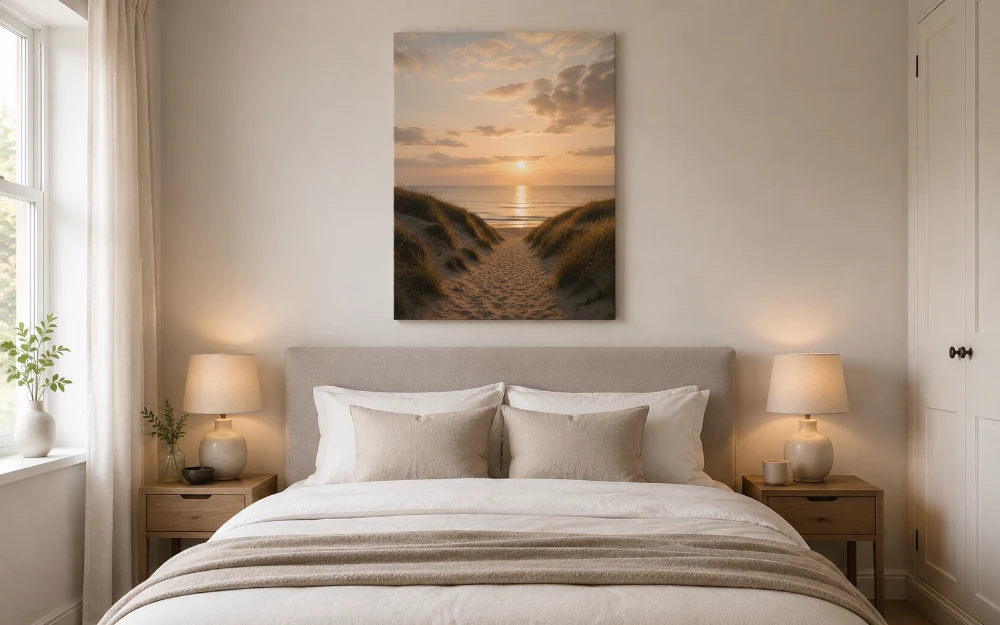
Use the headboard or mattress width, not the wall. A standard UK double is 135 cm, so aim for around 90 cm of canvas; a king (150 cm) suits about 100 cm; a super king (180 cm) carries up to 120 cm.
Portrait orientation usually feels gentler above a bed than a wide landscape, and a calm, softer image suits the room better than a bold one. Keep the bottom of the canvas at least 20 cm above the headboard so nobody knocks it sitting up.
Chimney Breast and Alcoves
The chimney breast is a natural home for a single statement canvas. A 60×80 cm piece sits comfortably within most UK chimney-breast widths.
Leave 15–20 cm between the top of the mantelpiece and the bottom of the canvas.
In the alcoves either side, two matching 30×40 cm canvases create neat symmetry.
Hallways and Stairwells
Hallways reward tall, narrow formats that lead the eye along the space. A single portrait canvas (such as 50×70 cm) works well, or a row of three matching 30×40 cm prints spaced evenly. Up a staircase, step the canvases to follow the angle of the stairs, keeping equal gaps between them.
Dining Rooms and Open-Plan Spaces
Dining rooms suit one bold, single-statement piece. Above a six-seater table (around 180 cm), a 120×80 cm landscape canvas looks generous; hang it 75–85 cm above the table surface so seated diners can see it comfortably. In open-plan rooms, remember the canvas will be viewed from the kitchen too, so go one size larger than you think and avoid anything that reads oddly at an angle.
Small Flats and Box Rooms
In a compact room, restraint wins. Keep individual canvases at or under 50×70 cm, choose lighter tones to keep the space feeling open, and resist filling every wall. One well-placed piece beats five cramped ones, and portrait formats help a low-ceilinged room feel taller.
Landscape, Portrait or Square?
Orientation matters as much as size. The shape of the canvas should echo both the photo and the wall.
Landscape (wider than tall): best above sofas, beds and sideboards, and ideal for scenery, group shots and panoramas.
Portrait (taller than wide): flatters single-person photos, fills narrow walls and alcoves, and adds height in rooms with low ceilings.
Square (1:1): clean and modern, and the natural choice for a 3×3 grid or a set of matching panels.
Ceiling height is the deciding factor when you are unsure. Standard UK ceilings of around 2.4 m — common in newer homes — suit landscape formats. If your ceilings are above 2.6 m, a portrait canvas draws the eye upward and makes the most of the height.
A note on aspect ratio
Aspect ratio is just the relationship between width and height. It is worth a glance because cropping a 3:2 photo into a square loses a chunk of the image.
3:2 — the classic camera and phone shape; suits 40×60 cm and 80×120 cm.
4:3 — a slightly boxier, traditional shape; suits 30×40 cm and 60×80 cm.
1:1 — square; suits 20×20 cm up to 100×100 cm and grid layouts.
Match the canvas ratio to your photo's ratio where you can, and you keep full control of the composition.
Will My Photo Be Sharp at That Size?
This is the question people forget until the canvas arrives. The larger the print, the more pixels your photo needs to stay crisp. Here is a rough guide for a file straight off your phone or camera.
Canvas size
Minimum pixels (approx.)
Real-world check
20×30 cm
800 × 1,200
Almost any recent phone photo is fine.
40×60 cm
1,600 × 2,400
Most modern smartphone shots cope easily.
80×60 cm
2,400 × 3,200
Worth checking on older phones or zoomed shots.
120×80 cm
3,000 × 4,000
Use a recent phone or camera; avoid heavy cropping.
The simplest test: open the photo at full size on a computer. If it looks sharp on screen, it will print well. If it already looks soft or blocky, enlarging it onto canvas only makes that worse. For the full breakdown, see our guide to the best resolution for canvas prints.
One thing to plan for: a gallery-wrapped canvas wraps the image around the edges of the frame, so a little of your photo continues round the sides. If your subject sits right at the edge of the shot, leave breathing room when you crop, or choose a mirror or colour edge so nothing important disappears round the corner.
Hanging Height and Viewing Distance
A perfectly sized canvas can still look wrong if it floats too high or sits too low. Two numbers cover almost every situation.
Hang to eye level
Hang the canvas so its centre — not its top — sits about 145 cm from the floor. This is the gallery standard and the most comfortable viewing height for most people. The most common mistake is hanging art 15–20 cm too high.
Leave the right gap above furniture
Between the top of a sofa or sideboard and the bottom of the canvas, leave 15–25 cm. Closer and the piece looks crammed against the furniture; further and it disconnects from what is beneath it. Above a fireplace, leave at least 15 cm above the mantel.
Think about viewing distance
The further back people view from, the larger the canvas needs to be to read properly. A handy rule: the ideal viewing distance is roughly one-and-a-half to two times the diagonal of the canvas. A large piece across the room earns its size; a small canvas viewed from a distance simply disappears.
Sizing a Gallery Wall (the Maths Made Simple)
A gallery wall follows the same proportion rules — you just treat the whole group as one shape. The trick is to plan the outer dimensions first, then fill in.
Decide the total footprint. Apply the two-thirds rule to the furniture or the 60–75% rule to the wall. That gives you the overall width the group should span.
Choose an anchor. Start with one larger canvas (say 50×70 cm or 60×80 cm) roughly in the centre, then build outwards with medium and small pieces.
Keep spacing consistent. Aim for 5–7 cm between canvases of similar size; tighten to 2–3 cm for triptych panels meant to read as one image.
Lay it out on the floor first. Arrange everything on the floor, adjust until it looks right, then transfer the layout to the wall.
A mix of one large, two or three medium and a few small canvases almost always looks more considered than a grid of identical sizes — unless you specifically want the clean, modern look of a matching 3×3 square grid.
Common Sizing Mistakes (and Easy Fixes)
Going too small
The most frequent error by far. A canvas that is too small for the wall looks apologetic. When torn between two sizes, choose the larger — it almost always reads as more confident and deliberate.
Hanging too high
Art tends to creep up the wall. Aim for the centre at about 145 cm from the floor and most rooms instantly look more polished.
Forgetting the gap above furniture
Too far above the sofa and the canvas floats; too close and it looks cramped. The 15–25 cm gap is the comfortable middle ground.
Ignoring the room's scale
A 30×40 cm canvas vanishes in a large open-plan lounge, while a 120×80 cm piece overwhelms a box room. Match the size to the floor area, not just the wall in front of you.
Ordering a large print from a small file
A low-resolution photo blown up to 120×80 cm will look soft and pixelated. Check the resolution table above before committing to a large size.
Test the Size Before You Buy
You do not need to guess. Two quick, free tricks remove almost all the risk — and they cost less than a roll of masking tape.
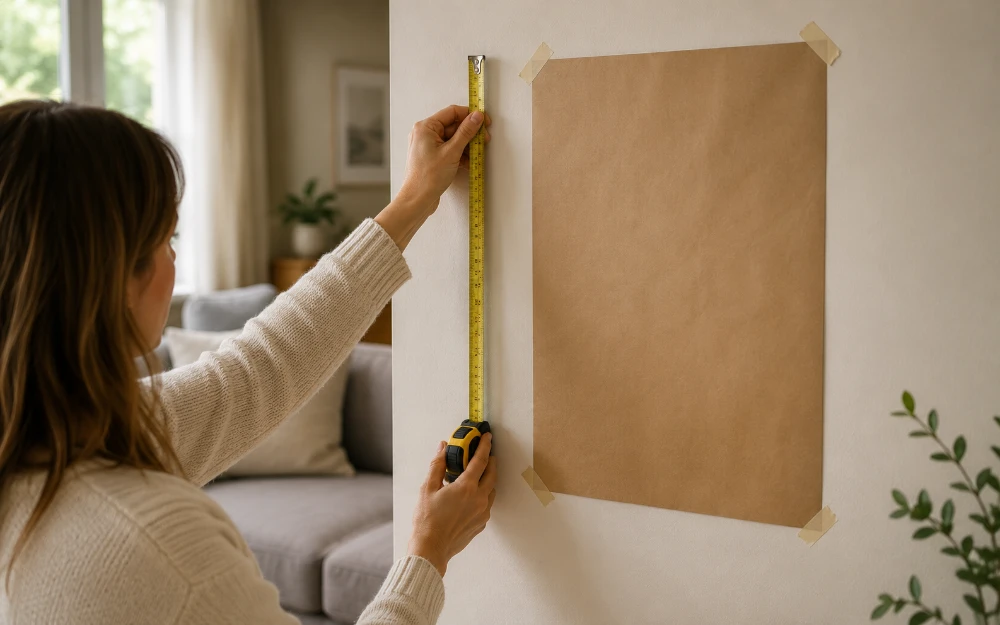
The paper template. Cut sheets of paper or newspaper to the exact size you are considering, tape them to the wall, and live with the layout for a day. Sit on the sofa, stand in the doorway, look from across the room. It is striking how often the size that felt right on screen looks wrong on the wall — and how easily you spot it this way.
The phone-photo trick. Photograph the taped-up template on your wall. Seeing it on a small screen flattens the perspective and reveals proportions your eye glosses over in the room itself.
Once the size feels right, you are ready to order. When the canvas arrives, our step-by-step guide on how to hang a canvas print covers everything from picture hooks to heavier large-format pieces.
What If Canvas Isn't Quite Right?
Canvas is the most popular choice for good reason — light, easy to hang and forgiving in almost any room. But the same sizing rules apply to every wall format, so it is worth knowing your options.
For a sleek, modern look with depth and shine, acrylic photo prints suit contemporary rooms and catch the light beautifully.
For a traditional finish with a border, framed photo prints add a white mount that lets the image breathe.
On a tighter budget, a photo poster print gives you a big format for very little, ready for your own frame.
Can't commit to drilling? MIXPIX® photo tiles are nail-free 20×20 cm tiles you can rearrange whenever you like — ideal for renters and ever-changing gallery walls.
Getting the Size Right, First Time
Canvas sizing stops being daunting once you know the rules. Measure the furniture or wall, apply the two-thirds rule (or the 60–75% rule on an empty wall), check your photo has enough pixels, and test the size with paper before you drill. Do those four things and you will get it right first time — no returns, no regrets.
When you are ready, you can explore all 22 formats and preview your own photo on our canvas prints page before you order.