Turning a favourite photo into a poster is still the cheapest way to get proper wall art in your home. In 2026 you can order a personalised photo poster in the UK for less than the price of a meal deal — but prices swing wildly between shops, sizes and paper types, and it's very easy to pay three or four times more than you need to.
This guide gives you the real numbers. We'll cover exactly what photo poster printing costs in the UK right now, which sizes fit which walls, how to check your photo is sharp enough before you order, and the traps (like ex-VAT pricing and auto-cropping) that catch people out. No jargon, no hard sell — just everything we've learnt from printing millions of photos.
Key Takeaways
A personalised photo poster costs between £3 and £45 in the UK in 2026, depending on size and where you order. Online photo labs are almost always cheaper than high-street and same-day services.
A3 (29.7 x 42 cm) is the most popular poster size in the UK and the best value for money. Go A2 or bigger for a statement wall.
Aim for at least 150 DPI, ideally 200 DPI. A standard 12-megapixel phone photo prints sharply up to around 60 x 40 cm.
Choose a matte finish for most rooms — it kills glare and hides fingerprints. Save gloss for evenly lit spaces.
Check the crop before you pay. Phone photos and A-size posters are different shapes, so careless ordering chops off heads and edges.
Watch for ex-VAT prices. Many commercial print shops quote prices without VAT, so the real cost is 20% higher than the number on screen.
What is a photo poster print — and why is it so cheap?
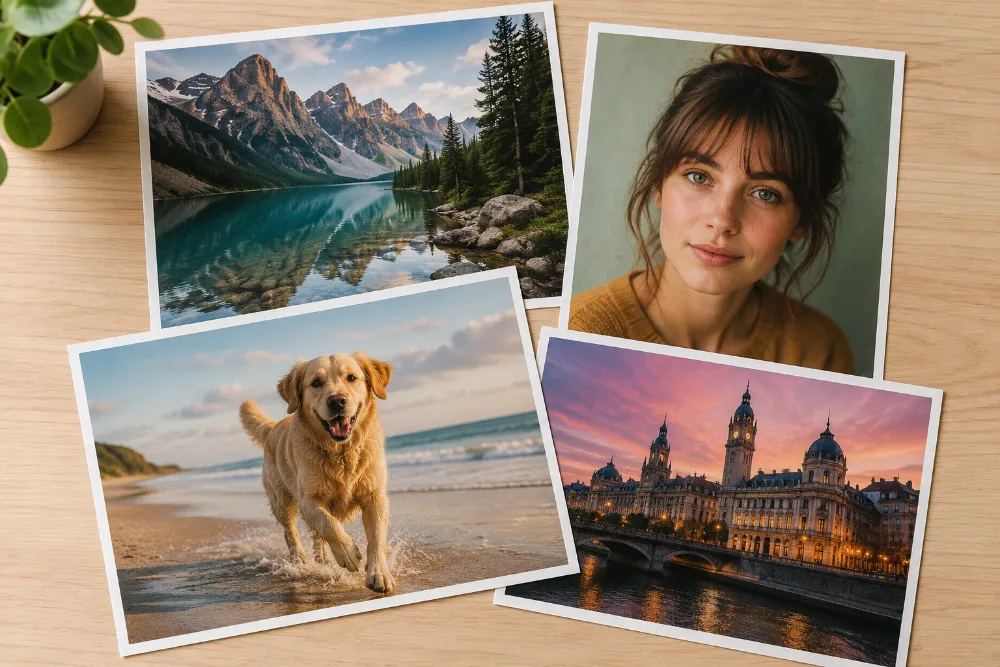
What is a photo poster print? A photo poster print is your own picture printed onto a single sheet of quality photo paper, usually with a matte or gloss finish and no frame. It's the most affordable type of personalised wall art because there's no wooden frame, glass, canvas or mounting board to pay for — just the print itself.
Think about what goes into other wall art. A canvas needs a wooden stretcher frame and someone to wrap and fix the fabric around it. A framed print needs the frame, the glass and a mount. An acrylic print needs a thick sheet of acrylic glass. A poster needs none of that. You're paying for premium paper, ink and skilled printing — nothing else.
That's why a poster is the natural choice when you want to:
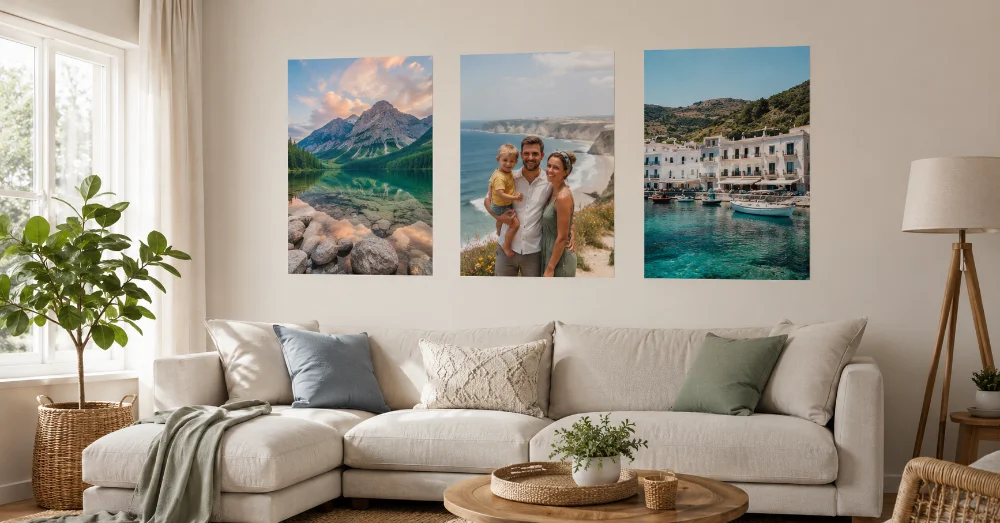
Decorate on a tight budget — a full gallery wall of posters costs less than one large canvas
Fill a big blank wall without a big spend
Change your display often — posters swap out in seconds
Test a photo at full size before committing to a pricier canvas or framed version
Decorate a rented flat, student room or nursery without drilling a single hole
At My Picture, our Photo Poster Prints start from a Factory Price of just £3.00 for a 30 x 20 cm poster (down from a Retail Price of £10.90). They're printed in HD on art-grade 275 g/m² photo paper with an elegant matte finish, and there's a self-adhesive version on 340 g/m² adhesive paper too — it sticks straight to any smooth wall and peels off cleanly, no tape or hooks needed.
How much does photo poster printing cost in the UK in 2026?
Here's the honest picture, based on live prices across the main UK photo printers in 2026. Prices vary a lot by size, paper and service speed, so this table shows you the realistic range — and what a fair deal looks like.
Size
Typical UK price range (2026)
Notes
Small (A4 / 30 x 20 cm)
£3 – £9
Online labs cheapest; in-store dearest
A3 (approx. 30 x 40 cm)
£5 – £14
The value sweet spot
A2 (approx. 40 x 60 cm)
£13 – £22
Statement size, still affordable online
A1 (approx. 60 x 84 cm)
£17 – £43
The biggest price gap between shops
Extra-large (70 x 100 cm+)
£28 – £55
Online labs far cheaper than high street
And here are our own poster Factory Prices, verified live:
Format
Retail Price
Factory Price
30 x 20 cm
£10.90
£3.00
40 x 30 cm
£15.90
£4.00
60 x 20 cm
£17.90
£6.00
60 x 30 cm
£17.90
£6.00
60 x 40 cm
£19.90
£7.00
What's a "Factory Price"? Because we make everything ourselves in our own European production sites, we cut out the middleman and pass the saving straight on. The Factory Price is the everyday price you pay direct from the maker — not an inflated Retail Price waiting for a "sale". We also back it with a Lowest Price Guarantee: find the same poster format cheaper at another UK online shop (comparing total price including delivery) and we'll beat that price by 5%.
The hidden cost trap: ex-VAT pricing
Here's something almost nobody warns you about. Many commercial print shops — the ones aimed at businesses printing event and advertising posters — quote their prices excluding VAT. That £10 poster is actually £12 at checkout. Consumer photo services like ours always show the full price including VAT, but if you're comparing across different types of printer, check the small print before you get excited about a "bargain". A quiet "all prices exclude VAT" line in the footer is the giveaway.
Bigger posters are better value per centimetre
One thing worth knowing: the price per square centimetre falls as posters get bigger. Our 30 x 20 cm poster works out at about 0.5p per cm², while the 60 x 40 cm is under 0.3p per cm² — four times the area for just over twice the price. So if you're torn between two sizes and your photo's resolution allows it, sizing up usually gives you more wall impact for your money.
UK poster size guide (in cm, with what fits where)
Poster sizes in the UK mostly follow the "A" series. The clever bit is that each size is exactly half the one above it — two A3 sheets make an A2, two A2 make an A1, and so on. Every A size is also the same shape (a ratio of 1 to 1.414), which matters more than you'd think, as we'll see in a moment.
Size
Dimensions (cm)
Inches
Best for
Viewing distance
A4
21 x 29.7
8.3 x 11.7"
Desks, shelves, gallery walls
Up close
A3
29.7 x 42
11.7 x 16.5"
Bedrooms, hallways — the UK's most popular size
~0.8–1 m
A2
42 x 59.4
16.5 x 23.4"
Living rooms, above a desk or dresser
~1–1.5 m
A1
59.4 x 84.1
23.4 x 33.1"
Feature walls, above a sofa
~1.5–2 m
A0
84.1 x 118.9
33.1 x 46.8"
Big rooms, stairwells, maximum impact
~2–3 m
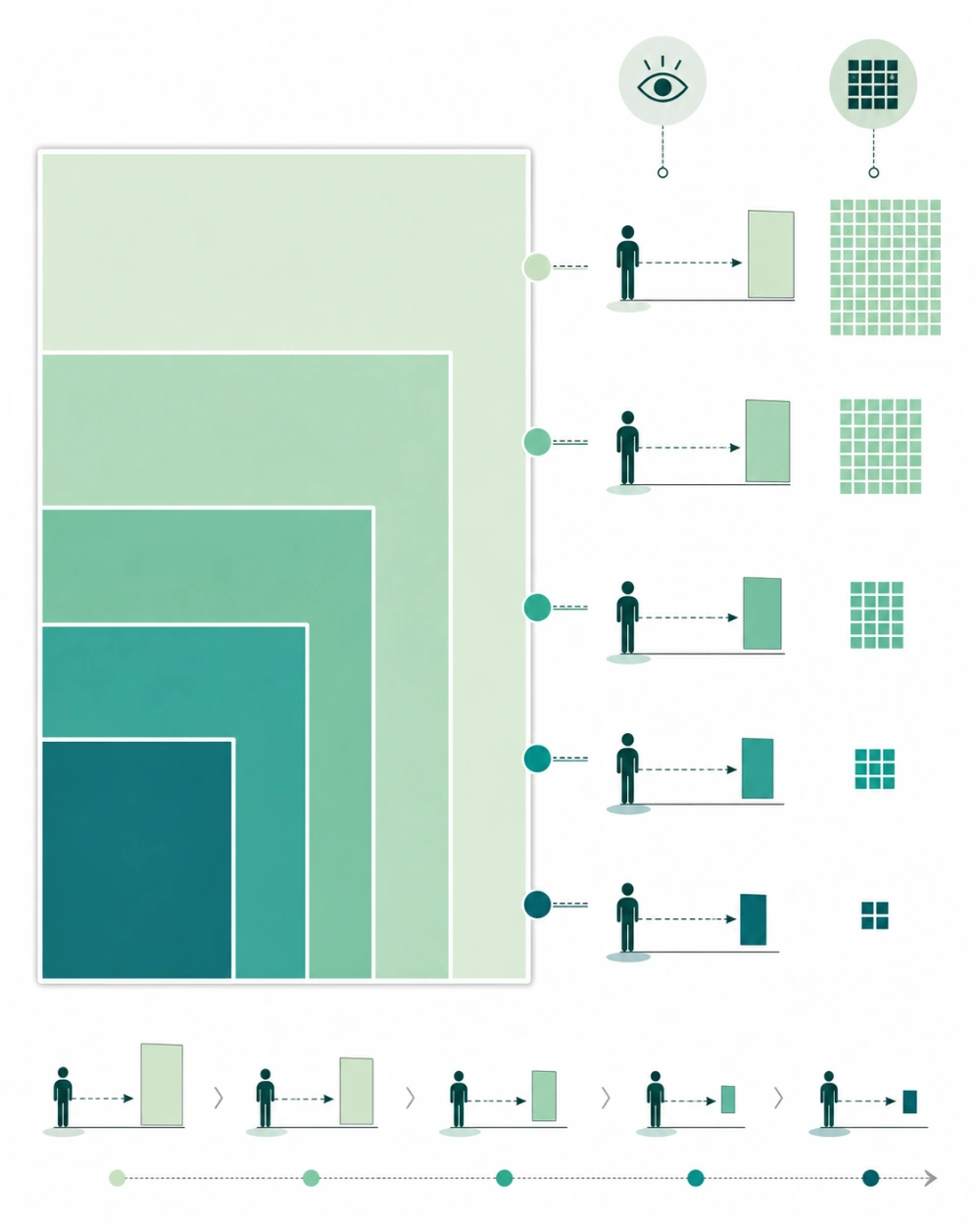
The viewing distance column uses a simple designer's rule of thumb: people naturally stand back from a print at roughly one and a half to two times its diagonal. It's why a huge poster in a tiny hallway feels overwhelming, and a small one across a big room disappears.
A quick sizing shortcut for above furniture: aim for your poster (or group of posters) to span roughly two-thirds the width of the sofa, bed or sideboard below it. For lots of worked examples and layouts, our gallery wall ideas guide has over 100 arrangements you can copy directly.
Not every printer sticks rigidly to A sizes, and that's often good news for photos. Our own poster range comes in cm formats like 30 x 20, 40 x 30, 60 x 30 and 60 x 40 — shapes chosen to match how cameras actually take pictures. You'll find every format listed on our Formats & Prices page.
The cropping trap: why poster shape matters as much as size
This is the single most common reason people end up disappointed with a photo poster — and hardly anyone explains it.
Your photo and your poster are usually different shapes. Most phone photos are a 4:3 ratio. Most proper cameras shoot 3:2. But every A-size poster is 1:1.414 — a shape no camera produces. So when you put a phone photo on an A2 poster, something has to give: either a slice of your image gets cropped off, or you get white bars down the sides.
Here's how the shapes line up:
Your photo
Its shape
Poster sizes that match exactly
Phone photo (iPhone, Samsung, Pixel)
4:3
40 x 30 cm, 60 x 45 cm
Camera photo (DSLR, mirrorless)
3:2
30 x 20 cm, 60 x 40 cm
Square (Instagram-style crop)
1:1
Square formats only
Any photo
—
A-sizes always crop a little
Three ways to stay in control:
Pick a poster shape that matches your photo. A 40 x 30 cm poster is exactly 4:3 — the same shape as your phone photos — so nothing gets trimmed at all.
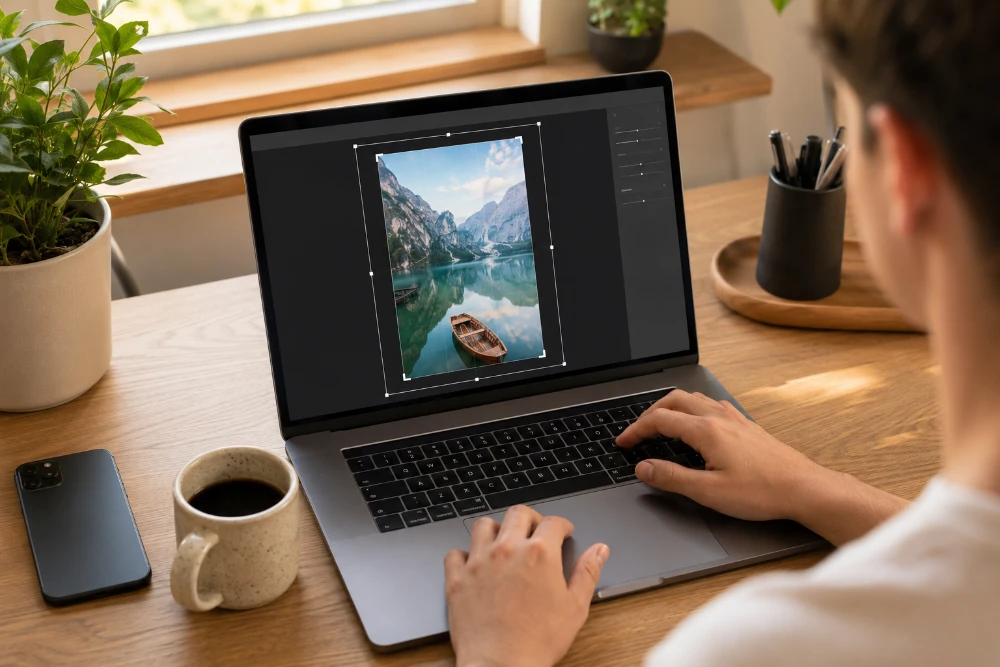
Preview the crop before you pay. Every decent online editor shows you exactly what will print. Drag the photo around until heads, feet and important details sit safely inside the frame.
Crop the photo yourself first. If you crop your image to the poster's shape in your phone's photo app before uploading, you decide what goes, not an algorithm.
What resolution do you need for a sharp poster?
The other big cause of poster disappointment is resolution. A photo can look perfect on your phone screen and still print soft at A1, because blowing an image up spreads its pixels thinner.
The good news: posters are more forgiving than small prints, because you view them from a step or two back. For poster printing, 150 DPI is the practical minimum and 200 DPI is the sweet spot. You only need the full 300 DPI for small prints people will study up close — for giant wall art viewed from across the room, even 100 DPI can look fine.
DPI in plain English. DPI stands for "dots per inch" — how many dots of ink land in each inch of paper. More pixels in your photo means more dots per inch at a given size, which means a sharper print. To find your photo's DPI at any poster size: divide the photo's pixel width by the poster's width in inches. A 4,000-pixel-wide photo on a 16.5-inch-wide A3 poster = 242 DPI. Lovely and sharp.
Here's what your photo's longest edge needs to measure, size by size:
Poster size
Minimum (150 DPI)
Recommended (200 DPI)
What that means in practice
A4 (29.7 cm)
~1,750 px
~2,340 px
Any phone from the last decade
A3 (42 cm)
~2,480 px
~3,300 px
Any modern phone
A2 (59.4 cm)
~3,500 px
~4,680 px
A standard 12 MP phone (4,032 px) clears this
A1 (84.1 cm)
~4,970 px
~6,620 px
16–20 MP camera, or a high-res phone mode
A0 (118.9 cm)
~7,020 px
~9,360 px
24 MP+ camera
A standard 12-megapixel phone photo (4,032 x 3,024 pixels) comfortably covers everything up to about 60 x 40 cm and squeaks past A2. For A1 and A0 you'll want a proper camera or a recent phone shooting in its full-resolution mode.
And a reassuring backstop: when you upload a photo to our editor, it automatically warns you if the resolution isn't enough for the size you've picked — so you can't accidentally order a fuzzy A1.
One firm rule: never print from a screenshot, a WhatsApp forward or a photo saved from social media. All of them are heavily compressed copies of the original. Go back to the source — your camera roll, or ask the person who took it to send the original file.
Paper explained: gsm, gloss, matte and satin
Two things define poster paper: its weight and its finish. Both change how your poster looks and lasts, and both are worth thirty seconds of thought.
What does gsm actually mean?
You'll see "gsm" (grams per square metre) everywhere in printing, and almost nobody explains it. It's simply how heavy — and therefore roughly how thick and sturdy — the paper is.
80 gsm — ordinary office printer paper. Flimsy, see-through, curls instantly. Fine for a school project, not for a wall.
130–170 gsm — budget poster paper used for short-term event and advertising posters.
200 gsm — the standard for consumer photo posters at most big online labs.
250–275 gsm — premium photographic poster paper. Noticeably stiffer, hangs flatter, feels like a proper print. Our standard posters use 275 g/m² stock, which is why they don't ripple or curl at the corners the way lightweight posters do.
300 gsm+ — approaching card. Used for fine-art prints.
Simple rule: for wall art, don't go below 200 gsm. The paper is a small part of the cost but a huge part of how "cheap" or premium the finished poster feels.
Gloss vs matte vs satin
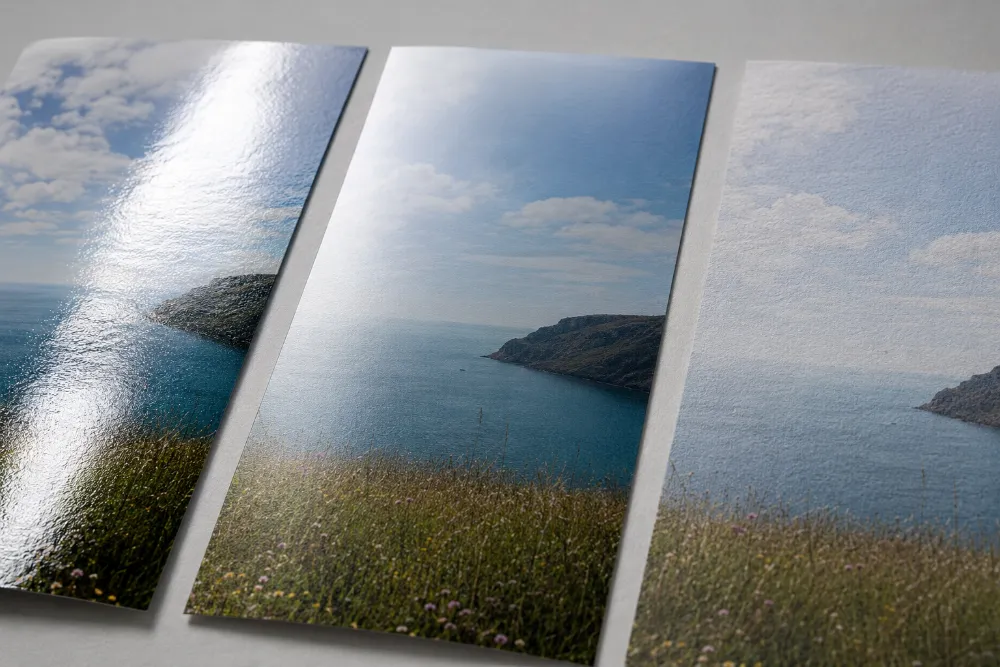
Matte has a flat, non-reflective surface. It cuts glare completely, hides fingerprints and gives a soft, modern gallery look from any angle and in any light. It's also the kinder choice for black-and-white photos, where reflections spoil shadow detail. It's the best all-rounder, and it's the finish we use as standard.
Gloss is shiny and makes colours punchy — brilliant for vivid travel shots and bold graphics. The catch: it bounces light. Hang a gloss poster opposite a window and you'll spend half the day looking at the window's reflection instead of your photo. Gloss suits rooms with soft, even lighting.
Satin (also sold as lustre or silk) sits in between — richer colour than matte, far less glare than gloss. A safe middle ground if you truly can't decide.
Quick finish picker. Matte = best for most walls; no glare, no fingerprints. Gloss = vivid colour in evenly lit rooms. Satin = the happy medium. Planning to frame behind glass or acrylic? Always choose matte — the cover already adds one reflective layer, and a shiny print underneath doubles the glare.
Where can you print photo posters in the UK? All your options compared
There are four realistic routes to a printed photo poster in the UK, and they suit different situations. Here's the honest comparison.
Best quality-for-price, biggest size and paper choice
Delivery time — order ahead for gifts
Supermarket & high-street counters (Asda, Max Spielmann, Boots)
2–4x online prices
Same day, collect in store
Genuine emergencies
A1 can cost £40+
Stationers' print services (Ryman and similar)
Mid-range + flat fees
Same day possible
Documents and one-off quick jobs
Base fees added per order
Commercial print shops (business poster printers)
Cheap per unit ex VAT
24–48 hours
Bulk runs of the same design
Prices usually exclude VAT; thin 130–170 gsm paper as standard
What about printing posters at home?
Tempting, but the maths rarely works. Most home printers top out at A4 — genuinely poster-sized prints are physically impossible on them. And even at A4, once you add up photo paper (roughly 20–50p a sheet) and ink (often the most expensive liquid in your house), a single home photo print typically costs as much as — or more than — ordering the same size from an online lab, without the professional colour accuracy or heavyweight paper. A3-capable photo printers exist, but they start at a few hundred pounds. Unless you already own one and print constantly, ordering online wins on both cost and quality.
Seven honest ways to pay less for poster printing
Order online, not on the high street. The same A1 photo poster can cost two to three times more as a same-day, in-store print. Unless you genuinely need it today, online wins.
Combine your order to unlock free delivery. Most photo labs charge delivery on small orders but waive it above a threshold — ours is £49. Two or three posters, or a poster plus a gift, often costs barely more than one poster plus postage.
Sign up before you buy. Most photo printers offer a first-order discount for joining their mailing list — ours gives £5 off your first order by email, with a further £5 off a second order for UK customers who add SMS. Thirty seconds of admin for real money off.
Match the size to the photo, not your ambition. A crisp A3 always beats a soft, over-stretched A1 — and costs less.
Students: ask about discounts. Several UK print services offer student discounts on posters (some London same-day printers give 10% off) — always worth checking before checkout.
Time big orders around sale events. Photo printing follows the same rhythm as the rest of UK retail — late-November sales and January promotions are reliably the cheapest moments for big multi-poster orders.
Check whether the price includes VAT. As covered above — a "cheap" trade price that excludes VAT is 20% dearer at checkout.
How to prepare your photo for poster printing: a 6-step checklist
Start with the original file. From your camera roll or the photographer — never a screenshot or social-media download.
Check the pixel count against the resolution table above for your chosen size.
Match the shape. Landscape photo on a landscape poster, portrait on portrait — then pick a format that matches your photo's ratio, or crop it yourself first.
Preview the crop and keep faces and key details away from the very edges, in case of a slight trim.
Sharpen gently. Prints look a touch softer than glowing screens, so a small sharpening boost helps — especially on matte paper. Most phone photo apps have a sharpen slider.
Export at full quality. If you edit, save as a maximum-quality JPEG, not a "reduced size" version.
Which photos make the best posters?
Poster format loves images with one clear subject and a bit of breathing room: a landscape with a strong horizon, a portrait against a simple background, a pet mid-leap, city architecture at dusk. Very busy group shots and dim, grainy evening photos are the ones that struggle at scale. And if a photo you love is simply too small for a big poster, don't force it — order it as a set of smaller photo prints instead and group them; you keep the sharpness and gain a display with real character.
How to display and hang your poster (renters welcome)
A poster's superpower is flexibility — there are more ways to hang one than any other kind of wall art, and most leave no trace on the wall.
Frames. A frame instantly upgrades a poster and protects it from knocks and curling. Standard A-size frames are cheap and everywhere. Prefer everything in one parcel? Our posters come with an optional decor frame in five designs — classic black, white and silver plus warm wood tones — with a slim profile and an acrylic glass cover, and a hanger set to get it straight on the wall.
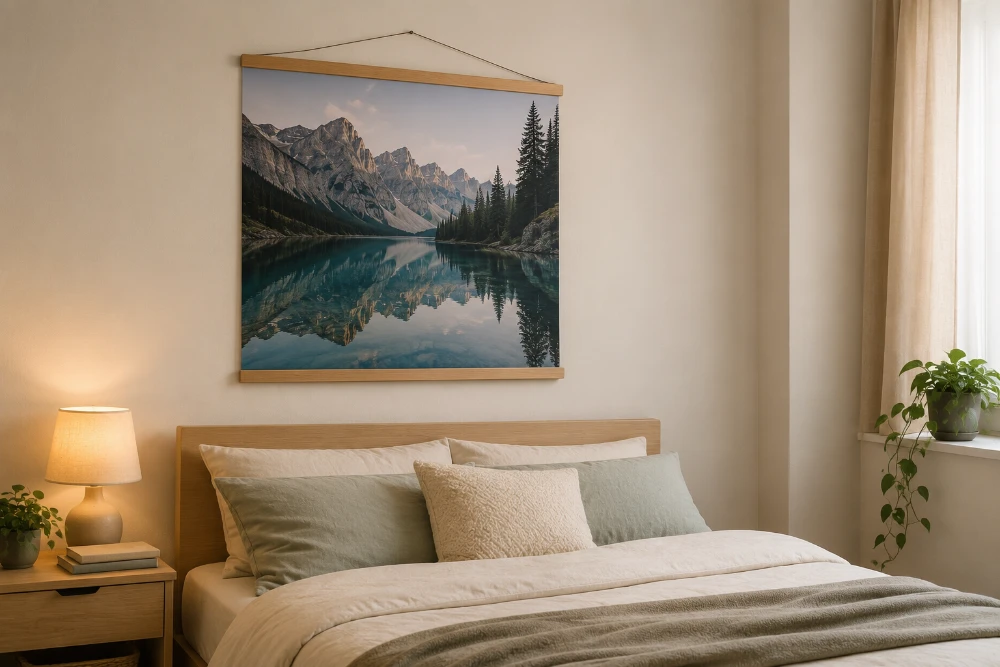
Poster hangers. Two wooden or magnetic strips that grip the top and bottom edges, with a cord to hang from. Warm, modern, frameless — and you can swap posters in seconds. Perfect for a rotating display.
Washi tape. Decorative paper tape that peels off cleanly, making it a renter's best friend. Tape the corners, or run it right round the edge as a colourful faux frame. Use tape at least 1 cm wide on larger posters so the corners don't lift.
Command strips and poster putty. Removable adhesive strips hold firmly and come away without pulling paint; poster putty is the reusable student-room classic. For a full run-down of no-drill methods and their weight limits, see our guide to hanging pictures without nails.
Self-adhesive posters. The zero-fuss option: printed on thick adhesive photo paper, it presses straight onto any smooth wall and can be peeled off and repositioned without leaving a mark. No tape, no frame, no holes, no debate with the landlord.
Renting? Two rules. First, check your tenancy agreement before hanging anything. Second, stick to damage-free methods — adhesive strips, putty, washi tape or a self-adhesive poster — and your deposit stays safe. Hang the poster's centre at about 145–150 cm from the floor for a natural eye-level view.
Keeping your poster looking good
Flatten a rolled poster before hanging: roll it gently the opposite way for a few minutes, or leave it under a stack of heavy books overnight.
Keep it out of strong direct sunlight, which fades any print over time — the wall opposite a south-facing window is the harshest spot in the house.
Avoid steamy rooms. Bathrooms and kitchen splash zones make unframed paper ripple. If you want a print there, frame it behind acrylic.
Handle by the edges with clean, dry hands — especially gloss finishes, which show fingerprints.
Common poster printing mistakes to avoid
Using a low-resolution image. The number one cause of blurry posters. Thirty seconds with the resolution table saves the whole order.
Ignoring the crop. Letting auto-crop decide is how heads and hemlines get lopped off. Always preview.
Printing from a screenshot or WhatsApp image. Far too compressed for a sharp large print.
Picking gloss for a bright room. You'll fight the glare every day. Go matte.
Going below 200 gsm for wall art. Thin paper ripples, curls and looks cheap within a week.
Choosing a size too big for the photo. A gorgeous A3 beats a soft A1, every time.
Forgetting delivery and VAT. Compare total checkout prices, not headline prices.
Poster, canvas, framed or acrylic: which is right for your photo?
Posters are unbeatable value, but they're not always the right call. Here's an honest steer on when to choose each.
A poster is perfect when you want low-cost, flexible wall art you can change often, you're decorating a rented or temporary space, you're covering a large area on a small budget, or you want to see a photo big before committing to something dearer.
Choose a canvas when you want a warmer, more finished look that's ready to hang straight out of the box. A canvas print is gallery-wrapped around a wooden stretcher frame with no glass and no glare, and its gentle fabric texture is also more forgiving of photos that sit right at the edge of poster-friendly resolution.
Choose a framed print when you want the polished, gallery-ready result without hunting for a frame that fits. Our framed photo prints arrive with a smart frame and a bevel-cut mount already fitted — nothing to assemble, nothing to measure.
Choose acrylic when you want maximum wow. An acrylic photo print sets your image behind high-gloss acrylic glass for a bright, almost three-dimensional depth — the most premium finish of the lot, and a lovely showcase for a really sharp photo.
Rough 2026 price comparison at around 60 x 40 cm: poster ~£7 at Factory Price, canvas typically £15–£30, framed print £25–£50, acrylic £30–£60 across the UK market. The poster is the budget champion by a distance — which is exactly why it's the smart first step for any wall.
The bottom line
Photo posters are the best-value wall art in the UK, and 2026 prices are genuinely low — if you shop online, compare total prices including VAT and delivery, and match the poster's size and shape to your photo. Get the resolution right, go matte unless you've a good reason not to, preview the crop before you pay, and you'll have a print you're properly chuffed with for the price of a couple of coffees. And because posters cost so little, you can afford to experiment — swap them with the seasons, test a photo big before upgrading it to canvas, or paper a whole wall for less than a night out.
Frequently Asked Questions
How much does it cost to print a poster in the UK?
A personalised photo poster in the UK costs between £3 and £45 in 2026, depending on size and where you order. Small posters start at around £3 from online photo labs, A3 typically costs £5–£14, and a large A1 ranges from £17 online to over £40 at same-day high-street services.
Where can I get a poster printed from my own photo?
You can print a poster from your own photo through an online photo service such as My Picture — upload your image, pick a size and finish, and it's delivered to your door. Supermarket photo counters and high-street shops offer same-day collection, though online labs are usually cheaper with more sizes.
What is the standard poster size in the UK?
A3 (29.7 x 42 cm) is generally considered the standard poster size in the UK and is the most popular choice for homes, fitting most off-the-shelf frames. For bigger impact, A2 (42 x 59.4 cm) suits living rooms, while A1 and A0 work best on feature walls viewed from a distance.
What is the cheapest poster size?
The cheapest poster size is the smallest, usually A4 or a 30 x 20 cm print, costing as little as £3 from online labs. A3 offers the best value per pound, while larger posters actually cost less per square centimetre — so sizing up gives more wall coverage for your money if your photo allows.
What resolution do I need to print a poster?
For a sharp poster, aim for at least 150 DPI, with 200 DPI ideal. In practice, a 12-megapixel phone photo prints well up to about 60 x 40 cm, while A1 and A0 posters need a 16 to 24-megapixel image. Posters are viewed from a distance, so they need less resolution than small prints.
Can I print a poster from a phone photo?
Yes — a standard 12-megapixel phone photo has enough resolution for posters up to around 60 x 40 cm, and recent phones shooting in full-resolution mode can go larger. Always use the original from your camera roll rather than a screenshot or social-media download, which are too compressed to print sharply.
Is matte or gloss better for a photo poster?
Matte is usually better for a photo poster because it eliminates glare, hides fingerprints and looks refined from every angle. Gloss makes colours more vivid but reflects light, so it only suits evenly lit rooms. If you plan to frame the poster behind glass or acrylic, always choose matte.
What paper weight is best for a poster?
For wall art, choose poster paper of at least 200 gsm; premium photo posters use 250–275 gsm stock, which hangs flatter and feels far more substantial. Thin 80–170 gsm papers suit short-term event posters but ripple and curl on a wall. Heavier paper is a small cost for a much better result.
Is it cheaper to print posters at home?
Usually not. Most home printers only reach A4, and once you count photo paper and ink, a single home print typically costs as much as ordering online — without the professional colour accuracy or heavyweight paper. A3-capable photo printers cost several hundred pounds, so they only pay off with constant use.
Can I hang a poster without damaging the wall?
Yes. Removable adhesive strips, poster putty, washi tape and magnetic poster hangers all hold posters securely and come away without marking paint, which makes them ideal for renters. A self-adhesive poster is the simplest option of all — it presses onto a smooth wall and repositions cleanly.
Do photo posters come with a frame?
Not usually — a standard poster is just the print, which is what keeps the price low. Many printers, including My Picture, offer an optional slim decor frame with an acrylic cover you can add at checkout. Alternatively, standard A-size frames are cheap to buy, or use a magnetic poster hanger.
How long do photo posters last?
A quality photo poster on premium 250 gsm-plus paper, kept out of direct sunlight and damp, will look good for many years. To extend its life, avoid south-facing walls in full sun, keep it out of steamy rooms, and frame it behind glass or acrylic for protection against fading and knocks.