The best canvas prints in the UK are gallery-wrapped on a solid wooden stretcher frame, printed with fade-resistant inks on canvas of at least 300gsm, and made from a photo with enough resolution for the size you order. Get those four things right and your canvas will look sharp for decades. Get them wrong and it can sag, fade or arrive blurry.
The trouble is that most canvas websites all say roughly the same thing. Premium this, stunning that, 80% off everything. It is very hard to tell a genuinely good canvas from a cheap one until it arrives on your doorstep.
So this guide does something a bit different. Instead of just showing you pretty pictures, we will explain exactly what separates a quality canvas print from a poor one — the material, the weight, the inks, the frame and the finish. We will cover sizes, photo resolution, honest pricing advice for the UK market in 2026, and the mistakes that catch people out most often.
By the end, you will be able to judge any canvas print from any company like someone who works in the industry. Let us start with the short version.
Key Takeaways
Judge the build, not the discount. A quality canvas uses 300gsm+ canvas, a solid wood stretcher frame (2cm standard, 4cm for large sizes) and fade-resistant inks such as HP latex.
The 150 DPI rule. Canvas needs around 150 pixels per inch of print. A standard phone photo from the last few years is fine for most sizes up to 80×60cm.
Compare checkout totals, not headline prices. UK canvas pricing is built on permanent “discounts”. The real test is the final price including delivery and the hanging kit.
Size to your wall, not your screen. Art above furniture should span roughly two-thirds of the furniture’s width, with the centre of the print at about 145cm from the floor.
Pick the right edge. A folded (gallery) wrap suits photos with space around the subject. A mirrored edge keeps the whole image on the front — better for portraits.
Keep canvas away from steam and direct sun. Bathrooms, radiators and south-facing windows shorten the life of any canvas print, however good it is.
Order early for occasions. Every canvas is made to order — typically 3–9 working days in the UK — and Christmas, Mother’s Day and Father’s Day stretch every printer’s timeline.
What Is a Canvas Print?
Quick definition. A canvas print is a photo or design printed directly onto woven canvas fabric, which is then stretched by hand or machine over a wooden frame called a stretcher frame. The image usually wraps around the sides, so it needs no glass and no outer frame to look finished.
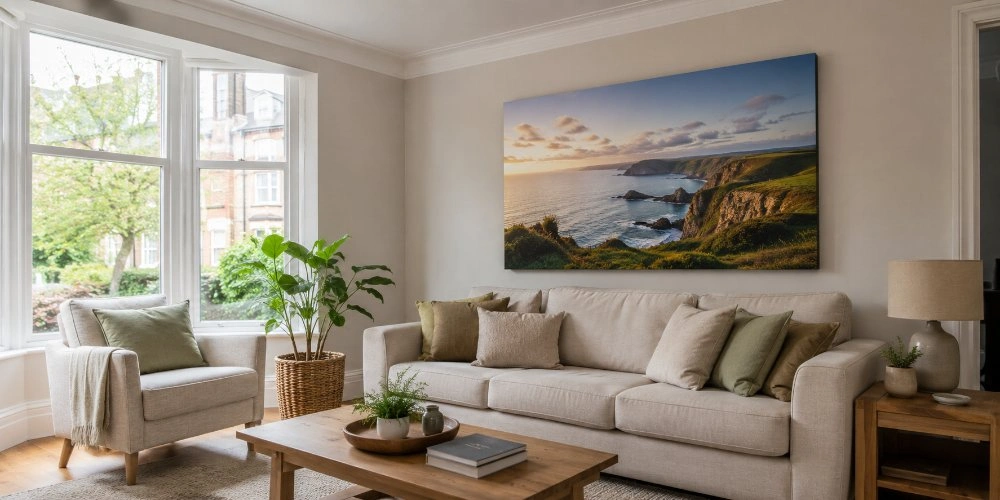
That wrap-around finish is called a gallery wrap, and it is what gives canvas prints their clean, modern look. Because there is no glass, there is no glare — a real advantage in bright British living rooms and under lamps in the evening.
Canvas prints are also very light for their size. A 60×40cm canvas typically weighs under a kilogram, so it hangs happily on a single picture hook. That makes them one of the most renter-friendly types of wall art you can buy.
One thing worth knowing before you shop: not every “canvas print” is stretched. Some companies sell rolled canvas — just the printed fabric in a tube, with no frame. It looks cheaper on the price page because it is. You would then need to stretch and frame it yourself, which is fiddly and usually cancels out the saving. Always check whether the price includes the stretcher frame.
How to Judge Canvas Print Quality: The 5 Things That Matter
This is the part most buying guides skip, and it is the part that decides whether your print still looks good in ten years. Five things make the difference: the canvas material, its weight, the inks, the stretcher frame and the edge finish.
1. The canvas material
Printing canvas comes in three main types, and companies rarely shout about which one they use. Here is how they compare.
Canvas type
Feel and look
Durability
Typical price
Best for
Polyester
Smooth, slightly shiny, very white base
Very good — resists moisture and stretching
Lowest
Bright photos, everyday wall decor
Poly-cotton blend
Light woven texture, warmer look
Very good all-rounder
Mid-range
Most home photo prints
100% cotton
Pronounced texture, matte, softer tones
Excellent when sealed, but absorbs damp
Highest
Fine art and gallery reproductions
Do not assume cotton is automatically “best”. Cotton is lovely for fine art, but polyester and poly-cotton actually hold ink on the surface better, which gives sharper detail and brighter colour in photographic prints. For family photos on a wall, a well-made polyester or blended canvas is the sensible choice — and it is what most reputable UK printers use.
2. The canvas weight (GSM)
Canvas weight is measured in grams per square metre (gsm). Heavier canvas is more robust, sits tighter on the frame and is far less likely to sag over time.
Under 280gsm: thin budget canvas. Fine for a short-term print, but expect some sag on larger sizes.
300–350gsm: the standard for good home wall decor. This is the range to look for.
400gsm and above: professional and gallery grade, usually paired with fine-art pricing.
If a company will not tell you the gsm anywhere on its site, that usually tells you something too. The number alone is not everything — weave and fibre matter as well — but it is the quickest single check you can make.
3. The inks
Ink is where cheap prints quietly cut corners, and it is the number one reason canvas prints fade. There are three types you will meet:
Dye inks: cheap and vivid at first, but they fade fastest — sometimes noticeably within a couple of years in a bright room.
Pigment inks: the archival standard used for fine-art “giclée” printing. Excellent fade resistance.
Latex inks: water-based pigment inks, best known as HP latex. They combine the durability of solvent-based inks with the safety of water-based ones — solvent-free, odourless and UV-resistant, which is why they are considered safe for children’s bedrooms.
Honest bit. A note on fade guarantees. You will see UK printers promising anything from 50 to 100 years of fade resistance. We back our own HP latex prints with a 75-year fade guarantee, and we stand by it — but be aware that all such figures across the industry come from accelerated lab testing, not from someone watching a canvas for 75 years. Treat any guarantee as a sign the company trusts its inks, and keep every canvas out of direct sunlight regardless.
4. The stretcher frame
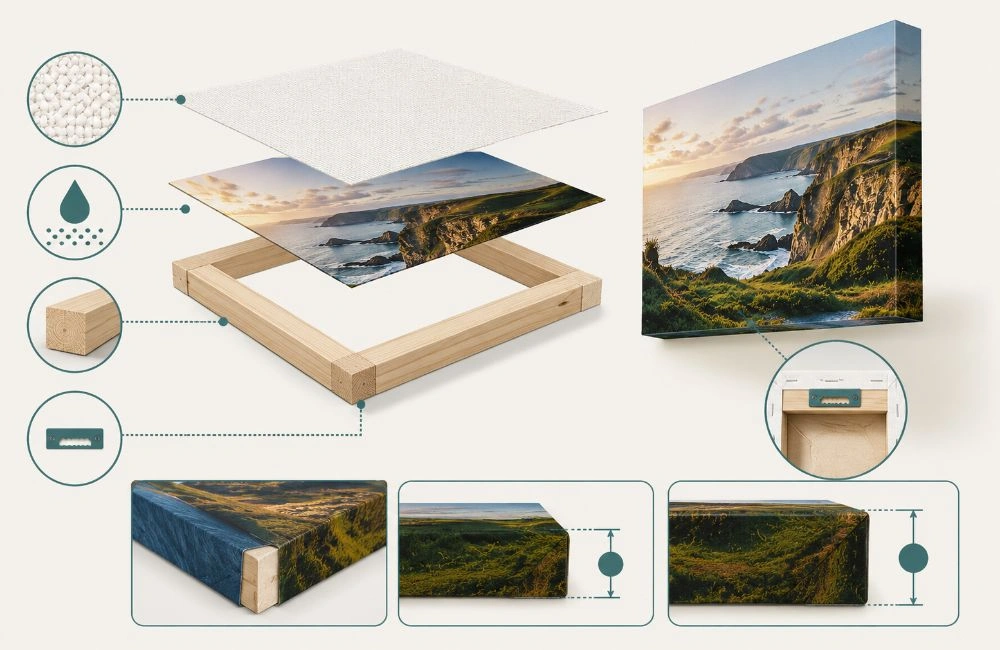
The stretcher frame is the wooden skeleton the canvas is pulled over, and it does more work than anything else in the build. A weak or damp frame will twist, and once a frame twists, the canvas ripples with it.
Look for these three things:
Solid wood, ideally kiln-dried pine or spruce. Kiln-drying removes moisture so the bars stay straight through British central-heating winters. FSC certification means the timber comes from responsibly managed forests.
The right depth. A 2cm frame is standard and looks neat on small and medium prints. For anything around 80×60cm or bigger, a 4cm deep frame resists warping and gives the print a more substantial, gallery-style presence on the wall.
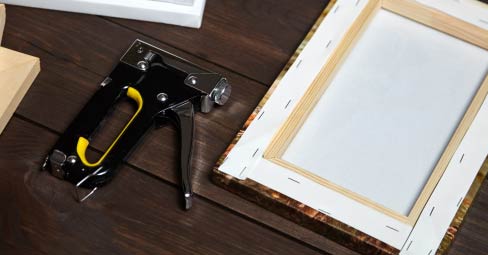
A proper wrap and fixing at the back. The canvas should be folded cleanly at the corners and stapled to the rear of the frame, never to the sides.
If you want the full detail on how this construction works — and why it matters so much — our guide to what gallery wrapped canvas actually means walks through it step by step.
5. The edge finish
Because a gallery wrap folds the canvas around the frame, something has to appear on those sides. Most good printers give you a choice, and picking the right one for your photo makes a surprising difference.
Edge option
What happens
Choose it when
Folded (gallery) wrap
The outer part of your photo continues around the sides
Your photo has space around the subject — landscapes, scenery
Mirrored edge
The border of the image is reflected onto the sides; the full photo stays on the front
Faces or details sit near the photo’s edge — portraits, group shots
Stretched edge
The outermost pixels are stretched along the sides for a motion-blur effect
You want a wrap look without losing any of the image
White or black edge
The photo prints on the front only, with plain coloured sides
You want a crisp, minimal, poster-like finish
The most common regret we see: choosing a folded wrap for a portrait, then finding the top of someone’s head has disappeared around the side of the frame. If people are close to the edges of your photo, pick mirrored.
Canvas Print Sizes: A UK Guide
Size is the decision people agonise over most, and the one that is easiest to get right with two simple rules.
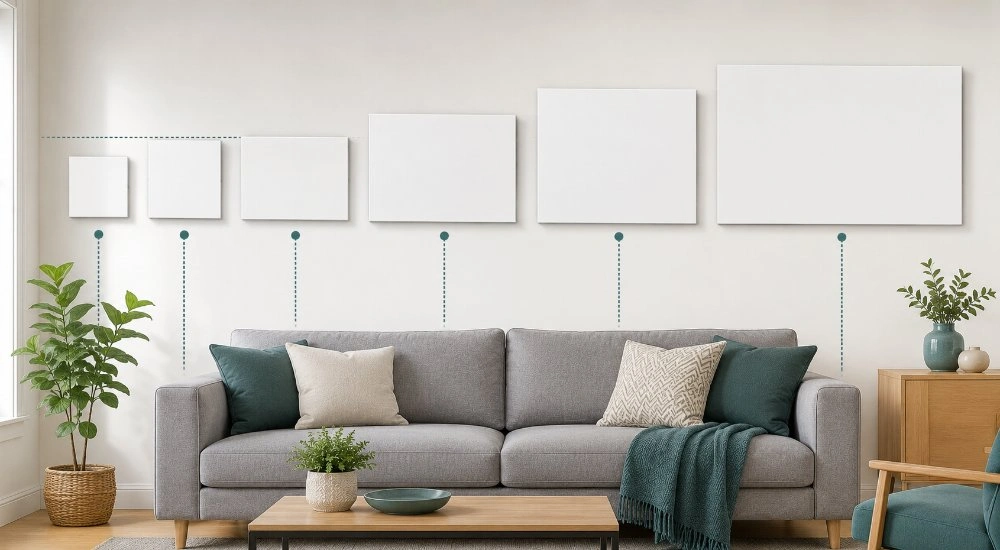
The two-thirds rule: art hung above furniture should span roughly two-thirds of the furniture’s width. Above a 200cm sofa, aim for an arrangement around 130–150cm wide — one big canvas or a trio.
The 145cm rule: hang the centre of the print about 145cm from the floor. That is the eye-level standard galleries use, and most people hang art 15–20cm too high.
Size band
Common formats
Where it works
Typical UK price range
Mini / small
20×20cm, 30×20cm
Shelves, desks, gallery wall filler, gifts
£4.50–£15
Medium
40×30cm, 50×40cm
Hallways, bedrooms, pairs and trios
£12–£30
Large
60×40cm, 80×60cm
Above sofas and beds, chimney breasts
£20–£50
Extra large
100×75cm, 120×80cm
Feature walls, open-plan rooms
£38–£90+
A quick word on the extremes. Mini canvases are brilliant value and make lovely gifts, but hang them in groups — a single 20×20cm print on a big empty wall looks lost.
At the other end, going big is the single most reliable way to make a room feel finished. If in doubt between two sizes, choose the bigger one: a slightly-too-large canvas looks confident, while a slightly-too-small one looks like an afterthought. Most UK printers now go well beyond the old standard formats — our own canvas prints run from 20×20cm minis up to 120×80cm statement pieces, in rectangles, squares and wide formats. Just remember that big prints need big photo files, which brings us neatly to resolution.
What Resolution Does Your Photo Need?
This is where most canvas disappointments actually begin — not at the printer, but with the photo file. The good news is that canvas is forgiving.
Paper prints need around 300 DPI (dots per inch) to look sharp. Canvas only needs about 150 DPI, because the woven texture softens fine detail anyway and you view a wall print from further away. That halves the resolution you need.
Canvas size
Minimum photo resolution
Roughly equal to
20×30cm
1,200 × 1,800 px
Any smartphone from the last decade
40×30cm
2,400 × 1,800 px
A 4–5 megapixel photo
60×40cm
3,600 × 2,400 px
A 9 megapixel photo
80×60cm
4,800 × 3,600 px
A 17 megapixel photo — recent phones manage this
120×80cm
7,200 × 4,800 px
A 35 megapixel photo — needs a very good source image
To check a photo on Windows, right-click the file, choose Properties, then Details — the pixel dimensions are listed under Image. On a phone, open the photo’s info screen. And be careful with three troublemakers: zoomed shots, screenshots and photos saved from WhatsApp, which compresses images heavily. Always print from the original file.
A decent printer protects you here as well. Our editor, for example, analyses your upload and simply will not offer sizes that would print blurry. For the full per-size breakdown and how aspect ratios affect cropping, see our guide to the best resolution for canvas prints.
How Much Should You Pay? UK Canvas Prices in 2026
Here is the honest truth about canvas pricing in the UK: almost every major printer runs permanent “discounts”. You will see 70%, 80%, even 87% off, all year round. The crossed-out price was never really the price.
Why is every canvas “always on sale”?
It works like this. A printer sets a high Retail Price that nobody is ever expected to pay, then sells at a permanent discount from it. The discounted figure is the real everyday price — the theatre is in the percentage. Some shops, ourselves included, are open about this and simply call the everyday figure a Factory Price, because prints ship straight from the factory rather than through retail. Others let you believe the sale ends on Sunday. It never does.
That does not make the deals fake value — a good 40×30cm canvas genuinely can be had for £10–£16 in 2026, which is remarkable. It just means the discount percentage is useless for comparing companies. So compare like this instead:
Compare the checkout total, including delivery. A “£6.99 canvas” with £7.99 postage costs more than a £12 canvas with free delivery over a threshold you were going to hit anyway. Most UK printers charge £5–£9 for standard delivery below their free-delivery threshold, and those thresholds typically sit between £45 and £99.
Check whether the hanging kit is included. Several UK printers charge extra for it, and some charge extra only on their budget canvas range. It is a small cost, but it catches people out.
Compare the same spec, not just the same size: frame depth, edge options and ink type vary between the cheapest and mid-range products at the same shop. Two “60×40cm canvases” can be very different objects.
Look for a price guarantee. A company willing to beat any like-for-like UK price is effectively doing the comparison shopping for you.
Read recent verified reviews, not the star rating alone. Sort by newest and look specifically for comments on colour accuracy, frame quality and how problems were handled. A shop with tens of thousands of verified reviews and a 4.8+ average has far less room to hide than one with a few hundred.
As a benchmark for 2026: expect around £4.50–£10 for a small canvas, £12–£30 for a medium one, and £38–£90 for extra-large formats from reputable UK printers, before any voucher codes. Paying much more than that should buy you a visible reason — fine-art cotton, a floating frame, or true giclée printing. Paying much less should make you ask what has been cut: it is usually the gsm, the ink or the frame.
Beyond the Rectangle: Square, Panoramic, Split and Collage Canvas
Standard rectangles suit most photos, but they are not the only option — and sometimes a different format rescues a photo that would otherwise be awkward.
Square canvas
Squares (20×20cm up to 80×80cm) are the natural home for Instagram-era photos and work beautifully in grids. A 3×3 grid of square canvases is one of the most popular gallery wall layouts in UK homes for good reason: it looks deliberate with almost no design skill required.
Panoramic canvas
Wide shots — coastlines, city skylines, mountain ranges, big group photos — get badly cropped by standard formats. Extended wide formats such as 100×50cm or 120×60cm let the whole scene breathe, and they are usually the difference between “nice photo” and “wow” for holiday landscapes. One rule: aim for at least 3,000 pixels on the long side of the photo, because panoramic prints magnify any softness in the file.
Split (multi-panel) canvas
A split canvas divides one photo across three or more panels hung a few centimetres apart. It creates a striking, modern-gallery effect — but choose the photo carefully. Faces that land on a join between panels look odd, so splits work best with landscapes and abstracts where nothing critical sits at the divide.
Collage canvas
A collage puts several photos onto one canvas in a set layout. It is the tidy alternative to a gallery wall when you have one hook and twenty favourite photos, and it is a favourite for milestone gifts — a first year of a baby’s life, or a couple’s best travel moments on a single print. Most canvas collage prints offer a range of grid and mosaic layouts. The main rule: fewer, bigger photos beat lots of tiny ones. On a 60×40cm canvas, six to nine photos is the comfortable maximum before faces become too small to enjoy from across the room.
Round canvas
Circular prints are a smaller niche, but they have grown noticeably in UK homes as gallery walls have relaxed — one round print breaks up a wall of rectangles beautifully. They suit close-cropped portraits and single striking subjects, and because the shape does the talking, they work best kept simple.
Canvas vs Other Wall Art: Which Format Suits Which Photo?
Canvas is the most popular photo wall art in the UK, but it is not always the right answer. Here is how it honestly compares with the other main formats, so you can check you are buying the right thing before you compare canvas companies at all.
Format
Look and feel
Strengths
Watch out for
Canvas print
Woven texture, matte, frameless gallery look
No glare, very light, cheapest at large sizes, warm and personal
Not for steamy or damp rooms; texture softens very fine detail
Framed print
Photo paper behind glass with a mount
Formal, traditional, crisp detail
Glass glare and weight; costs climb quickly at large sizes
Acrylic print
High-gloss, colours seem to glow with depth
Stunning for vivid photos; wipeable, handles humidity
Reflections in bright rooms; heavier; higher price
Aluminium print
Sleek matt or gloss metal panel
Extremely durable, slim, modern; fine indoors anywhere
Cooler, more industrial feel; less cosy for family photos
Poster
Printed paper, framed or unframed
Cheapest way to test an image or fill a rented flat
Least durable; needs a frame to look finished
A rule of thumb that rarely fails: canvas for warmth, acrylic for drama, aluminium for durability, framed for formality. Family photos, weddings, pets and landscapes nearly always feel most at home on canvas; neon cityscapes and underwater shots reward acrylic’s glow.
There is also a halfway house worth knowing about: a canvas wall hanging prints your photo on canvas fabric hung between two wooden bars, tapestry-style, rather than stretched over a frame. It is lighter still, has a relaxed, textile look that suits boho and Scandi rooms, and packs flat — handy if you move house often.
Delivery: How Long Do Canvas Prints Take in the UK?
Every canvas is made to order, so there are always two clocks running: production time (printing, stretching and quality checks) and shipping time. Most reputable UK-facing printers quote somewhere between 3 and 9 working days in total for a standard canvas — as a guide, ours take 4–7 working days, made up of a day in production and 3–6 days with the courier.
Three things commonly add time, and they are worth knowing before you order for a birthday or anniversary:
Extras extend production. A floating frame, an XXL deep frame or a multi-panel split usually adds a day or two, because there is simply more to build.
Peak seasons stretch everything. The weeks before Christmas, Mother’s Day and Father’s Day are the busiest of the year for every photo printer in the country. Order early — two weeks of headroom costs nothing and saves a lot of refreshing the tracking page.
“From” delivery times are not promises. No printer controls the courier network, so treat quoted times as typical rather than guaranteed, and check the shipping page for the product you are actually ordering — canvas, framed and photo book timelines often differ at the same shop.
Hanging a Canvas: The Two-Minute Version
One of the quiet advantages of canvas is how easy it is to hang. A 60×40cm canvas typically weighs under a kilogram, so for most sizes a single brass picture hook tapped into the wall at a slight downward angle is all you need — no drill, no wall plugs.
Bigger prints: from about 80×60cm, or any canvas with a wooden floating frame, use two fixing points to keep it level and take the extra weight — proper wall plugs on plasterboard.
Renting? Adhesive strips hold small and medium canvases (check the strip’s weight rating, usually 3–4kg) with no wall damage, and Victorian picture rails were literally made for this job.
Height: centre of the print about 145cm from the floor, and 15–25cm of gap above sofa backs and headboards. Use a spirit level. Thirty seconds now saves months of low-level irritation.
7 Canvas Buying Mistakes to Avoid
Printing from a low-resolution file. Screenshots, WhatsApp downloads and heavily zoomed shots are the usual culprits. Use the original photo, and check the pixel count against the table above.
Ignoring the aspect ratio. If your photo is a different shape from the canvas you order, something gets cropped. Preview the crop before you pay, and move it so nothing important is lost.
Choosing a folded wrap for edge-to-edge portraits. Heads and hands vanish around the frame. Use a mirrored or white edge instead.
Buying on the discount percentage. An 87% discount off an imaginary price is worth less than a fair everyday price. Compare final checkout totals.
Forgetting the hanging kit. Check whether hooks and fixings are included, and add a kit if not — a canvas leaning against the skirting board for six weeks helps nobody.
Going too small. The most common sizing regret in reviews across every UK printer is “I wish I’d gone bigger”. Measure the wall, apply the two-thirds rule, and round up.
Hanging it somewhere hostile. Steamy bathrooms, spots directly above radiators and walls in full southern sun will shorten the life of any canvas, whatever the guarantee says.
How to Care for a Canvas Print
Canvas needs almost no maintenance, which is part of its charm. Three habits keep it looking new:
Dust it gently with a soft, dry cloth or a feather duster every few weeks. For marks, use a barely damp cloth with light pressure — never household cleaners or sprays, which can lift the ink.
Mind the placement. Avoid direct sunlight, radiators and humid rooms. Even UV-resistant inks last longest out of the sun, and damp is the enemy of the wooden frame more than the print itself.
Store flat or hanging. If you rotate prints seasonally, store the spares flat in a dry cupboard — never rolled around the frame or leaning at an angle under other objects, which can dent the surface.
If a canvas does develop a slight ripple after years on the wall, a light mist of water on the back of the canvas (not the front) will usually tighten it again as it dries. Cheap, thin canvas sags sooner — one more reason the gsm matters.
Canvas Print Trends in UK Homes for 2026
Style should never override what you love, but if you want your walls to feel current, four trends stand out in British homes this year:
Fewer, bigger pieces. The scattered-prints look is fading. One oversized statement canvas — or a single deliberate gallery wall — is replacing art on every surface.
The “everyday exhibits” gallery wall. Relaxed, collected-over-time arrangements that mix personal photos with art, rather than perfectly matched sets.
Warm, earthy palettes. Terracotta, clay, sage and ochre tones suit the deep blues and greens trending on UK walls, and they make north-facing rooms feel warmer.
Personal over generic. Shop-bought abstract prints are giving way to people’s own photography — family, travel, pets. Your photos tell a better story than anything mass-produced.
If you are planning a whole room rather than a single print, our living room canvas ideas guide covers layouts, spacing and arrangements for every British home type, from Victorian terraces to new builds.
Your 60-Second Pre-Order Checklist
Run through this before you click order:
Is the photo the original file, with enough pixels for the size (150 DPI rule)?
Does the canvas spec mention 300gsm+, a solid wood stretcher frame and fade-resistant (pigment or latex) inks?
Have you chosen the right edge — mirrored for portraits, folded for landscapes?
For sizes 80×60cm and up, have you picked the deeper 4cm frame?
Have you previewed the crop so nothing important is lost?
Is the checkout total — with delivery and hanging kit — still the best like-for-like price?
Is the wall you have in mind away from steam, radiators and direct sun?
The Bottom Line
A canvas print is one of the few things you can buy for under £20 that you will still look at every day in ten years. That is exactly why it is worth two minutes of checking before you order.
Judge the build, not the banner: the material, the weight, the inks, the frame and the edge. Match the size to the wall and the resolution to the size. Compare real checkout totals. Do those things and whichever photo you choose — the wedding, the dog, that beach in Cornwall — it will come out looking the way you remember it.
Frequently Asked Questions
What are the best canvas prints in the UK?
The best UK canvas prints combine 300gsm or heavier canvas, a kiln-dried solid wood stretcher frame, fade-resistant pigment or latex inks and a clean gallery-wrapped finish, backed by strong verified reviews and a clear guarantee. Judge any company against those five points rather than its headline discount, and you will rarely go wrong.
What is the best size for a canvas print?
The best canvas size depends on the wall: art above furniture should span about two-thirds of the furniture’s width, with the print’s centre roughly 145cm from the floor. Above a standard three-seater sofa that means an arrangement of 130–150cm — one large canvas around 100×75cm, or a trio of medium prints.
What resolution do I need for a canvas print?
Canvas prints need around 150 pixels per inch, half of what paper prints require, because the woven texture softens fine detail. A 40×30cm canvas needs roughly 2,400×1,800 pixels and an 80×60cm canvas about 4,800×3,600 pixels — well within reach of most smartphone photos taken in recent years. Avoid screenshots, heavy zoom and photos downloaded from messaging apps, which compress files. Always upload the original.
How long do canvas prints last?
A well-made canvas print with pigment or latex inks, kept out of direct sunlight and damp rooms, will stay vibrant for decades — manufacturers’ accelerated tests support fade guarantees of 50 to 75 years or more. Cheap dye-ink prints are the exception and can fade visibly within a few years in bright rooms.
How do you clean a canvas print?
Dust a canvas print every few weeks with a soft, dry cloth or feather duster, working gently and without pressure. For marks, wipe with a barely damp cloth and let it air dry. Never use household cleaners, sprays or soaked cloths, because chemicals and excess moisture can lift the ink and warp the frame.
Are cheap canvas prints worth buying?
Cheap canvas prints can be excellent value if the low price comes from direct-from-factory production rather than cut corners. Check the spec: 300gsm+ canvas, solid wood frame and pigment or latex inks at a low price is a bargain, while thin canvas with dye inks is cheap for a reason and will fade and sag.
What is the difference between folded and mirrored edges?
A folded (gallery) edge wraps the outer part of your actual photo around the frame sides, so a little of the image leaves the front face. A mirrored edge reflects the photo’s border onto the sides instead, keeping the entire image visible on the front — the safer choice for portraits and group shots.
Can you hang canvas prints in a bathroom?
We would not recommend it. Repeated steam and humidity soak into the canvas fibres and the wooden stretcher frame, causing sagging, warping and eventually mould. If you want art in a bathroom, a moisture-proof format such as an acrylic or aluminium print is the sensible choice; save canvas for drier rooms.
Do canvas prints come ready to hang?
Most UK canvas prints arrive stretched on their frame and ready to hang, but the hooks, nails or hanging kit are often a small optional extra rather than included — and some budget ranges exclude them entirely. Check the product page before ordering, and add a hanging kit at checkout if you need one.
Is a canvas print better than a framed print?
Neither is better — they suit different rooms and photos. Canvas is lighter, glare-free, cheaper at large sizes and needs no outer frame, which suits modern and casual spaces. Framed prints behind glass look more formal and traditional. Many people mix both, or add a floating frame to a canvas for a halfway option.
Why are canvas prints always on sale in the UK?
Most UK canvas printers set a high Retail Price that customers are never really expected to pay, then sell at a permanent discount from it, so the “sale” runs all year. The discounted figure is the true everyday price. Ignore the percentage and compare final checkout totals, including delivery and the hanging kit.
What is the best website for canvas prints in the UK?
The best canvas print website for you is the one that publishes its specification — canvas weight, ink type and frame material — offers the size and edge options your photo needs, carries thousands of recent verified reviews, and wins on the final checkout total. Judge sites against those five points rather than adverts or discount percentages.
Do canvas prints need a frame?
No — a gallery-wrapped canvas is designed to hang exactly as it arrives, with the image wrapping round the sides for a finished look from every angle. An outer floating frame is purely a style choice: it adds a slim border and a shadow-gap for a more formal, gallery feel, and suits large statement pieces especially well.
Can you print any photo on canvas?
You can print any photo you own or have permission to use. Professional photographs — wedding, school and studio portraits — are usually the photographer’s copyright, so you need their consent to reproduce them, and reputable printers may refuse obviously professional images without it. Your own phone and camera photos are always fine.