100+ Living Room Canvas Ideas UK: The Complete Guide (2026)
 by Jonathan Vincent
 12 Minutes
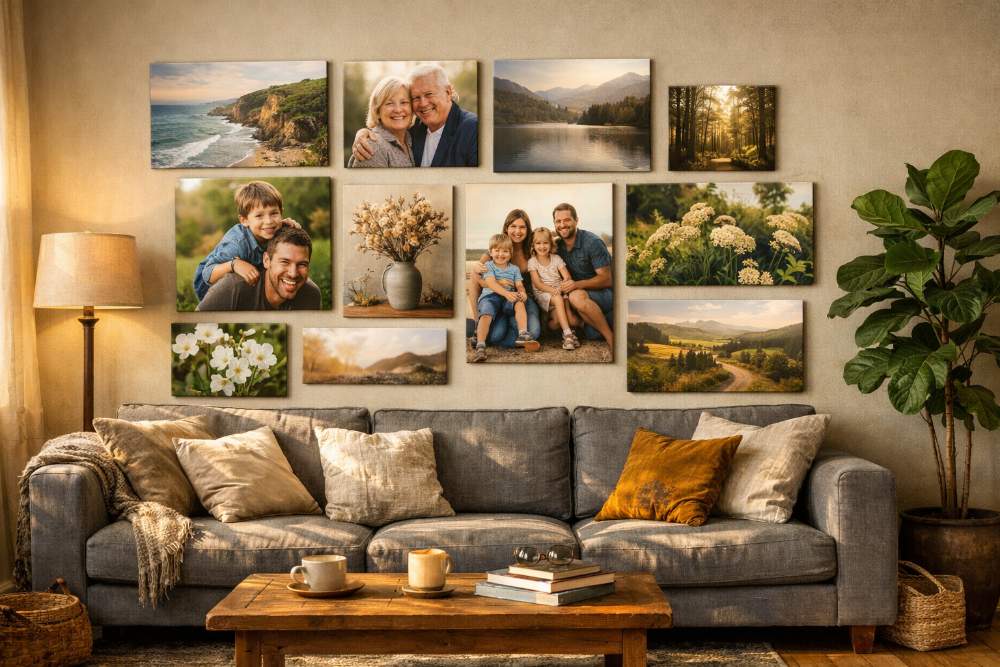
Walk into almost any living room in Britain and there is a good chance you will spot a canvas print on the wall. There is a reason they have become the go-to choice for home decor across the country — and it has very little to do with following trends.
Canvas prints just work. They look brilliant in small Victorian terraces and large detached homes alike. They suit first-time renters who cannot make permanent changes, and homeowners who want something genuinely personal on their walls. You can spend £12 or £300 and still end up with something you are really proud of.
But with so many options — sizes, layouts, styles, photo choices — knowing where to start can feel a bit overwhelming. That is exactly why we wrote this guide.
Whether you are decorating a compact new-build lounge or a sprawling period property, you will find ideas here that actually fit your space, your style and your budget.

Why Canvas Over Other Wall Art?
You could buy a framed print from the high street. You could hang a mirror. You could leave the wall bare. So why choose canvas?
- Canvas prints are gallery-wrapped, meaning the image wraps right around the stretcher frame and looks finished from every angle — no outer frame needed
- They are surprisingly affordable. Our Factory Price for a quality 30×20cm canvas starts from just £12, compared to £40–£80 for an equivalent framed print on the high street
- They are lightweight and easy to hang — most canvases need nothing more than a single picture hook
- They are personal. A photo of your family, your dog, your wedding day or your favourite holiday spot means far more on your wall than a generic print from a shop
- They do not reflect glare the way glass-fronted frames can, so they look great under any lighting condition
- They are renter-friendly — one small nail or hook means minimal wall damage
This guide covers everything from the best layouts for above your sofa to how to pick the right sizes for a small flat in Manchester. We will also show you exactly how to put together a proper gallery wall without it looking like a jumble sale.
Canvas Ideas by Wall Location
The first thing to think about is not which photo to use — it is where the canvas is going. Different walls in your living room call for completely different approaches.
Above the Sofa: 10 Layouts That Work
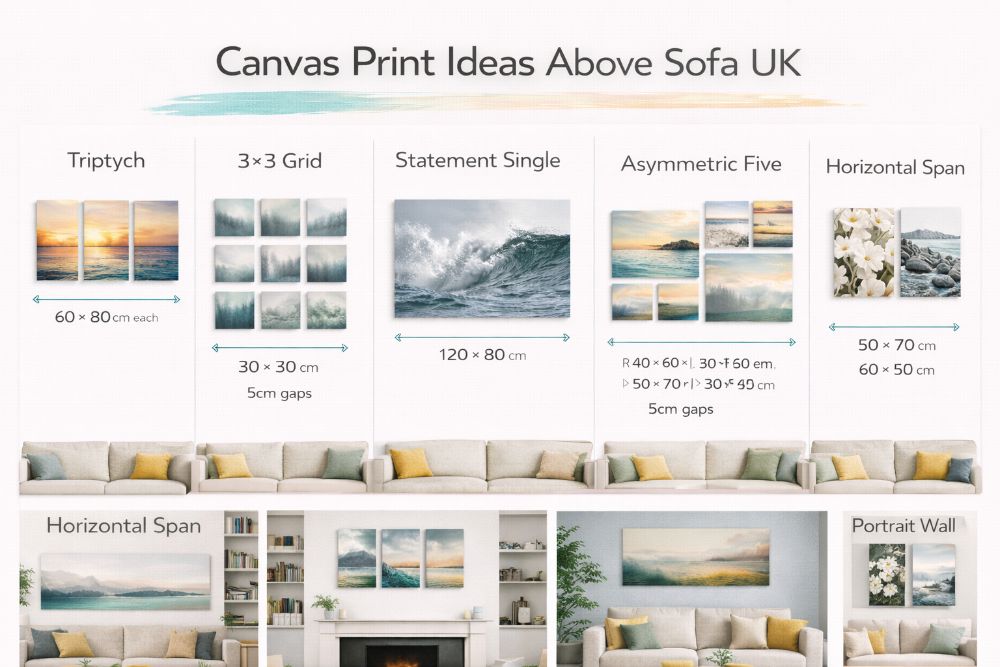
The wall above your sofa is the most important wall in most UK living rooms. It is the first thing people see when they walk in, and where visitors naturally look when sitting down. Getting it right makes a huge difference to how the whole room feels.
A good rule of thumb: whatever you hang above the sofa should be roughly two-thirds as wide as the sofa itself. So if your sofa is 180cm wide, you are aiming for something that spans about 120cm. That could be one large canvas, three medium ones side by side, or a neat grid.
1. The Classic Trio
Three canvases hung horizontally in a row. This is probably the most popular canvas arrangement in UK homes — and for good reason. It looks clean, balanced and intentional.
- Best sizes: 3x 50×70cm or 3x 40×60cm
- Spacing: 5–7cm between each canvas
- Works for: Any sofa, any style
- Photo ideas: A triptych split across three panels, three matching landscapes, or three black-and-white family portraits
► Shop our canvas trio sets — create your own 3-piece living room set at My Picture
2. The Statement Single
One large canvas, centred above the sofa. Simple, bold and surprisingly elegant. This arrangement is having a real moment in 2026 as people move away from cluttered gallery walls towards fewer, bigger pieces.
- Best size: 80×60cm or 100×75cm
- Works for: Modern and minimalist rooms, feature walls, rooms where you want to keep things simple
- Photo ideas: A wide landscape, a striking portrait, an abstract image with strong colour
3. The Gallery Grid
Nine canvases arranged in a 3×3 grid. This creates a brilliant focal point above a sofa and looks particularly striking in modern or Scandinavian-style rooms.
- Best sizes: 9x 30×30cm squares
- Spacing: 5cm between each canvas — consistent all the way around
- Works for: Modern, contemporary and Scandi-style rooms
- Photo ideas: Nine shots from a single holiday, a mix of black-and-white family photos, or nine abstract colour studies
- Money tip: Order 9 or more canvases with us and you save 15% — a 3×3 grid costs less than you might expect
4. The Asymmetric Five
Five canvases in mixed sizes, arranged in a loose cluster. This looks more relaxed and personal than a strict grid — more like a proper gallery wall than a matching set.
- Suggested layout: 1 large (50×70cm) central piece + 2 medium (30×40cm) + 2 small (20×30cm)
- How to arrange: Place the largest canvas roughly in the centre, then build outwards
- Works for: Eclectic, bohemian and traditional rooms
- Photo ideas: A mix of family portraits and landscapes in complementary tones
5. The Horizontal Span
Five to seven smaller canvases hung in a single horizontal line. This works particularly well in rooms where the wall space above the sofa is not very tall — a common situation in new-build homes with lower ceilings.
- Best sizes: 5x 40×30cm or 7x 30×20cm
- Spacing: 5–6cm between each piece
- Works for: New builds, rooms with 2.4m ceilings, modern interiors
- Key tip: Use a spirit level to keep the line perfectly straight
6. The Triptych Split
One photograph split across three canvases. This looks absolutely stunning — almost like a piece of modern art. The joins between the three panels give it a contemporary, gallery feel.
- Best sizes: 3x 40×60cm or 3x 50×70cm
- Spacing: 2–3cm between panels — tight, so the image reads as one
- Works for: Any style of room
- Photo ideas: A wide landscape, a wedding shot or a panoramic holiday image
7. The Family Timeline
A chronological display of family photos, showing how your family has grown over the years. This is one of the most sentimental and personal approaches you can take.
- Best layout: A horizontal row with 5–7 canvases in matching sizes, arranged oldest to newest
- Best sizes: 5x 30×40cm or 7x 20×30cm
- Works for: Traditional rooms, family homes, older properties
- Photo ideas: Wedding photo, birth announcement, first steps, first day of school, recent family portrait
8. The Monochrome Collection
All black and white, all different subjects. This is a very elegant approach that makes even a collection of completely different photos feel cohesive and intentional.
- Works because: The consistent black-and-white treatment ties everything together visually
- Best approach: Mix portrait and landscape orientations for interest
- Works for: Any room style — black and white goes with everything
- Photo ideas: Family portraits, your dog, architectural details, landscapes, street photography
9. The Two-Tone Pairing
Two canvases hung side by side with a deliberate gap between them. Bigger than a triptych, simpler than a gallery wall. This works beautifully in rooms where you do not want to fill the whole wall.
- Best sizes: 2x 60×80cm or 2x 50×70cm
- Spacing: 10–15cm between them
- Works for: Modern and minimalist rooms
10. The Portrait Wall
A collection of portrait-orientation canvases, staggered at different heights. This works particularly well in rooms with alcoves or where the wall has natural features like a chimney breast.
- Best approach: Mix 50×70cm and 30×40cm portrait canvases
- Stagger heights: Do not line up the tops or bottoms — vary them by 10–15cm for a more natural look
- Works for: Traditional, period and eclectic homes
Feature Wall and Blank Wall Ideas
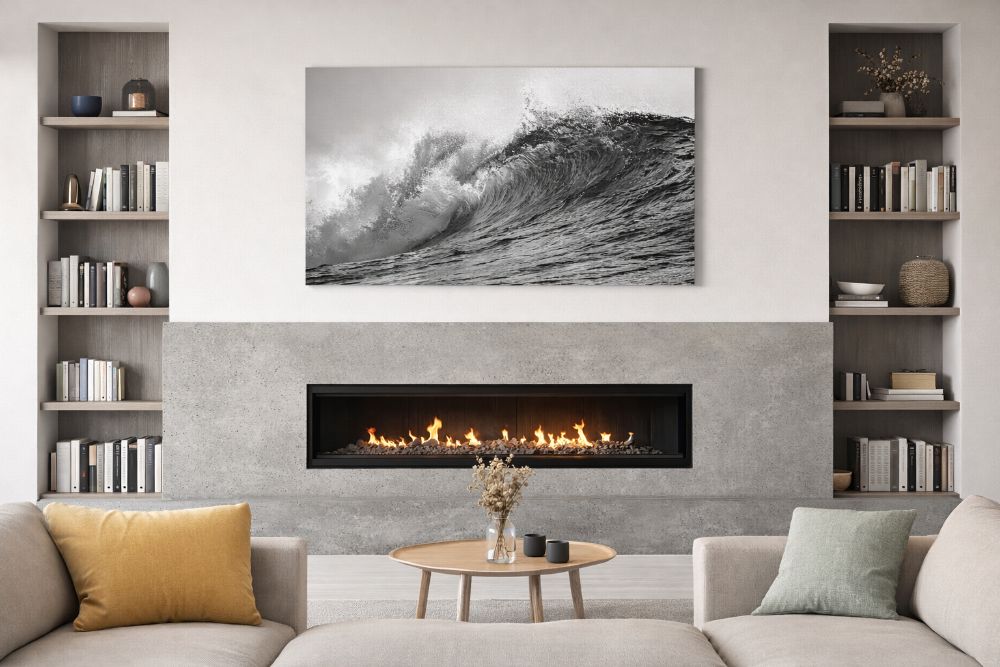
Got a big blank wall that needs attention? Lucky you. Blank walls are genuinely exciting to work with — you can go as bold or as restrained as you like.
The Salon-Style Gallery Wall
This is the most dramatic option: 15–25 canvases covering most of a feature wall, in mixed sizes, hung in a loose organic arrangement. It looks incredible and surprisingly personal.
The secret to making it work is treating the whole wall like a single composition. Start with your largest piece and work outwards, filling gaps with smaller canvases as you go.
- How many to use: 15–25 canvases depending on wall size
- Key tip: Lay the whole arrangement out on the floor first before you start drilling
- Spacing: 5–8cm between canvases for a proper gallery feel
- Best mix: Aim for 3–4 large pieces, 6–8 medium pieces, and the rest small
The Statement Wall — Fewer, Bigger
Instead of many small pieces, use 3–5 large canvases in a deliberate arrangement. This approach has been gaining ground across British homes in 2026 as the trend shifts from maximalist gallery walls to something more considered.
- Suggested layout: 1 extra-large central piece (100×75cm) flanked by 2 large pieces (80×60cm)
- Works for: Modern, minimalist and Japandi-style rooms
The Colour Gradient Wall
Arrange 12–15 canvases so that the colours shift gradually from one end of the wall to the other — perhaps from dark to light, or from warm tones to cool ones. This takes a bit of planning but looks genuinely spectacular.
The Timeline Mural
Arrange photos chronologically across a large wall — perhaps the history of your family, or the journey of a relationship. Each canvas tells part of the story.
The Themed Collection
Pick a single theme — all travel shots, all black and white, all pets — and fill a wall with 15–20 canvases exploring that theme. The consistency of subject matter keeps it from feeling chaotic.
Alcoves and Chimney Breast: British Home-Specific Ideas
The chimney breast and alcoves on either side of it are one of the most distinctive features of Victorian and Edwardian terraced houses — and one of the trickiest to decorate well.
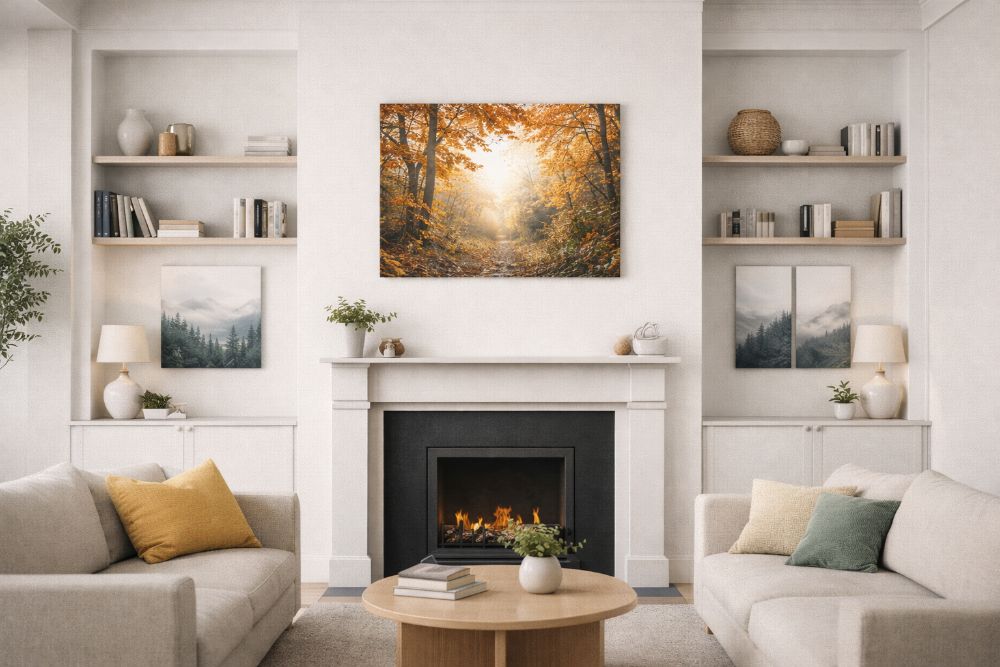
The Chimney Breast Statement
One large canvas, centred directly above the fireplace mantelpiece. The fireplace becomes the room's centrepiece, and the canvas completes it.
- Best size: 60×80cm or 80×60cm — something that sits comfortably within the chimney breast width
- Height: Bottom of canvas should sit 15–20cm above the top of the mantelpiece
- Works for: Any style — go bold with a landscape, sentimental with a family portrait, or elegant with a black-and-white shot
The Alcove Duo
Two matching canvases, one in each alcove on either side of the chimney breast. This creates perfect symmetry and makes the whole chimney breast feel considered rather than accidental.
- Best sizes: 2x 40×60cm or 2x 30×40cm
- Key tip: Hang both at exactly the same height — measure carefully and use a spirit level
The Alcove Gallery Fill
Fill one or both alcoves with a small gallery of 4–6 canvases. This works especially well if one alcove has shelving — mix canvases on the shelves with some hung on the wall above.
Using Picture Rails in Period Homes
Many Victorian and Edwardian homes have picture rails — the moulding strip near the ceiling put there specifically for hanging art without nailing into the walls. If your home has them, use them.
- Buy picture rail hooks and steel picture wire from any DIY shop
- They will hold canvases up to 15kg with no wall damage — brilliant for renters
- The wire length can be adjusted to change the canvas height without moving the hook
TV Wall Canvas Ideas: How to Get It Right
The TV wall is tricky. You do not want anything that competes with the screen visually, but leaving the rest of the wall bare can look unfinished.
The Balanced Flanks Method
Place one canvas on each side of the TV, at roughly the same height as the screen centre. This frames the TV symmetrically and makes the whole wall feel intentional.
- Best sizes: 2x 30×40cm or 2x 40×40cm
- Gap from TV: 20–30cm on each side
- Photo ideas: Keep these understated — abstract, landscape or black-and-white tones work best
Above the TV
A single wide canvas hung above the TV unit can look smart, but only if there is enough wall space. You need at least 30cm of wall between the top of the TV and the bottom of the canvas.
- Best size: 80×40cm or a similar wide-format canvas
The Opposite Wall Solution
Sometimes the best answer is to forget about the TV wall entirely and put your best canvas on the opposite wall — the one you are looking at when watching telly. When the TV is off, that canvas becomes your focal point.
Note: Canvas prints do not create reflective glare themselves, but a canvas that sits in a TV's direct sightline can be distracting when you are watching something. The opposite wall is often the smarter choice.
Canvas Ideas by Living Room Style
Not every canvas suits every room. The style of your living room — whether it is modern and minimal or cosy and cluttered with things you love — should guide your canvas choices almost as much as the photos themselves.
Modern and Contemporary Living Rooms
Modern and contemporary rooms tend to favour clean lines, neutral or bold single-colour walls, and furniture with minimal ornamentation. Canvas prints work particularly well here because they add texture and warmth to a space that can sometimes feel a bit cold.
What Works in Modern Rooms
- Large format single canvases — one bold statement piece rather than many small ones
- Black and white photography — striking contrast, no colour clashes
- Abstract art with a restrained colour palette — muted earth tones, or a single bold colour
- Clean grid arrangements — a perfectly spaced 3×3 grid of matching squares
- Geometric patterns — shapes and forms that echo modern furniture design
- Urban and architectural photography — cityscapes, buildings, bridges
- Minimalist trios in matching sizes — three identical canvases with a consistent theme
What to Avoid
- Busy, heavily detailed images that compete with the room's clean aesthetic
- Overly sentimental photo displays — save those for the hallway or bedroom
- Too many different sizes hung randomly — modern rooms need order
The 2026 trend for "warm minimalism" is particularly relevant here. Rather than stark black, white and grey combinations, contemporary British rooms are warming up with earthy canvas tones — soft browns, clay neutrals and dusty greens.
Traditional and Classic Living Rooms
Traditional British living rooms — think period properties, floral sofas, wooden furniture and rooms that have grown organically over decades — suit a completely different canvas approach.
What Works in Traditional Rooms
- Family portraits and multi-generational displays — pictures of people are what traditional British homes are built around
- British countryside landscapes — rolling hills, coasts, moorlands and countryside scenes
- Botanical and floral prints — classic herbarium-style illustrations look genuinely beautiful in period rooms
- Heritage displays — old family photos converted to canvas and hung in a chronological arrangement
- Formal arrangements — symmetrical placements, matching pairs, centred compositions
- Vintage-style photographs — contemporary photos printed with a sepia or aged treatment
- Watercolour-style landscapes — softer, painterly images rather than sharp photographic prints
The Heritage Wall
One of the most meaningful things you can do in a traditional home is scan old family photographs — even faded, creased ones from the 1950s or 1960s — and have them printed as canvas. The imperfections add to the charm rather than detracting from it.
A row of five or seven heritage photos in matching sizes, hung chronologically, tells your family's story in a way no purchased artwork ever could.
Scandinavian and Minimalist Living Rooms
Scandi and minimalist rooms have dominated British interior design for much of the last decade — and they are not going anywhere, though the look has softened considerably in 2026.
The principle here is simple: less is more. Every canvas on the wall should earn its place.
The Three-Print Maximum
In a genuinely minimalist room, three canvases is usually the maximum you should hang in any one area. Often one or two is even better. The power of a single large canvas in a spare, well-considered room can be extraordinary.
What Works in Scandi and Minimalist Rooms
- One large statement canvas above the sofa — let it breathe
- Line drawing-style prints — simple, single-line botanical or portrait illustrations
- Nature photography in muted, natural tones — greens, greys, soft blues
- Abstract studies — a single blurry close-up of a leaf, or a soft out-of-focus landscape
- Black-and-white photography with simple compositions
- Matching pair — two identical canvases, centred, no fuss
The Swedish concept of lagom — "just the right amount" — applies perfectly to canvas selection. Not too many, not too few. Not too busy, not too bare. One perfectly chosen canvas on the right wall can genuinely transform a minimalist room.
One thing worth knowing: an intentionally bare wall in a minimalist room is not a mistake. It creates breathing space and actually makes the canvases you do hang feel more significant.
Eclectic and Bohemian Living Rooms
If your living room is full of things you love — mismatched furniture, plants everywhere, vintage finds, bright colours — then almost anything goes. Eclectic rooms thrive on personality, so the more personal your canvas choices, the better.
The Maximalist Gallery Wall
30 or more canvases might sound like madness, but in the right room it is genuinely wonderful. The key is some kind of underlying logic that stops it looking completely random.
- Use a consistent colour treatment — all vintage-toned or all black-and-white — to tie disparate images together
- Vary sizes dramatically — from tiny 15×20cm prints to large 60×80cm ones
- Mix canvas with framed prints, mirrors and even hanging plants for a true gallery wall effect
- Keep spacing tight — 3–5cm between pieces gives it an abundant, generous feel
Travel and Adventure Collections
A collection of photos from different countries, mixed sizes, hung in a loose arrangement, is one of the most personal and interesting things you can put on a wall. If you have travelled widely, a bohemian room is the perfect place to celebrate that.
Industrial and Urban Living Rooms
Exposed brick, raw concrete, dark metal — industrial-style rooms need art that can hold its own against strong, textural backgrounds.
What Works in Industrial Rooms
- Large black-and-white urban photography — cityscapes, bridges, industrial architecture, street scenes
- Monochrome portraits with strong contrast
- Abstract art in charcoal, black and deep grey tones
- Minimal, graphic photography — stark compositions with clear subjects
- Oversized single canvases — small pieces get lost against a raw brick wall
If your wall is exposed brick, hanging canvas is actually easier than plaster — the mortar joints are perfect for rawl-plugged screws. A single large canvas (80×60cm or bigger) against brick looks genuinely spectacular.
Canvas Ideas by Theme
Once you know where your canvases are going and what style of room they are going into, the most important decision is the theme. What do you actually want on your walls?
Family and Personal Photos
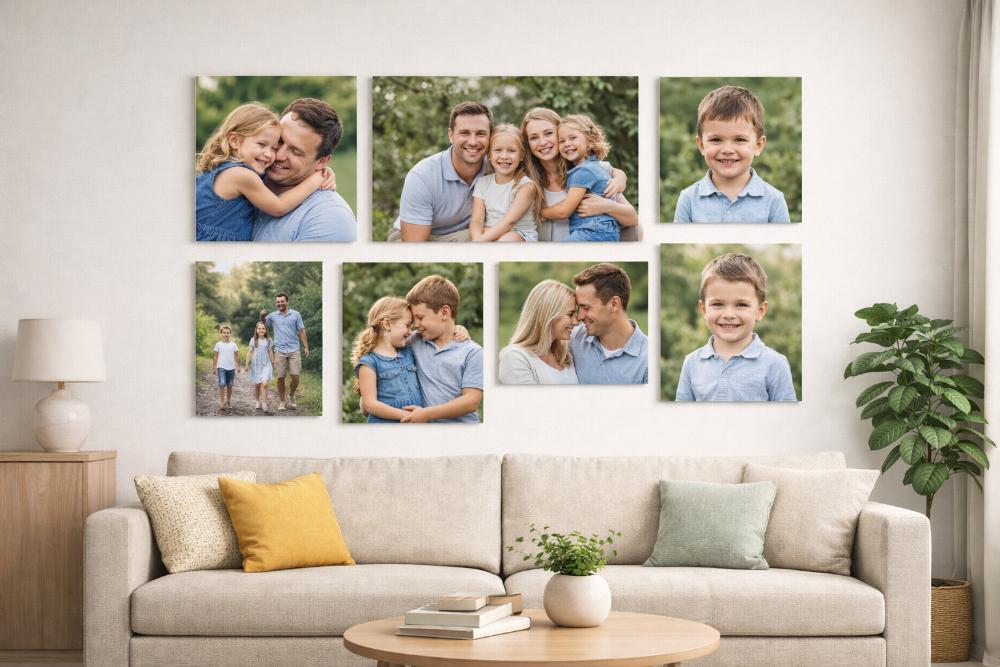
Ask most people what they want on their living room walls and the answer is almost always the same: photos of the people they love. Family and personal photos make the most meaningful canvas displays you can create.
The Family Portrait Collection
A curated selection of family portraits — some posed, some candid — hung as a gallery. This is the most popular canvas arrangement in UK family homes.
- Mix professional and casual photos for variety — a formal portrait alongside a candid beach shot creates lovely contrast
- Include different generations if you can — grandparents, parents, children, pets
- Keep colour treatment consistent — all in colour, all in black-and-white, or a deliberate mix of one colour portrait with the rest in B&W
Kids Growing Up
A timeline of your children from birth to the present day. Update it every year. It becomes one of the most treasured displays in the house. Use matching sizes — 30×40cm portrait works well — and leave gaps in the arrangement for future additions.
Couple Journey
From your first holiday together to the most recent milestone — a couple's timeline canvas wall tells your story far better than any shop-bought artwork.
Pet Portraits
Do not underestimate the impact of a large canvas portrait of your dog or cat. It is one of our best-selling ideas. A dog caught mid-run or staring straight at the camera makes a brilliant canvas.
Travel and Adventure
If travel is important to you, your living room is the perfect place to show it. A well-curated collection of travel photos on canvas says more about who you are than almost anything else you could hang on a wall.
The Destination Collection
Pick three to five of your favourite travel destinations and dedicate one or two canvases to each. Hang them together as a collection. Works best when images are selected for colour and mood rather than just subject matter.
The World Map Centre
A large world map canvas as the anchor piece, surrounded by photos from destinations you have visited. As you travel more, you add more photos around it.
Holiday Memories
A simple collection of your favourite holiday shots — not necessarily arty or professional, just moments that meant something to you. The Cornish coast in September. A narrow alley in Lisbon. Your kids on a Spanish beach. Black and white often works brilliantly for holiday photography — it removes the distraction of patchy lighting and focuses attention on the composition.
Nature and Landscapes
Nature and landscape photography is one of the most consistently popular choices for UK living rooms — and British landscapes in particular have a quality and character that you will not find anywhere else.
British Countryside
- The Yorkshire Dales — dramatic rolling hills under big skies
- The Scottish Highlands — brooding, majestic, and unlike anywhere in England
- The Cotswolds — honey-stone villages, green fields and wildflower meadows
- Cornwall and Devon — rugged Atlantic coastlines, beaches and sea stacks
- The Lake District — fells, lakes and moody autumn mist
- The Brecon Beacons and Snowdonia — genuinely spectacular Welsh landscapes
Any of these make extraordinary canvases. A large landscape canvas of a British scene gives a room a sense of place and character that no generic art print could ever match.
Coastal and Ocean
Coastal prints are particularly popular in UK homes — perhaps because most of us live within an hour or two of the sea. Blue-green ocean photography looks beautiful in almost any living room and has a genuinely calming effect. A three-canvas triptych of a favourite beach scene is particularly effective.
Seasonal Nature
Autumn leaves, bluebell woods in spring, snow on a village green in winter. British seasons have a particular photographic quality that almost no other country can match. Seasonal nature photography feels timeless rather than dated.
Black and White Collections
A black-and-white canvas works in any room, with any colour scheme, in any style of home. If you are not sure what will work with your decor, black and white almost certainly will.
Why Black and White Is Always a Safe Bet
- It removes colour clash — you never need to worry about your canvas fighting with your sofa or walls
- It makes a collection of different subjects feel cohesive and deliberate
- It gives photographs a timeless quality — a holiday snap from 1985 and one from 2024 can look equally at home side by side
- It works particularly well for portraits and architecture
Portrait Collections in B&W
A row of black-and-white portrait canvases — family members, close friends — is one of the most elegant and personal things you can do with a living room wall. Individual portrait canvases in 30×40cm or 40×60cm, hung in a line, look quietly sophisticated.
Architectural and Street Photography
Black-and-white architectural photography — bridges, buildings, urban streets, staircases — is a particularly strong choice for modern and industrial interiors. The monochrome treatment emphasises lines and form over colour.
Abstract and Artistic
Abstract canvas prints have evolved a lot in recent years. The generic swirly shapes from discount websites have largely been replaced by much more interesting, considered work.
Abstract Photography
Close-up photographs of textures, patterns and surfaces — peeling paint, reflections in water, the grain of wood, sand patterns — make fascinating abstract canvases. These are photographs rather than illustrations, but they function beautifully as abstract art.
Earth Tone Abstracts
For 2026, the trend in British homes is clearly towards warm, earthy abstract art — ochre, clay, terracotta and warm brown tones that complement the earthy interiors trend. A large abstract canvas in these colours works brilliantly in a beige, green or neutral-walled room.
Colour Study Pairs
Two canvases side by side, each in a different tone that relates to your room's colour scheme. Simple but extremely effective in modern interiors.
Canvas Size Guide for UK Living Rooms
Getting the size right is probably the single most important decision you will make. Too small and your canvas looks lost on the wall. Too large and it feels overwhelming. Here is everything you need to know about canvas sizes for UK living rooms.
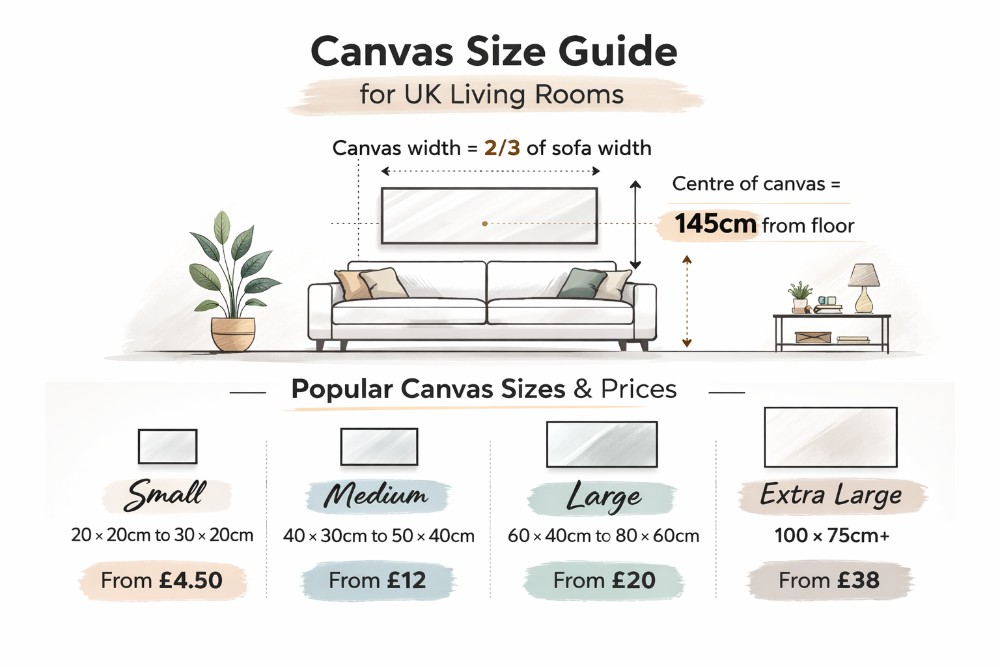
Quick Size Reference
Small (20×20 to 30×20cm): Best for flats and box rooms. Factory Price from £4.50.
Medium (40×30 to 50×40cm): The sweet spot for most standard UK living rooms. From £12.
Large (60×40 to 80×60cm): Feature walls and above sofa. From £20.
Extra Large (100×75cm+): Statement walls, detached homes and open-plan spaces. From £38.
Small Living Rooms (Under 12 Square Metres)
Many British flats, terraced houses and new-build homes have compact living rooms — and that is absolutely fine. You just need to be a bit more deliberate about sizing.
Key Rules for Small Rooms
- Maximum individual canvas size: 50×70cm — anything larger will dominate the space
- Maximum number of canvases in one arrangement: 5–7 in a group, with the rest of the wall left clear
- Stick to lighter colours and softer tones — dark, heavy images can make a small room feel even smaller
- Portrait-orientation canvases (taller than wide) create an illusion of height — useful if your ceiling feels low
- Leave adequate breathing space — do not cover every available wall
Best Arrangements for Small Rooms
- 3x 30×40cm triptych above the sofa — the most effective use of limited wall space
- 1x 60×40cm statement single — bold without being overwhelming
- 5x 20×30cm horizontal row — fills the wall above a 2-seater sofa perfectly
- 4x 30×30cm square grid — clean and neat, works in modern small spaces
Medium Living Rooms (12–18 Square Metres)
This is the size of most standard UK living rooms in terraced and semi-detached houses. You have real flexibility here.
The Sweet Spot Sizes
- Individual canvases: 40×30cm to 60×80cm
- Gallery wall: 7–12 canvases in a mixed arrangement
- Statement piece: 80×60cm is the ideal statement size for this room
- Triptych: 3x 50×70cm is the classic medium-room above-sofa arrangement
Complete Layouts with Measurements
Above a 3-seater sofa (typically 200cm wide): A trio of 50×70cm canvases, spaced 6cm apart, with the outer edges of the arrangement aligning roughly with the outer edges of the sofa, will fill the wall beautifully.
On a feature wall (typically 350–400cm wide): A salon-style gallery of 12–15 mixed canvases arranged around a large anchor piece (80×60cm) will make a genuinely dramatic focal point.
Large Living Rooms (18 Square Metres and Above)
Lucky enough to have a large living room? Go big. This is your chance to use canvas sizes that would overwhelm a smaller room.
Statement Sizes for Large Rooms
- 100×75cm or larger as a centrepiece — now genuinely in proportion
- Gallery walls of 15–20 or more canvases across a feature wall
- Multiple separate canvas arrangements — one above the sofa, one on the feature wall
- Floor arrangements — very large canvases (120×80cm) leaned against the wall for a gallery-showroom look
Rather than filling the walls with lots of small canvases, consider using 3–5 very large pieces. A 100×75cm canvas has real presence in a large room and makes a statement that 20 smaller prints never could.
The Complete Measurement Guide
These are the numbers you need when planning your canvas placement.
- Centre height: Hang the centre of your canvas at 145cm from the floor — this is the gallery standard and the most comfortable viewing height for most people
- Above furniture: Leave 15–25cm between the top of a sofa or sideboard and the bottom of the canvas — close enough to look connected, far enough to give breathing space
- Spacing between canvases: 5–7cm is the standard gallery spacing for prints of similar size. Go tighter (2–3cm) for triptych panels, looser (8–12cm) for large pieces
- Canvas to wall width ratio: Your canvas arrangement should cover roughly two-thirds of the wall width below it
- Above fireplace: Leave at least 15cm between the top of the mantelpiece and the bottom of the canvas
The paper template trick: Before you drill a single hole, cut out pieces of paper the same size as your planned canvases and stick them to the wall with masking tape. You can move them around, try different arrangements and live with the layout for a day or two before committing.
Colour Schemes and Coordination
One of the most common questions we hear is: "Will this canvas go with my living room?" The answer is almost always yes — but knowing a few basic colour principles will help you make choices you genuinely love.
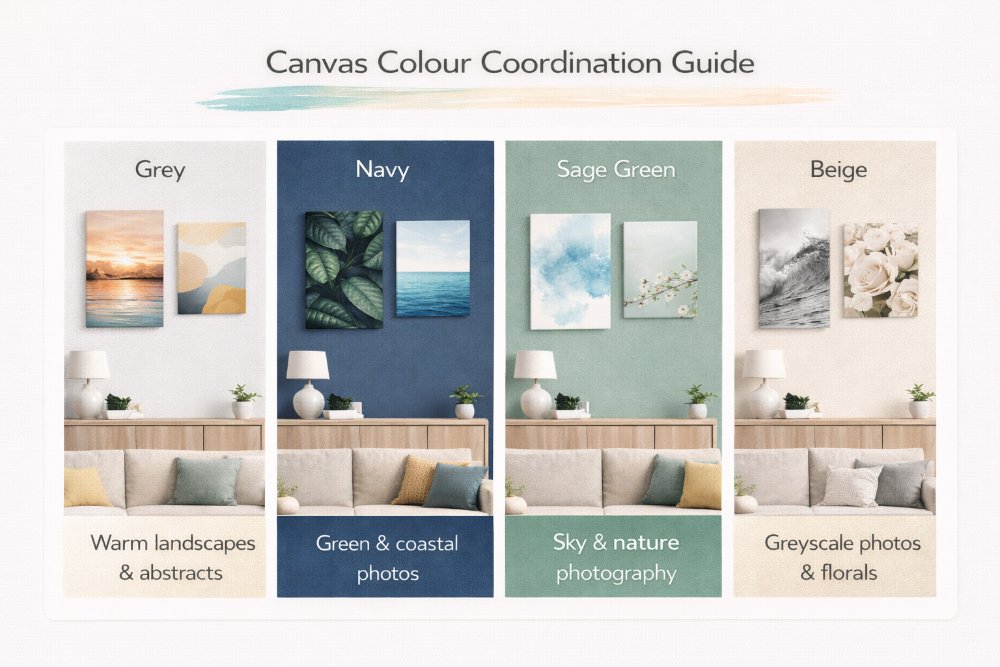
Matching Canvas to Your Room's Colours
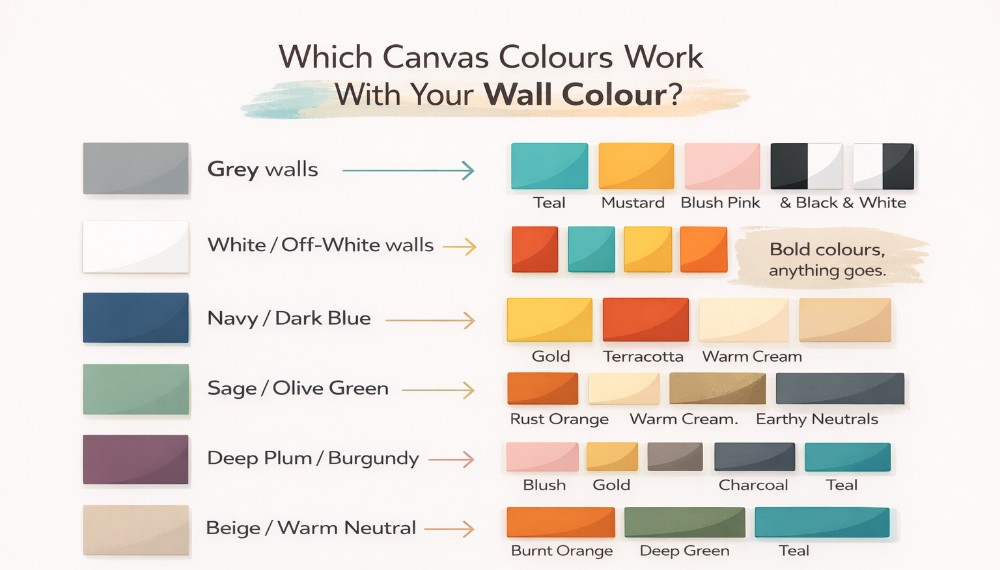
Grey walls (warm or cool): Teal, mustard, blush pink and black-and-white all work beautifully
White and off-white walls: Anything goes — bold colours pop particularly well
Navy or dark blue (trending heavily in 2026): Gold accents, terracotta, soft pinks and warm cream tones create beautiful contrast
Sage or olive green: Earthy neutrals, rust orange, warm cream and black-and-white work brilliantly
Deep plum or burgundy: Blush florals, gold abstracts and charcoal tones complement perfectly
Beige and warm neutral: Burnt orange, deep green, teal and soft pastels all work well
The 2026 Navy and Indigo Trend
Dulux's Colour of the Year 2026 is "Rhythm of Blues" — a range of indigo shades — and many UK living rooms are going deep blue. Against a navy or indigo wall, warm canvas tones create beautiful contrast: terracotta, gold-accented art, earthy abstracts and warm cream-toned photography.
The Sage Green Moment
Green walls are having a big moment in British homes. Against sage or olive green, earthy neutrals work brilliantly — rust orange, warm cream and brown tones. Nature photography looks particularly at home against a green wall.
Creating Colour Harmony
The 60-30-10 Rule
A simple formula: 60% of your room should be your main colour (walls), 30% a secondary colour (furniture), and 10% an accent colour (accessories, including canvas art). Your canvas does not have to match the room — it should accent it.
The "Lift-a-Colour" Technique
Pick up one of the secondary colours in your room — a cushion colour, a rug tone, a piece of furniture — and make it the dominant colour in your canvas selection. This creates cohesion without matching anything exactly.
The Monochromatic Approach
Choose canvas art in different shades and tones of the same colour family as your walls. For example, sage green walls paired with a slightly darker green botanical print and a soft green abstract creates a beautifully harmonious, layered effect.
Colour Psychology: What Different Canvas Colours Do to a Room
Blues
Blue tones in canvas art create a calm, relaxed atmosphere. Coastal and ocean photography is so popular in living rooms partly for this reason — it genuinely affects how a room feels. Blue also makes a space feel slightly larger and more airy.
Greens
Green brings the outdoors in. Botanical prints, forest photography and nature images in green tones make a living room feel refreshed and connected to nature. Psychologically, green is restful and easy on the eye — ideal for a room where you relax.
Warm Tones — Orange, Red, Yellow
Warm canvas art — terracotta landscapes, golden sunsets, autumn colours — makes a room feel cosy and welcoming. This is particularly good for north-facing rooms that get little natural light, where cool tones can make a space feel chilly.
Black and White
Timeless and sophisticated. Black-and-white canvas art does not affect the emotional temperature of a room as strongly as colour does, which makes it the safest choice if you are unsure what will work.
Budget-Based Canvas Ideas
One of the best things about canvas prints is that you genuinely do not need to spend a fortune to transform a room. Here is what is possible at every budget level.
Budget: Under £50
A tight budget is absolutely fine. Some of the best canvas arrangements are created for well under £50.
- 3x 20×30cm canvases: From around £13–£15 — a simple three-photo trio above a desk or beside a window
- 1x 40×30cm statement print: From around £12 — a single photo that speaks for itself
- 5x 15×20cm mini canvas collection: From around £22–£25 — a charming small gallery for a compact space
Our Factory Price for a 20×30cm canvas starts from £4.50. That means you can create a five-piece arrangement — a genuinely striking wall display — for around £22–£25.
Budget: £50 to £150
This is the most popular price range for canvas walls in UK homes — and where you start to have real creative options.
- 9x 30×30cm grid: With our 15% bundle discount, nine canvases costs less than most people expect. A 3×3 grid above your sofa is one of the most impressive arrangements you can make
- 3x 50×70cm triptych: Three matching canvases side by side, making a beautiful display for around £70–£85 total
- Mixed gallery wall of 12–15 pieces: By mixing small and medium sizes you can fill a feature wall for under £150
Do not forget: order 9 or more canvases and you automatically save 15%. That makes bigger orders much more affordable.
Budget: £150 to £300
At this budget level you can genuinely transform a living room. Large statement pieces become accessible and you can build a proper multi-wall display.
- Large statement canvas (100×75cm) plus a flanking pair: A genuinely imposing focal point
- A complete feature wall gallery of 20 or more canvases: A full salon-style transformation
- Canvases for multiple rooms: Living room plus hallway, for example
Budget: £300 and Above
With £300 or more, you can overhaul a living room's entire wall decor. Multiple large-format canvases, full feature wall treatments, or a mix of large statement pieces with gallery walls on secondary walls.
For a large living room with several walls to fill, we would suggest: one large statement canvas (100×75cm), one salon-style gallery wall of 15–18 canvases, and matching pairs for the remaining walls. This usually works out to between £300 and £500 with our Factory Prices.
UK-Specific Considerations
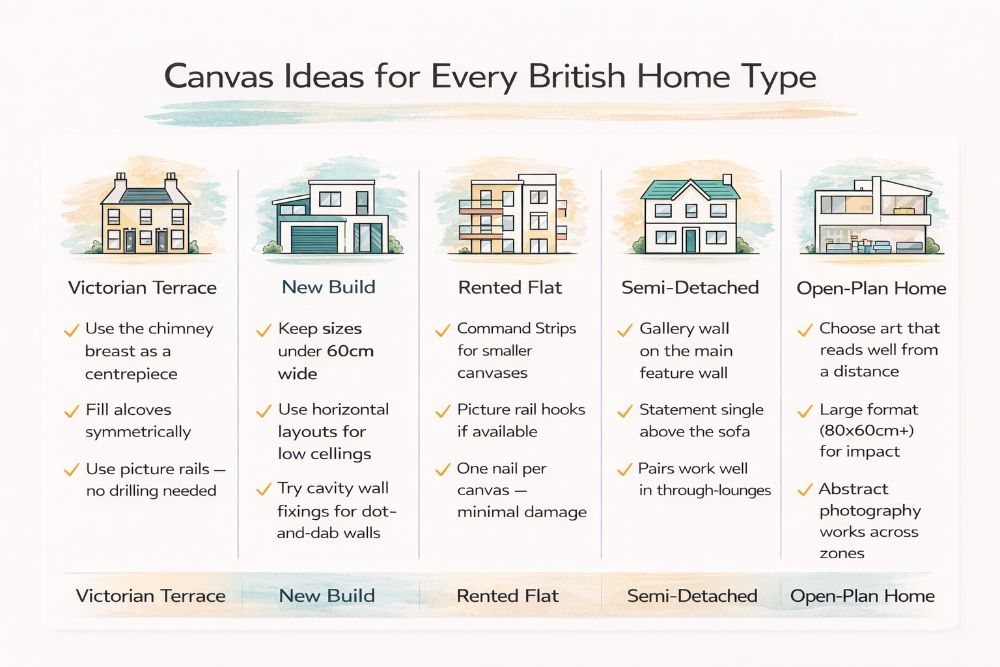
British Home Challenges
Victorian and Edwardian Terraced Houses
The Victorian terrace is the most common type of home in British cities, and it comes with a specific set of features that affect how you hang canvas.
- Chimney breast: Use it as a centrepiece — hang one statement canvas directly above the fireplace
- Alcoves on either side: Symmetrical placements in both alcoves create a beautifully balanced room
- Picture rails: If they are there, use them — they are perfect for canvas prints and you do not need to drill a single hole
- Narrow rooms: Prioritise the chimney breast wall and above the sofa — do not try to fill every wall in a narrow room
- Bay windows: The bay wall, opposite the fireplace, often gets ignored. A large canvas or small gallery can bring it to life
New-Build Homes
- Lower ceilings (typically 2.4m): Avoid very tall portrait canvases — horizontal or square formats feel more natural
- Dot-and-dab walls: Use cavity fixings specifically designed for this type of construction — standard wall plugs can fail
- Open-plan living-kitchen: Canvas art in the living area needs to work when viewed from the kitchen too — avoid anything that looks odd at an angle
- Limited wall space: In open-plan rooms, the sofa back wall is often your only real canvas wall — make it count
Rental Properties
If you are renting, your wall decor options feel limited. But canvas prints are actually one of the most renter-friendly choices you can make.
- Most canvas prints only need a single small nail or hook — minimum wall damage
- Command Strips (adhesive strips) hold canvases up to about 3–4kg without drilling — fine for smaller canvases
- If your property has picture rails, you are in luck — use them with no drilling at all
- Many landlords accept "fair wear and tear" which includes picture hooks
North-Facing Rooms
North-facing living rooms get very little direct sunlight, which can make them feel cold and gloomy. Canvas art can genuinely help.
- Choose warm-toned canvas art — terracotta, golden yellows, warm whites — to counteract the cool light
- Avoid very dark or very cool-toned canvas art — it will make the room feel even colder
- Coastal and landscape photography with warm golden-hour light works particularly well
- Make sure you have adequate artificial lighting near your canvas — a picture light or angled spotlight makes a huge difference
UK Living Room Trends 2026
The Shift from Minimalism to Warm Maximalism
The cold, clinical white-walled minimalism that dominated British interiors for years is fading. In 2026, British homes are getting warmer, more colourful and more personal. Earthy tones, dark walls, layered textures — and more art on the walls. Canvas prints are perfectly placed for this shift.
Fewer Walls, Bigger Art
Rather than filling every available wall, the trend in 2026 is to choose one or two walls and make them genuinely spectacular. One enormous canvas or a very deliberately curated gallery wall, rather than scattered prints on every surface.
Personal Over Generic
Shop-bought art prints are declining in popularity as people recognise the appeal of putting genuinely personal photography on their walls. Your own photos — your family, your travels, your pets — tell a more interesting story than any purchased artwork.
The 75-Year Investment
People are thinking more carefully about what they put on their walls. Our canvas prints are printed with HP latex inks and built to last — we guarantee they will stay vibrant for 75 years. In a world of disposable decor, that permanence matters.
How to Choose the Right Photos
The best canvas layout in the world will not save a bad photo. Here is how to pick photos that work brilliantly on canvas.
Photo Quality Requirements
Resolution: What Is Enough?
- 20×30cm canvas: Minimum 800×1,200 pixels — almost any phone photo from the last eight years will work
- 40×60cm canvas: Minimum 1,600×2,400 pixels — still fine for most recent smartphone photos
- 80×60cm canvas: Minimum 2,400×3,200 pixels — worth checking with older phones or zoomed shots
- 100×75cm and above: Minimum 3,000×4,000 pixels — modern iPhones and Samsung Galaxy phones are fine
As a rule of thumb: if the photo looks sharp on your computer screen at full size, it will be fine as a canvas. If it looks pixelated on screen, it will be worse when enlarged.
When Phone Photos Work Brilliantly
- Portrait shots with faces close up — phones are very good at these
- Landscape photography in good lighting
- Candid family moments — the emotional content matters far more than technical perfection
- Holiday photos — modern phone cameras capture colour and light beautifully
When to Be Careful
- Old photos scanned from prints — quality depends heavily on the scan quality
- Heavily zoomed shots — digital zoom degrades quality significantly
- Dark or blurry images — enlarging them to canvas size amplifies both issues
- Screenshots — these are usually too low resolution for canvas printing
Photo Selection Strategy
Tell a Story
The best canvas collections are not just random photos — they tell a story. What story do you want your living room wall to tell about your family, your life, your interests?
- A family portrait wall that spans multiple generations tells the story of your family's history
- A travel collection tells the story of adventures shared
- A timeline of your children tells the story of watching them grow
Choose for Cohesion
A collection of photos that feel visually similar — similar lighting, similar colour palettes, similar moods — looks far more considered than a random selection.
- Consistent colour temperature: Mix warm-toned and cool-toned photos with care — they can clash on a wall
- Consistent brightness: Very dark and very light photos side by side can look unbalanced
- Consider cropping: Canvas prints come in set aspect ratios. Cropping your photo to match the canvas size before ordering gives you full control of the composition
The Editing Basics
You do not need to be a photographer to improve your photos. A few simple edits can make a big difference. Free apps like Snapseed and Lightroom Mobile make all of these easy to do on a phone.
- Brightness and contrast: Slightly more contrast than you would use for a phone screen — canvases benefit from it
- Colour saturation: A very slight increase in saturation makes canvas colours pop
- Black-and-white conversion: A proper B&W edit with adjusted contrast is far more striking than simply desaturating
Installation and Hanging Guide
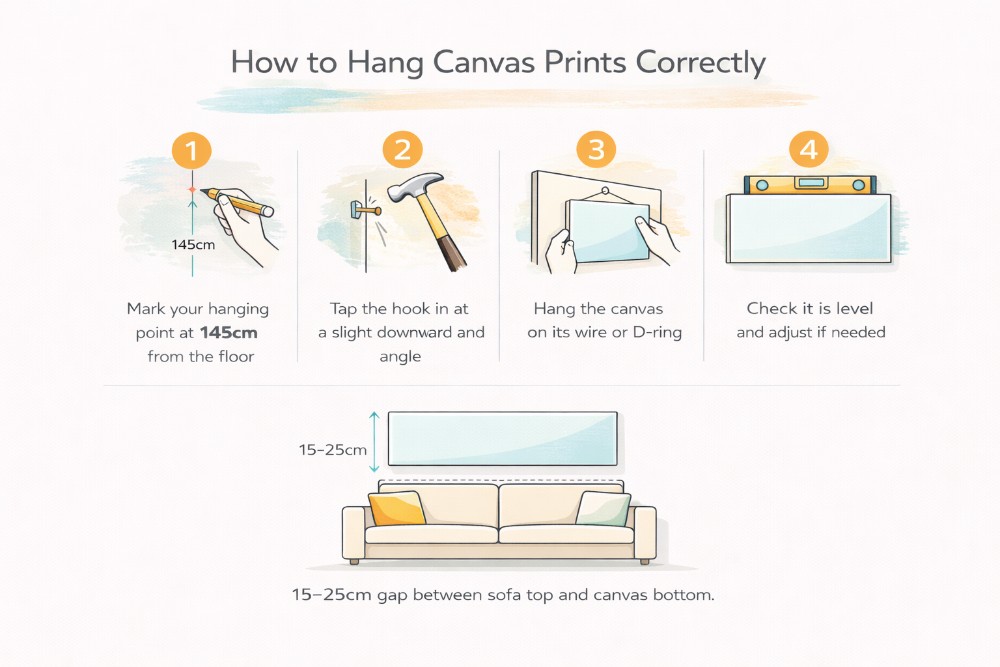
Hanging Methods
The Standard Picture Hook (Recommended for Most Canvases)
For canvases up to 5kg, a standard brass picture hook is all you need. These go into plaster walls without drilling.
- Mark your hanging point with a pencil
- Tap the picture hook in at a slight downward angle — the angled nail grips better and is less likely to work loose
- Hang the canvas on its hanging wire or D-ring
- Check with a spirit level and adjust
For Heavier Canvases or Plasterboard Walls
Canvases over 5kg (usually anything 80×60cm or larger) or canvases going onto modern plasterboard walls need proper wall plugs and screws.
- Tap the wall: solid sounds mean plaster or brick behind; hollow sounds mean plasterboard with a void
- Plasterboard with a void (common in new builds): Use cavity wall fixings such as Toggler fixings or Driva screws
- Plaster on brick (common in Victorian homes): Drill into the plaster and into the brick behind — use a standard wall plug and screw
No-Drill Options for Renters
- Command Strips (3M): Suitable for canvases up to about 3–4kg. Clean the wall with an alcohol wipe first, press firmly for 30 seconds, and wait one hour before hanging. Not suitable for textured or old plaster walls
- Picture rails: If your property has them, use picture rail hooks and adjustable hanging wire — zero wall damage and fully adjustable height
Common Hanging Mistakes
Hanging Too High
This is the most common mistake. The centre of your canvas should be at eye level — around 145cm from the floor. Most people hang art about 15–20cm too high.
Wrong Size for the Wall
A canvas that is too small for the wall looks lost and apologetic. If in doubt, go a size up — a canvas that is slightly too big looks confident; one that is too small looks like an afterthought.
Not Using a Spirit Level
It takes about 30 seconds to check your canvas is straight. If it is not, it will bother you every time you look at it.
Ignoring Viewing Distance
Consider where people will actually be sitting when they look at your canvas. A very large canvas hung too close to a seating area will feel overwhelming. A small canvas on a wall viewed from across the room will disappear.
Canvas Combinations: What Works Together
Canvas prints rarely exist in isolation. They share a room with mirrors, shelves, plants, furniture and other art. Knowing what to combine them with — and what to keep well away — makes a real difference.
What Works Brilliantly Together
Canvas and Floating Shelves
Hang two or three canvases above a row of floating shelves. The shelves hold plants, books and objects; the canvases anchor the whole arrangement visually. This works particularly well in modern and Scandi-style rooms.
Canvas and Mirrors
A large circular mirror alongside a group of canvases creates a beautifully varied wall display. The mirror adds depth and light; the canvases add colour and personal content. Make sure they sit at a consistent height.
Canvas and Plants
Trailing plants like pothos or string of pearls positioned near or below canvas prints create a natural, layered effect. Particularly beautiful with botanical or nature-themed canvas art.
Canvas and a Statement Object
A piece of antique pottery, a sculptural vase or a decorative wall clock positioned alongside canvas prints gives the wall multiple focal points at different scales.
What Does Not Work
Competing Styles
A very modern, minimal canvas group and a traditional ornate mirror on the same wall will fight each other. Your wall decor should have some stylistic consistency, even if it is not a matching set.
Too Many Competing Focal Points
If a TV, a large mirror, a gallery wall and a statement plant are all on the same wall, nothing stands out. Pick one dominant element per wall.
Mixed Print Quality
Hanging a professionally printed large canvas alongside a phone-printed A4 photo in a cheap frame will make the cheaper print look worse and the expensive canvas look less impressive. Keep your wall displays at a consistent quality level.
Seasonal Changes and Flexible Canvas Displays
One of the underrated advantages of canvas prints is how easy they are to swap out. Unlike built-in shelving or painted features, a canvas can come down and go back up in minutes.
Seasonal Canvas Approaches
Spring and Summer
Brighter colours, florals, coastal photography, green landscapes. A spring refresh might mean swapping out a moody autumn landscape for a wildflower meadow print, or replacing a family portrait with a recent holiday shot.
Autumn and Winter
Deeper, warmer tones come into their own. Autumn foliage, cosy woodland scenes, golden-hour landscape photography. Rich ochre and deep amber canvas art makes a living room feel genuinely cosy when the nights draw in.
Christmas
Seasonal canvas prints — family Christmas photos, winter scenes, photographs from Christmas morning — are a lovely way to mark the season without filling your home with temporary tinsel and baubles that need storage.
Building a Rotating Collection
Rather than buying one set of canvases for your living room, consider building a small collection of 15–20 that you rotate seasonally. With our Factory Prices, this is much more affordable than most people expect.
- Keep your winter collection in a flat box under the bed
- Rotate 4–6 canvases per season — you do not need to swap the whole display
- Your gallery wall can evolve gradually as you add new photos and retire older ones
Real UK Living Room Examples
Sometimes the most useful thing is seeing exactly what other people have done. Here are seven real examples from British living rooms, covering different home types, budgets and styles.
Case Study 1: Small Manchester Terrace
- Room size: 3.5m × 4.5m
- Budget: £75
- Solution: 9x 30×30cm grid above a two-seater sofa
- Photos used: Mix of black-and-white family candids and one Pennines landscape
- Result: The 3×3 grid (total width 110cm) sits perfectly above the sofa and transformed the room from feeling empty to genuinely finished
Case Study 2: Large London Semi-Detached
- Room size: 4.5m × 6m
- Budget: £280
- Solution: Feature wall salon gallery of 18 mixed canvases plus a three-canvas triptych above the sofa
- Photos used: Family portraits, travel photography, pet portrait and two landscapes
- Result: A complete room transformation. The feature wall became the first thing guests commented on
Ready to Transform Your Living Room?
Canvas prints are one of the most affordable, personal and genuinely effective ways to improve how your living room looks and feels. Whether you are after a single statement piece or a full gallery wall transformation, you have everything you need to get it right.
At My Picture UK, our gallery-wrapped canvas prints are made to last — printed with HP latex inks on premium quality canvas and backed by our 75-year fade guarantee. Prices start from just £4.50 at our Factory Price, and you save 15% when you order nine or more.
Free delivery is available on qualifying orders, and our online design tool makes it easy to upload your photos, preview your canvas and order in minutes.
Frequently Asked Questions
-
A 3-seater sofa is typically 200–220cm wide. Your canvas arrangement should be roughly two-thirds of that width — so around 130–150cm total. A trio of 50×70cm canvases (spaced 6cm apart, total width about 160cm) works perfectly. Alternatively, a single 100×75cm canvas centred on the sofa looks bold and modern.
-
There is no strict rule, but most rooms look best with a focused display in one or two locations rather than canvas on every wall. For a small to medium room, 3–9 canvases in a grouped arrangement works well. For large rooms, 15–25 in a gallery wall plus 3–5 elsewhere can look spectacular.
-
It depends on what you are hanging and where. Landscape orientation (wider than tall) works well above sofas and for scenic photography. Portrait orientation (taller than wide) works better for portrait photography, for creating an illusion of height in rooms with low ceilings, and for filling narrow alcove walls.
-
The bottom of the canvas should sit 15–25cm above the top of the sofa back. The centre of the canvas should be at roughly 145cm from the floor. If following these measurements results in the canvas sitting too high or too low for your room, prioritise the 15–25cm gap above the sofa — that visual connection between sofa and canvas is the most important thing.
-
Yes, absolutely. Mixing canvas and framed prints on the same wall can look great in eclectic and traditional rooms. The key is to maintain some consistency — either of theme, colour palette, or style — so the mix looks curated rather than random.
-
5–7cm between individual canvases is the standard gallery spacing. Go tighter (2–3cm) for triptych panels where you want the image to read as continuous. Go slightly wider (8–10cm) for large format canvases that need more visual breathing space.
-
You do not need to match your canvas to your sofa, but picking up one of the sofa's secondary colours in your canvas art can create lovely cohesion. If your sofa is grey with mustard cushions, a canvas with warm golden tones will complement it beautifully.
-
Use the paper template method: cut out pieces of paper the same size as your canvases, stick them to the wall with masking tape, and try different arrangements before drilling a single hole. You can also use Command Strips for lighter canvases (up to about 3kg) to avoid drilling altogether.
-
A quality canvas print, kept out of direct sunlight and humidity, should last decades. Our canvas prints are printed with HP latex inks on premium stretched canvas and we back them with a 75-year fade guarantee — so they will genuinely outlast most of the furniture in your house.
-
Yes, if the fireplace is not in regular use, this is one of the most striking placements in any room. Leave at least 15cm between the top of the mantelpiece and the bottom of the canvas. For working fires, a significant gap and good ventilation are advisable.
-
Choose warm-toned canvas art — landscapes with golden light, terracotta or ochre tones, warm white photographic backgrounds. Avoid very cool blues and greys, which can amplify the already cool light in a north-facing room.
-
Use a long spirit level or laser level. For a horizontal row, measure up from the floor rather than down from the ceiling — floors are more level than ceilings in most UK homes. For a gallery wall, use the paper template method and take your time getting the layout right on the floor before transferring it to the wall.
-
In a small flat, scale down proportionally. Above a 2-seater sofa (typically 140–160cm wide), a trio of 30×40cm canvases or a single 50×70cm canvas works well. Avoid anything wider than about 90cm in a room under 3.5m wide.
-
The key is an anchor piece — one large canvas that everything else is arranged around. Start with the largest canvas roughly in the centre of the space, then build outwards. Maintain consistent spacing throughout. Lay the whole arrangement out on the floor first so you can see how it looks before anything goes on the wall.
-
Most of the time, yes. Modern smartphones — including iPhones from about 2016 onwards and recent Samsung Galaxy phones — have more than enough resolution for canvases up to 80×60cm. Avoid heavily zoomed shots, very dark or blurry images and screenshots.