Let’s be honest about the word “cheap”. When you search for cheap canvas prints, you are not asking for something shoddy. You want a fair, low price for a print that looks brilliant on your wall — and stays looking brilliant.
The trouble is, the market is full of both. Some low-cost canvas prints are genuine bargains made by efficient printers who pass the savings on. Others are cheap because someone cut corners on the frame, the fabric or the ink. From across the room, they can look identical on day one. Six months later, one is still taut and vibrant. The other is sagging like a deckchair and fading in the sunlight.
The good news? You can tell them apart before you spend a penny. This guide shows you exactly how — what makes a canvas look cheap, what a fair UK price actually is in 2026, and the styling tricks that make a £16 canvas pass for something four times the price.
In a nutshell: A cheap canvas print that doesn’t look cheap is one printed with fade-resistant inks on a proper kiln-dried wooden stretcher frame, using a sharp, high-resolution photo — sold at a low price because the printer keeps costs down, not because they skimped on materials. The price should be cheap. The result never should.
Key Takeaways
Only five things make a canvas look cheap: a flimsy stretcher frame, dye inks that fade, thin fabric, sloppy edges, and the wrong size hung badly. Every one of them can be spotted — or fixed — before you spend a penny.
A fair UK price for a 40×30cm photo canvas in 2026 is £12–£25 from specialist online printers. High-street photo brands charge £35–£45 for a comparable print; prices far below £12 usually mean corners have been cut.
Bigger is cheaper per square metre. A 120×80cm canvas works out at around £63 per m² of wall covered, against £133 per m² for a 40×30cm — so one large statement piece is the best-value wall art you can buy.
Check the materials list, not the price tag. Kiln-dried FSC pine stretcher bars, latex or pigment inks, and a fade guarantee are the marks of the good kind of cheap. Silence on any of them is a warning sign.
The most expensive-looking upgrades are free: size your art to two-thirds the width of the furniture below it, hang the centre at 145cm, match the edge design to your photo, and group prints in odd numbers with even 5cm gaps.
Mind the delivery line. Free delivery kicks in at £49, so bundling a small print with a large one often costs less than paying postage on the large one alone.
Why Are Some Canvas Prints So Cheap?
There are two very different answers, and knowing the difference is half the battle.
The good kind of cheap. Big online canvas printers run high-volume, made-to-order production. Nothing sits in a warehouse gathering dust, nothing gets thrown away, and there is no high-street shop rent to pay. Those savings get passed on to you. A canvas that would cost £30–£40 in a shop can genuinely be made and sold for £10–£16 online without a single corner being cut.
The bad kind of cheap. Some sellers hit rock-bottom prices by using thin fabric, weak timber and dye-based inks that fade. The print looks fine in the listing photo. The problems show up on your wall.
The price tag alone will not tell you which kind you are looking at. The materials list will. So let’s look at exactly what to check.
What Actually Makes a Canvas Look Cheap
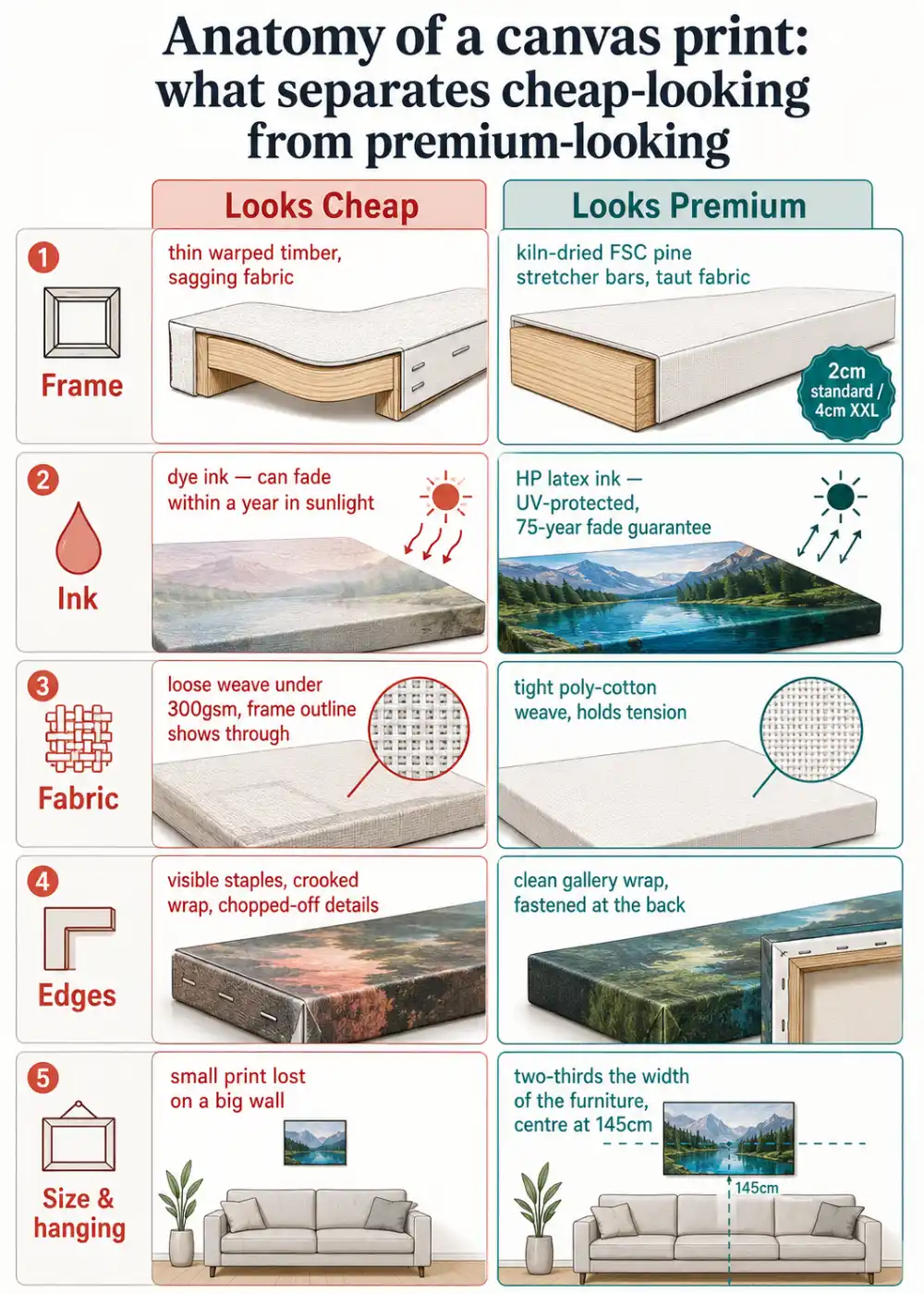
Five things, in practice. Get familiar with them and you will spot a dud from the product description alone.
1. A flimsy stretcher frame
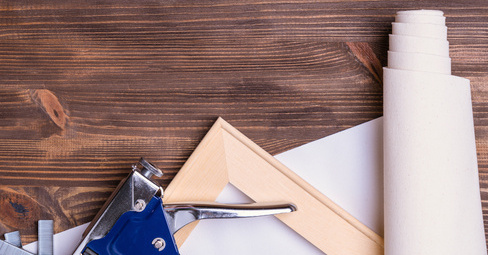
The wooden frame underneath — the stretcher frame, made up of stretcher bars — is the skeleton of your canvas. If the timber is thin, damp or poorly dried, the canvas cannot be held taut. The result is the single most common complaint about budget canvas: sagging, rippling fabric that looks like a windless sail.
What to look for instead is kiln-dried or well-seasoned pine, ideally FSC-certified so you know the wood is responsibly sourced. Dried pine is light, strong and — crucially — it doesn’t twist as the humidity in your home changes through a British winter.
Frame depth matters too. A slim 2cm frame looks clean and modern on small and medium prints. For big statement pieces, a 4cm XXL frame gives the print a bolder, more substantial look from the side and stops long stretcher bars bowing over time.
2. Dye inks that fade
This is the sneakiest one, because you cannot see it on delivery day. The cheapest canvases are printed with dye-based inks. They look punchy at first, then break down under UV light — sometimes fading noticeably within a year, especially near a window.
Better prints use pigment or latex inks, where the colour bonds to the fabric as tiny solid particles rather than soaking in like a stain. Our own canvases are printed with solvent-free HP latex inks, which combine the staying power of solvent-based inks with the safety of water-based ones — no fumes, safe for a child’s bedroom, and backed by a 75-year fade guarantee.
Here’s the simple rule: if a seller doesn’t say what inks they use, assume the cheapest. Printers who invest in good ink tend to shout about it.
3. Thin canvas fabric
Canvas fabric is measured in grams per square metre (gsm). Very cheap prints use loose-weave fabric well under 300gsm, which struggles to hold tension and shows the frame’s outline through the front — a dead giveaway. A tight poly-cotton weave holds its shape, takes ink cleanly and gives that subtle painterly texture that makes canvas feel like art rather than a printed sheet.
4. Sloppy edges
Edges are where corner-cutting is literally visible. Look out for crooked wraps, staples showing on the sides, puckered corners, or a photo that awkwardly chops off someone’s forehead as it turns the corner.
A proper gallery-wrapped canvas has the fabric pulled smoothly around the frame and fastened neatly at the back, so the sides are clean and the front is uninterrupted — the same construction used for traditional paintings.
5. The wrong size, hung badly
This one costs nothing to fix, and it is the biggest giveaway of all. A tiny canvas marooned in the middle of a big wall looks like an afterthought no matter what it cost. A well-sized print hung at the right height looks expensive no matter how little it cost. We will cover the exact measurements shortly.
The 60-Second Checklist Before You Buy
Run through this on any product page. A seller who ticks most of these boxes is selling the good kind of cheap.
Frame: Is the wood named? Pine, kiln-dried, FSC-certified — and is a depth given?
Ink: Pigment or latex inks mentioned? Any fade guarantee?
Fabric: Any mention of the canvas weave or weight? Silence usually means thin stock.
Resolution check: Does the website warn you if your photo is too small for the size you picked? Good printers block sizes your photo can’t support. Bargain-bin ones happily print a blur.
Edge options: Can you choose how the sides are finished? Choice is a sign of a proper operation.
Reviews: Thousands of verified reviews on an independent platform beat a handful of quotes on the seller’s own site.
The real total: Add delivery before you compare. A “£6.99” canvas with £8 postage is not the bargain it looks.
What Canvas Prints Actually Cost in the UK in 2026
To spot a bargain, you need to know the going rate. Broadly, the UK market splits into two tiers for a popular 40×30cm single-photo canvas:
High-street and big-brand photo services: roughly £35–£45
Anything far below the first band usually means a smaller size than you think, a thin frame, or the materials problems we covered above. Anything in the second band is mostly paying for the brand name — the canvas itself is rarely better.
For a concrete yardstick, here is our full Factory Price list for canvas prints, checked live in July 2026. (Factory Price is our permanent price — we deliver straight from our factories, so it is the everyday cost, not a flash sale.)
Square formats
Size
Retail Price
Factory Price
20×20cm
£29.90
£4.50
40×40cm
£45.90
£20.00
60×60cm
£59.90
£36.00
80×80cm
£85.90
£48.00
Landscape and portrait formats
Size
Retail Price
Factory Price
30×20cm
£34.90
£10.00
40×30cm
£37.90
£16.00
60×40cm
£49.90
£24.00
75×50cm
£59.90
£33.00
80×60cm
£69.90
£38.00
90×60cm
£75.90
£45.00
100×75cm
£99.90
£55.00
120×80cm
£125.90
£60.00
Panoramic formats
Size
Retail Price
Factory Price
60×30cm
£45.90
£23.00
80×40cm
£59.90
£33.00
100×50cm
£75.90
£45.00
120×60cm
£95.90
£50.00
The value secret nobody mentions: price per square metre
Here is a genuinely useful way to compare canvas prices that almost nobody talks about. Work out what you are paying per square metre of wall covered:
Size
Wall area
Factory Price
Cost per m²
40×30cm
0.12m²
£16
£133 per m²
60×40cm
0.24m²
£24
£100 per m²
80×60cm
0.48m²
£38
£79 per m²
120×80cm
0.96m²
£60
£63 per m²
Key takeaway: The bigger the canvas, the cheaper every square metre of it becomes. A 120×80cm canvas costs less than half as much per square metre as a 40×30cm one. If your goal is maximum impact for minimum spend, one large canvas nearly always beats several small ones — on looks and on maths.
The Delivery Maths That Saves You a Fiver
Delivery is where “cheap” quietly stops being cheap, so it pays to plan your basket. Our standard delivery is free on orders over £49, which sits at a slightly mischievous spot in the price list: an 80×60cm canvas is £38, and two 60×40cm prints come to £48 — a pound short each time.
The smart move is to bundle. An 80×60cm plus a 30×20cm for a shelf comes to £48... still short. Add a 20×20cm mini instead and you’re at £52.50, over the line, and you’ve gained an extra print for less than the delivery charge would have been. There’s a full breakdown of how the threshold works — and what doesn’t count towards it — in our guide to free shipping on canvas prints in the UK.
Timing-wise, budget canvas needn’t mean a long wait either. Standard canvases are ready for dispatch within 24 hours and typically arrive in 4–7 working days.
When Cheap Is a False Economy
Sometimes the rock-bottom option genuinely costs more in the end. Be careful when:
The price seems impossible for the size. A huge canvas for pocket change almost always means loose fabric on weak timber that will sag within months.
Nothing is said about inks. For a print destined for a bright room, dye inks are a false saving — you will be reordering within a couple of years.
You’re printing something irreplaceable. Wedding photos, a much-missed pet, a grandparent’s portrait. These are the moments to pick a printer with a proper guarantee and a long review history, not the cheapest listing on a marketplace.
Delivery wipes out the saving. Always compare the price with postage, from a seller with a comparable delivery time.
A lowest-price guarantee removes most of this worry. Ours works simply: find the same size and model cheaper from another UK online shop (including delivery), and we beat that price by 5%. That means you can stop hunting and start choosing photos.
How to Make a Budget Canvas Look Properly Expensive
Now the fun part. These five moves cost little or nothing, and they matter more than the price tag ever will.
1. Go bigger than feels comfortable
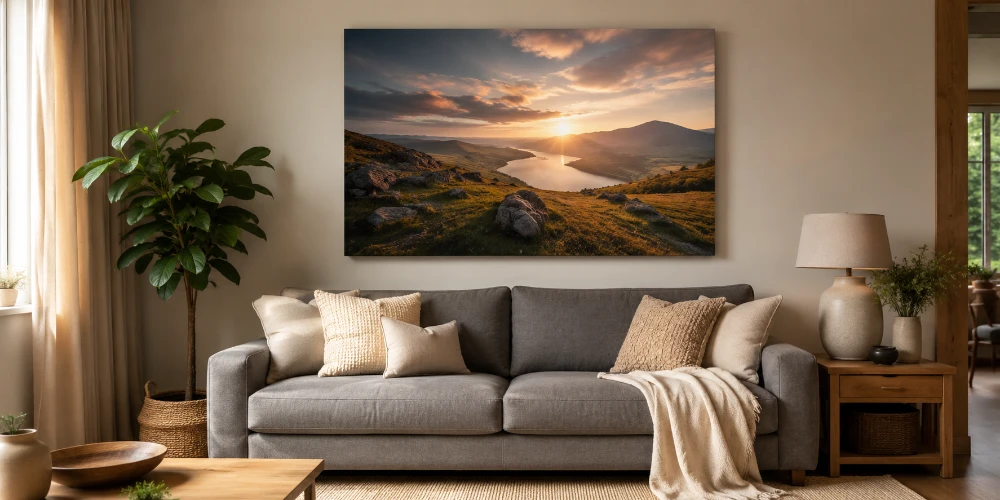
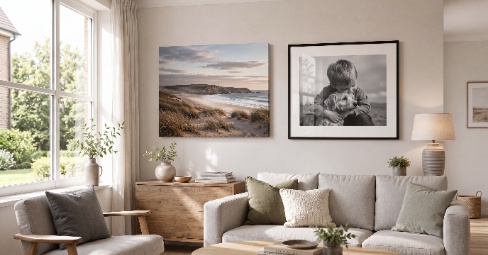
The number-one mistake with wall art is buying too small. Interior designers work to a simple rule: art above a sofa, bed or sideboard should span roughly two-thirds of the furniture’s width. Above a standard 200cm three-seater sofa, that means an arrangement around 130cm wide. A lone 30×20cm print up there will look apologetic.
Hang it at the right height too. Galleries place the centre of the artwork at about 145cm from the floor — average eye level — with the bottom edge sitting 15–25cm above the sofa back. Most people hang art 15cm too high; dropping it to gallery height is a free upgrade that makes everything look more considered.
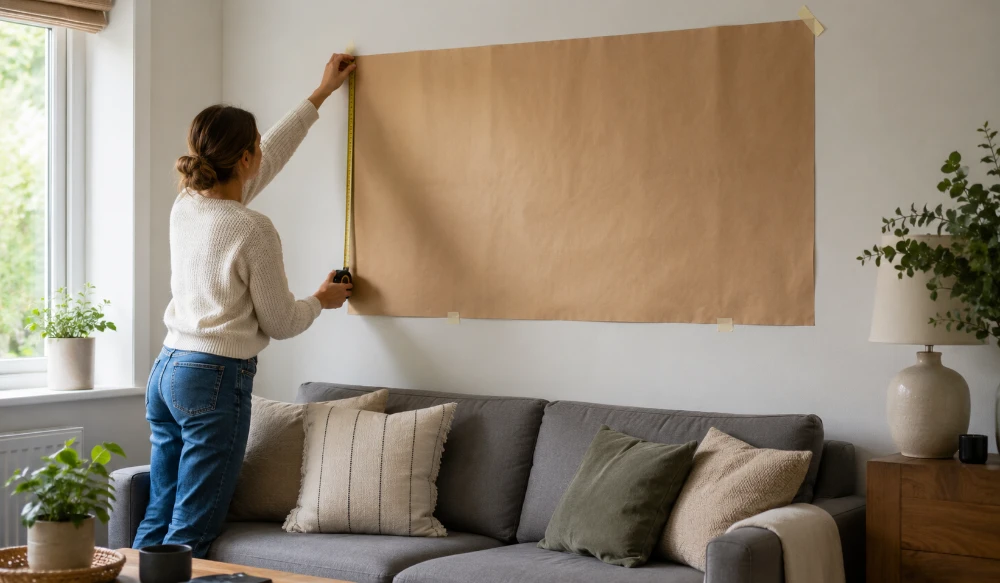
One last trick before you order: cut newspaper or wrapping paper to your planned canvas size, tape it to the wall with masking tape, and live with it for a day. Five minutes of faffing saves an expensive re-think.
2. Choose a photo that can carry the size
Scale amplifies everything — including flaws. On a big canvas, a busy, cluttered photo turns into visual soup, while a simple composition with a clear subject and a bit of breathing space reads as sophisticated from across the room. Landscapes with a strong horizon, a single portrait against a plain background, or a bold close-up all enlarge beautifully.
Then check the file itself. Canvas is more forgiving than glossy paper because its texture hides minor softness, but there is a limit, and it is the most common reason budget prints disappoint. As a rough guide, if the photo looks sharp on your computer screen at full size, it will print well; if it looks fuzzy on screen, it will look worse at 80cm wide. Our guide to the best resolution for canvas prints lists the minimum pixel counts for every size, so you can check before you order. Avoid heavily zoomed shots, screenshots and anything rescued from an old WhatsApp thread.
3. Pick the right edge design
The sides of your canvas quietly separate “homemade” from “gallery”, and choosing well costs nothing. There are five options:
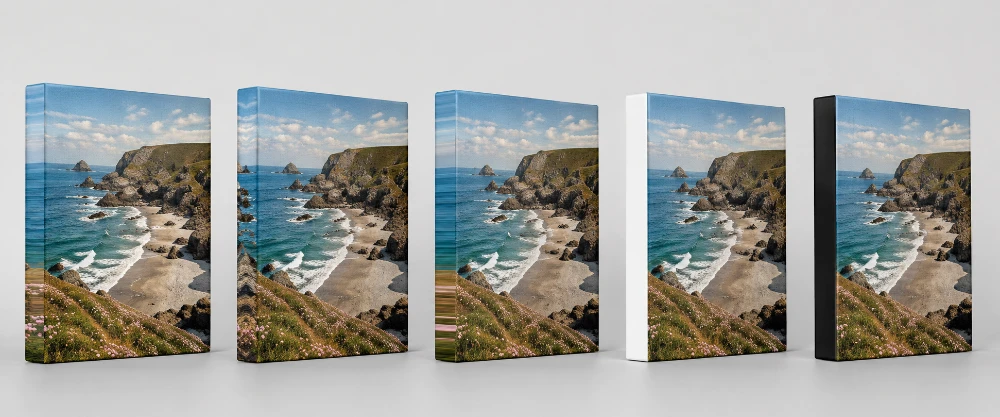
Mirrored edge — the border of your photo is copied, flipped and printed on the sides. Nothing gets cropped and the sides look seamless. The safe choice for portraits and family photos.
Folded edge — your photo wraps around the sides like a classic painting. Lovely for landscapes with space to spare; just keep faces away from the corners.
Stretched edge — the outermost pixels are pulled along the sides for a soft motion-blur effect. Full photo on the front, subtle colour on the sides.
White edge — a clean white strip on the sides that makes the canvas appear to float against a light wall.
Black edge — a black strip for a smart pop of contrast, especially striking with black-and-white photography.
If you want to understand how the wrap itself works — and why it means a canvas never needs a traditional frame — our explainer on what a gallery-wrapped canvas is covers it in plain English.
4. Group prints like a gallery would
Two or three canvases hung as a deliberate set look far richer than the same prints scattered around the house. The rules galleries swear by are easy to copy:
Odd numbers — three or five pieces feel natural; even numbers can look like a shop display.
Consistent spacing — around 5cm between prints reads as intentional. Tighter (2–3cm) if the set forms one split image; looser (8–10cm) for large pieces.
Anchor first — place your biggest print roughly central and build outwards.
Treat the group as one rectangle when sizing it against the furniture below.
5. Add a Premium Frame if you fancy a small splurge
A bare gallery wrap with a well-chosen edge already looks great. But if you have a few extra pounds, an outer Premium Frame — sometimes called a floating or shadow-gap frame — leaves a slim gap around the canvas so the whole print stays visible, exactly the presentation style you see in modern art galleries. It is the single upgrade that most transforms a budget canvas into something that looks seriously high-end.
The Budget Canvas Formats Worth Knowing
“Canvas print” covers more shapes than most people realise, and picking the right format for your photo and wall is another free way to look expensive.
Mini canvas prints
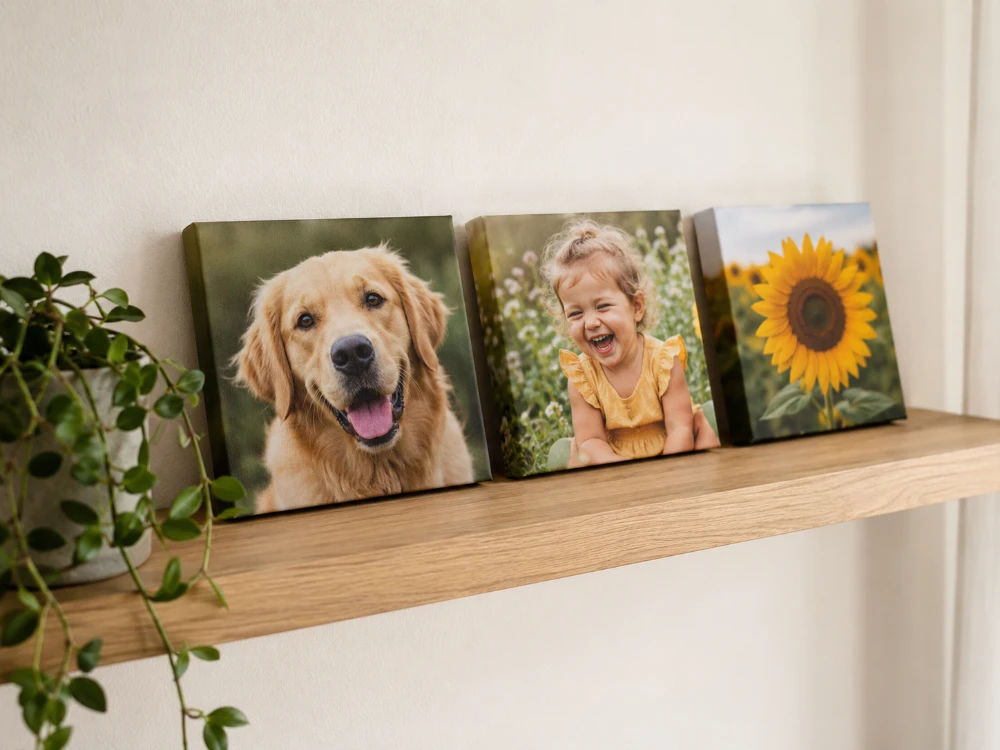
Small does not mean cheap-looking. A 20×20cm mini canvas costs £4.50 and is perfect for shelves, desks, narrow bits of wall and stocking-filler gifts. The trick at this size is to crop in tight on one clear subject — a face, a paw, a single flower. Fussy wide shots lose all their punch at 20cm.
Grouped in threes along a shelf or hung in a neat grid, minis punch far above their price. A five-piece mini display costs £22.50 — less than one framed print from the high street.
Large canvas prints
As the price-per-square-metre table showed, big canvas is the best-value wall covering in the house — a single large canvas print often costs less than framing three or four small photos, and it does far more for the room. Sizes run right up to 120×80cm.
Two things keep a large print looking premium rather than stretched thin: a genuinely high-resolution photo (the editor will warn you if yours falls short) and the 4cm XXL frame, which gives big formats the sturdiness and side-profile presence they deserve.
Panoramic canvas prints
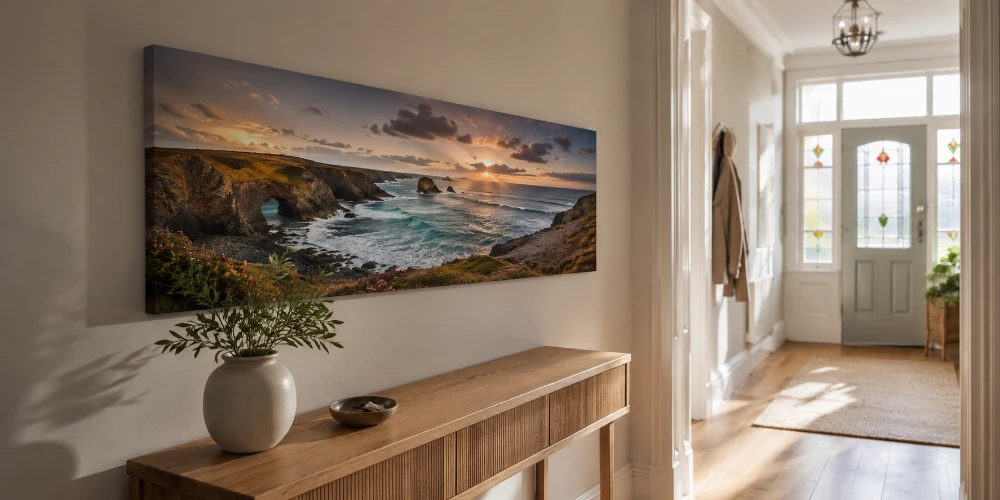
Wide shots — coastlines, city skylines, big group photos, that once-in-a-lifetime mountain view — look cramped forced into a standard rectangle. Panoramic formats from 60×30cm (£23) up to a sweeping 120×60cm (£50) let the photo breathe, and they solve awkward wide walls above sideboards, beds and radiator covers that standard shapes never quite fill.
Collage canvas prints
When you genuinely cannot choose between photos — a wedding, a holiday, a baby’s first year — a collage canvas print puts several photos on one canvas from £14, using the same fabric, inks and pine frame as our single-image prints. It is a much cheaper way to tell a whole story than buying a wall of separate canvases.
One styling tip: fewer photos, bigger, almost always looks classier than cramming twenty tiny snaps onto one print. Six to nine images is the sweet spot for most layouts.
Framed canvas prints
Want the low price and glare-free finish of canvas but the crisp, finished look of framed art? Framed canvas prints pair the gallery wrap with an outer Premium Frame in five finishes — vintage silver, black matte, white, walnut flair and oak vintage flair. Because there is no glass, they stay lighter and cheaper than traditional framed prints of the same size, with none of the reflections.
Honest Corner: When Canvas Isn’t the Cheapest Answer
A quick word of honesty, because it will save some readers money. If you simply want an image on the wall for the absolute minimum spend and don’t care about texture or depth, a paper poster is cheaper than canvas — it just needs a frame, sits behind reflective glass, and looks flatter. Photo board is another low-cost, lightweight option for casual spaces like kids’ rooms and home offices.
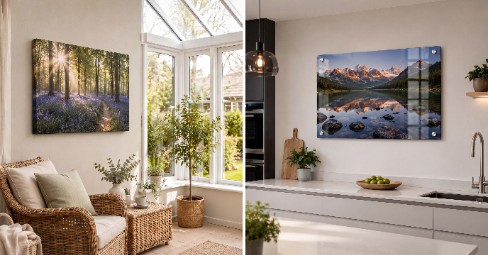
Where canvas earns its keep is everywhere you want the print to feel like art: living rooms, bedrooms, hallways, and anything with sentimental weight. The fabric texture, the depth of the stretcher frame and the absence of glass glare are what make people assume a print cost far more than it did — which is, after all, the whole point of this guide.
Three Budget Plans That Look Expensive
To make it concrete, here is what smart money buys at three budgets, using the verified prices above.
Around £20 — the shelf gallery. Four 20×20cm mini canvases (£18) of one consistent theme — all black-and-white family portraits, or four shots from one holiday. Lined up on a shelf or in a 2×2 grid, the consistency does the expensive-looking work.
Around £50 — the statement single. One 80×60cm canvas (£38) of your best landscape or portrait, mirrored edge, hung with its centre at 145cm above the sofa. Add a 30×20cm (£10) for the hallway and you’ve crossed the free-delivery line at £48... one pound short, maddeningly. Swap the 30×20cm for a 40×30cm (£16) and you’re at £54, delivered free.
Around £100 — the considered trio. Three 60×40cm canvases (£72) hung in a row with 5cm gaps — a triptych of one wide photo split across three panels, or three matching landscapes. Total width about 190cm: perfect above a large sofa or bed, and it reads as a several-hundred-pound gallery set.
Frequently Asked Questions
Do cheap canvas prints look cheap?
Not necessarily. A cheap canvas only looks cheap when the seller skimps on the stretcher frame, the inks or the fabric — or when the photo is low-resolution or the print is badly sized for its wall. A budget canvas made with kiln-dried pine, latex or pigment inks and a sharp image can easily pass for a far pricier piece.
Why are some canvas prints so cheap?
Two reasons, and they matter. Efficient online printers make canvases to order in high volume with no shop rent or wasted stock, so they can charge £10–£16 for genuine quality. Other sellers hit low prices with thin fabric, weak frames and dye inks that fade. The materials list, not the price, tells you which is which.
What is a fair price for a canvas print in the UK?
For a 40×30cm photo canvas in 2026, specialist online printers typically charge £12–£25, while high-street photo brands often charge £35–£45 for a comparable print. Our Factory Price for that size is £16. Prices far below the first band usually signal thinner fabric, weaker frames or dye-based inks.
Will a cheap canvas print fade?
It depends entirely on the ink. Canvases printed with dye-based inks can fade noticeably within a year or two in a bright room. Prints made with pigment or latex inks resist UV light for decades — ours use solvent-free HP latex inks and carry a 75-year fade guarantee, so fading shouldn’t be a worry in your lifetime.
Is one large canvas better than several small ones?
For value and impact, usually yes. Price per square metre falls sharply as sizes grow — a 120×80cm canvas costs around £63 per square metre against £133 for a 40×30cm. One well-sized statement piece also reads as more expensive than scattered small prints, though grouped sets suit family photo displays beautifully.
What size canvas should go above a sofa?
Aim for an arrangement about two-thirds the width of the sofa. Above a typical 200cm three-seater, that means roughly 130cm — one 120×80cm canvas, or three 60×40cm prints with 5cm gaps. Hang the piece with its centre about 145cm from the floor and its bottom edge 15–25cm above the sofa back.
What is the cheapest way to get quality canvas prints?
Buy direct from an online canvas printer rather than the high street, go as large as your best photo allows (bigger sizes cost less per square metre), and bundle your order past the free-delivery threshold — £49 with us. Ordering several prints at once for different rooms nearly always beats buying one at a time.
Are canvas prints worth it compared to posters?
If you want the lowest possible spend and don’t mind glass and glare, a framed poster is cheaper. Canvas is worth the small difference everywhere the print matters: it has fabric texture and physical depth, needs no frame or glass, arrives ready to hang, and reads as art rather than a printout — which is why it dominates British living rooms.