World Cup Group Photo Playbook: Posing Ideas for Large Fan Groups
 by Jonathan Vincent
 12 Minutes
Group photos at the World Cup are deceptively hard to get right. You have got 12 mates in a pub, three rounds in, the match is two minutes from kick-off, the lighting is terrible and someone is already heading to the toilet. Then someone shouts “group photo!” and the result is half the group blinking, three people half-out of the frame, and your friend’s chin doing something unflattering.
Six months later, when you want to look back at the summer of 2026, that is the photo you have got. Just one — and it is rubbish.
This guide is the playbook to fix that.
We are going to walk you through how to actually get a good group photo when there are 5, 10, 15 or 20+ people involved, the lighting is unhelpful, and everyone is half-cut and half-watching the telly. You will get specific posing formations that flatter every body type, lighting fixes for pub interiors and stadium nights, the right way to use timers and props, and a clear sense of when to go posed and when to let things stay candid.
And once you have got the shot, we will cover the most important step — turning the best one into something you can actually keep, give as a gift, or stick on the fridge alongside the rest of the tournament.
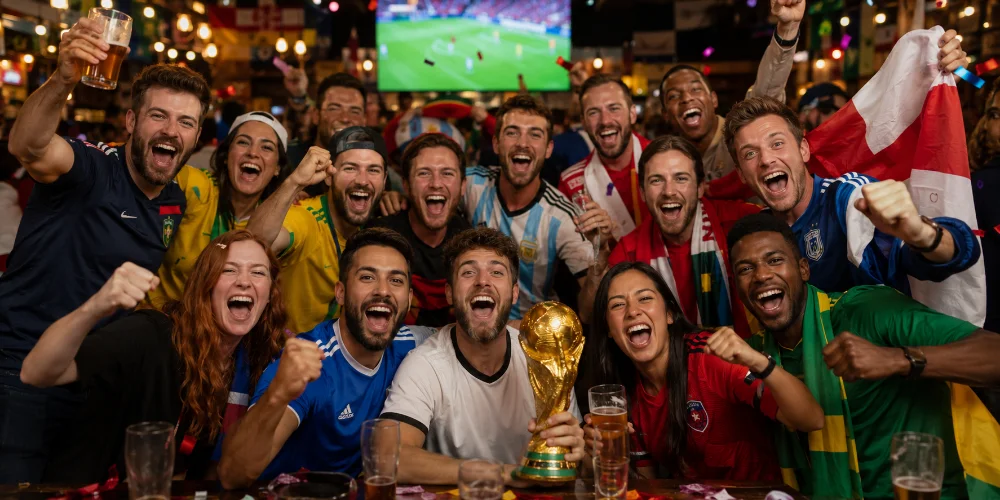
Why World Cup group photos matter more than the average snapshot
Most group photos get taken, posted to a WhatsApp chat, scrolled past, and forgotten. World Cup ones are different.
They mark a moment. The summer England nearly went all the way. The pub where you watched the quarter-final. The group of friends who happened to be in your life when something special was happening on the telly. People you will not necessarily be in the same room with again, even five years from now.
The World Cup is the biggest one in history — 48 teams, three host countries, six weeks of matches. There will be more group photo opportunities than at any tournament before it. Group stages with mates, knockout-round watch parties, the final at someone’s house with extended family. If you take this seriously, even just for a few hours of effort, you will end up with at least one photo from the summer that earns its place on a mug, a magnet, or in a proper tournament photo book.

Part 1: The setup — what to do before pressing the shutter
Most group photos go wrong before anyone gets in position. A few minutes of prep makes the difference between something usable and something mediocre.
Pick the right photographer
This sounds obvious. It is not. The default group photo gets taken by whoever shouts loudest about wanting one — usually the most enthusiastic person in the group, who is also usually the most distracted. They half-line everyone up, snap one shot, and move on.
Pick someone deliberately. Ideally:
- They are sober-ish (relative to the group)
- They have a phone with a recent camera — iPhone 14 onwards or Samsung Galaxy S22 onwards is the sweet spot
- They are willing to take 8–15 shots in quick succession rather than just one
- They are tall enough to shoot from slightly above the group, or willing to stand on a chair
If you have a friend who actually takes photos as a hobby, recruit them in advance. Pay them in pints.
Find the location before kick-off
The single biggest improvement you can make to your group photos is to scout the spot before the match starts. A great group photo location has three things:
- Decent natural light (window, garden, beer-garden corner) or a single strong artificial light source
- A simple background that is not visually busy — a plain wall, a row of bunting, a chimney breast, the front of a pub
- Enough space to fit everyone without people falling off the edges
Most British pubs have one decent group photo spot — usually near the front door, in the beer garden, or against a wall away from the bar. Identify it during your first round so you can drag everyone there during the half-time break, or after the final whistle when the celebration is peaking.
Set the camera up properly
Most phone cameras come out of the box with default settings that are wrong for group photos. Two minutes of fiddling fixes most of them.
- Turn on grid lines (Settings → Camera → Grid). The grid helps you actually centre the group rather than chopping someone’s head off
- Use the wide-angle lens (the 0.5x or 1x option, depending on phone), not the telephoto. Wide-angle gets more people in without you having to step into the next room
- Disable HDR for moving groups — it produces ghosting if anyone shifts during the shot
- Use Portrait mode only for groups of 6 or fewer; for larger groups it gets confused about depth and starts blurring people out
- Set the timer to 5 or 10 seconds if the photographer is going to be in the shot too — most phones have this hidden in the camera app’s top toolbar
Part 2: Nine posing formations that work for fan groups
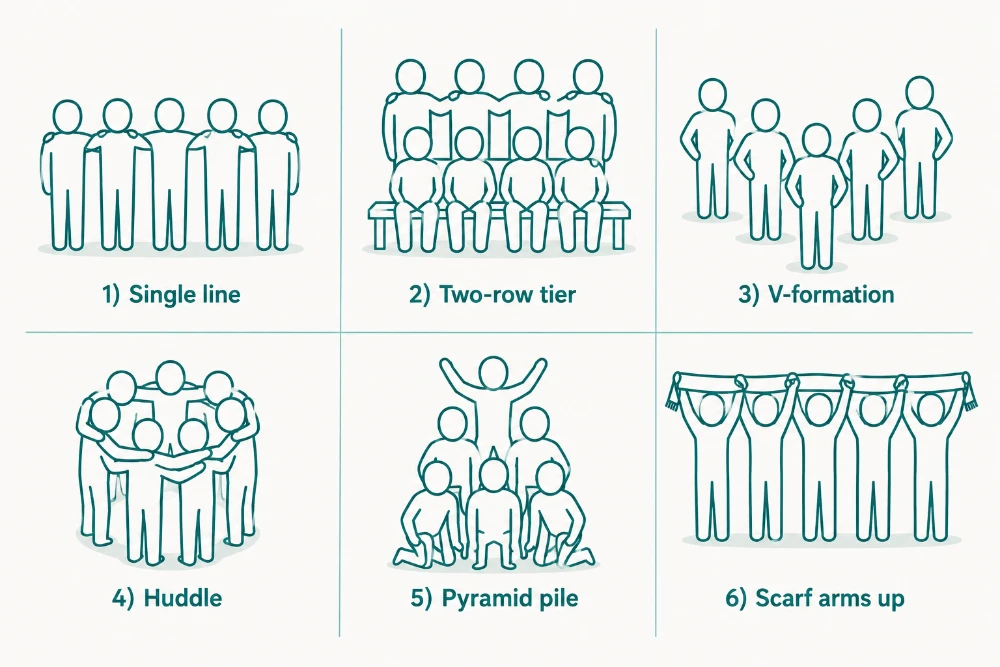
The right formation depends on how many people you are working with, the space you have, and how formal you want it to feel. These nine cover almost every World Cup group photo situation you will encounter.
1. The single line — best for 5–8 people
Everyone shoulder to shoulder, standing or sitting in a single horizontal row, all facing the camera. The simplest formation that works.
How to do it well: tighten the gap between people more than feels natural — about 5–10cm of shoulder overlap. Loose, well-spaced lines look formal and slightly awkward; tight ones look like a proper group of mates. Have the tallest person in the middle and the shortest at the edges, so the line has a gentle curve rather than a step-down.
Best for: pre-match outside the pub, beer garden, simple backgrounds.
2. The two-row tier — best for 8–14 people
Half the group seated on a bench, sofa or low wall in front. The other half standing directly behind, with their faces visible in the gaps between the seated people’s heads.
How to do it well: make sure each standing person’s face is between (not directly behind) two seated heads. The seated row should lean slightly forwards; the standing row should pack in tight. Stand-on-tiptoe rules are fine for the back row if there is a height issue.
Best for: sofas at home, pub benches, the bench seats outside most British pubs.
3. The V-formation — best for 6–10 people
People arranged in a shallow V-shape opening towards the camera. The point of the V faces away from the lens, the open ends face the viewer. Two or three people at the back forming the apex, the rest fanning out at the front.
How to do it well: the front-most people should be slightly lower than the back people — either crouching, sitting on a low wall, or naturally shorter. The V creates depth in the photo and stops it looking flat like a school class photo.
Best for: medium-size groups in beer gardens, parks, fan zones.
4. The huddle — best for 6–12 people, viewed from above
Everyone gathers in a tight circle, arms over each other’s shoulders, faces tilted up towards the camera. The photographer stands above (on a chair, a step, the edge of a table) and shoots straight down.
How to do it well: tilt heads slightly so faces face up, not the tops of heads. Pull the circle tight — closer than feels natural. Have everyone look at the lens, not at each other. Best done with a wide-angle setting.
Best for: post-goal celebrations, huddles in the kitchen at half time, smaller pubs.
5. The chair-and-crouch tier — best for 10–18 people
Three rows. Front row crouching or kneeling. Middle row seated on chairs. Back row standing. This is the formation team photographers use for proper squad photos, and it is brilliant for World Cup groups because it visually echoes a football team line-up.
How to do it well: stagger the rows so faces are not directly stacked. Get the kneeling row to lean slightly outwards rather than forwards (otherwise heads block the seated row). Make sure the chair row has straight backs and shoulders rolled back.
Best for: bigger groups, formal-ish photos, end-of-tournament group portraits.
6. The pyramid pile — best for 5–8 people, fun and playful
Two or three people kneeling at the front, two people in a middle row leaning slightly inward, one tallest person at the back centre. Forms a rough pyramid shape. Looks playful, energetic, slightly chaotic.
How to do it well: the front-row kneelers should sit back on their heels rather than upright on their knees, to keep them lower than the middle row. The whole arrangement should feel slightly tilted forward, as if the group is leaning into the camera.
Best for: post-match celebrations, garden gatherings, smaller groups who want personality over formality.
7. Scarf arms up — best for 6–15 people, signature World Cup pose
Everyone in a single line or shallow arc, holding a stretched-out scarf above their heads with arms raised. The classic football-fan formation. Works particularly well in red-and-white kit colours against a plain background.
How to do it well: choose the longest scarf available, or join two scarves end to end. Get everyone to lean back slightly so faces remain visible under the raised arms. Have the tallest people at the centre to keep the scarf at a roughly even height. Shout something to make people cheer mid-shot — gets the mouths open and the energy up.
Best for: outside the stadium, fan zones, big celebration moments.
8. The candid celebration capture — best for any group size, hardest to get right
Not really a posing formation — it is the opposite. Take the photo while people are reacting genuinely to something happening on the telly: a goal, a near-miss, a penalty save. The result captures real emotion in a way no posed shot ever does.
How to do it well: the photographer needs to be ready before the moment, watching faces rather than the screen. Take 8–10 shots in burst mode (hold down the shutter button) rather than one. Most will be unusable; one or two will be brilliant.
Best for: the actual match, in front of the TV, the second a goal goes in.
9. The seated bench — best for 5–10 people, pub-friendly
Everyone seated along a long bench, table or banquette, facing slightly inward as if mid-conversation but with eyes on the camera. Looks relaxed, social, slightly journalistic.
How to do it well: tilt drinks slightly forward and have hands either holding glasses or on the table. Keep elbows off the table for a cleaner line. Avoid the row of phone screens — get phones away from the table for the photo.
Best for: long pub tables, restaurants, post-match dinners.
Part 3: Lighting — five problem situations and how to fix each one
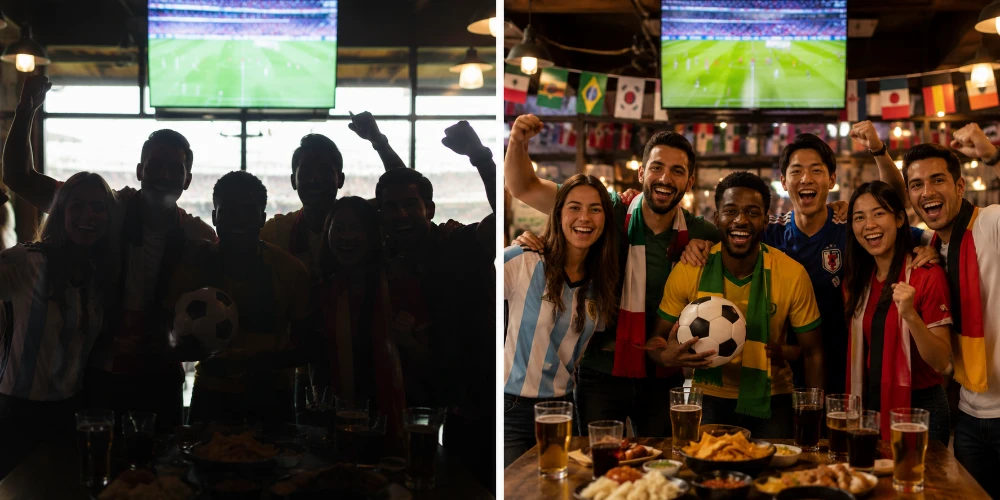
Lighting is the single biggest reason World Cup group photos disappoint. Pubs are dim. Living rooms have a bright TV in the background that throws everyone else into shadow. Stadiums are floodlit but with harsh contrast. Here is how to fix the five most common situations.
Problem 1: The dim British pub interior
The most common situation. Yellow tungsten bulbs, low ceiling, warm but dim. Everything photographed indoors looks slightly orange and slightly blurry.
Fixes:
- Move the group towards the window or front door — even on a grey day, daylight is brighter and cooler than pub lighting
- Avoid backlighting at all costs. Window directly behind the group = silhouettes. Window to one side = beautiful soft light
- Turn off Night mode if it is enabled. Night mode produces longer exposures, which means anyone moving comes out blurred
- Get one person to hold their phone torch as a fill light, pointed up at the ceiling above the group rather than at faces
Problem 2: The TV-lit watch party at home
Living room. Big TV showing the match. Everyone facing the screen. The TV is the brightest thing in the room and it is throwing weird blue light onto half the group.
Fixes:
- Pause the match at half-time and turn the room lights on. The TV stops being the dominant light source
- If you want a TV-on shot for atmosphere, position the group between the TV and the camera — the TV becomes a soft background glow rather than the main light
- Avoid the overhead spotlight directly above. Down-lighting from a single source creates harsh shadows under eyes and chins
- Soft side lighting from a lamp, ideally lampshade-on, is the best home lighting situation for groups
Problem 3: The stadium under floodlights
If you have actually made it to a World Cup match, the floodlights are powerful but the contrast is brutal — bright on tops of heads, dark under noses and chins.
Fixes:
- Tilt the group’s faces upwards slightly so floodlight reaches under their brows and down to their chins
- Group photos work better in the concourse before kick-off than in the seats during the match — controlled lighting, less crowded background
- Post-match shots on the way out, with the lit stadium behind the group, work brilliantly if you have a phone with night mode that can handle the contrast
Problem 4: Harsh outdoor sunlight
Beer garden, fan zone, garden barbecue. Bright midday sun. Everyone is squinting, harsh shadows under noses, foreheads white-hot.
Fixes:
- Move the group into open shade — under a parasol, against the side of the building, into the shadow of a tree
- If you cannot avoid direct sun, position the group with the sun behind the camera but not directly above. Mid-morning or late afternoon sun produces the most flattering light
- Get everyone to close their eyes for a count of three, then open them when you say “now” — eliminates the squinting epidemic
Problem 5: Mixed lighting (the worst kind)
Window on one side, overhead spotlight on the other, TV in the corner. Each person is lit differently. One side of the group looks blue, the other looks orange.
Fixes:
- Pick one light source and let it dominate. Either pull the group towards the window and turn the overhead off, or move them into pure indoor lighting
- Phone cameras can correct mixed lighting reasonably well in editing. The free app Snapseed has a White Balance slider that fixes most of it after the fact
- If all else fails, convert to black and white. Mixed-temperature lighting that looks weird in colour often looks brilliant in monochrome
Part 4: Posed versus candid — when to use each
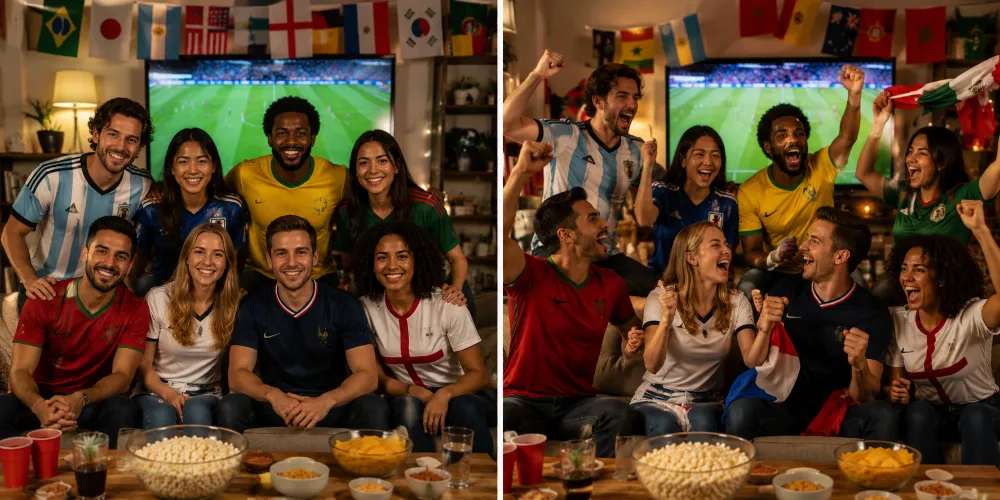
The single biggest mistake in group photos is doing only one or the other. The best fan group photo collections have both — the posed shot for the keepsake, and the candid shot for the WhatsApp chat.
When to go posed
Posed photos are the ones that end up framed, printed and given to people as gifts. Take them when:
- The group is calm and relatively focused (before kick-off, during half time, immediately after the final whistle but before the chaos)
- You want the photo to look intentional in five years’ time
- You are doing a year-on-year tradition (the same group photo, same formation, same place, every World Cup)
- Someone in the group is wearing something they want to remember
When to let it stay candid
Candid photos capture the actual emotion of the tournament. Take them when:
- Something has just happened on the screen and people are reacting — never interrupt a celebration to ask people to pose
- You want the photo for personal memory rather than display
- The group is too drunk to pose convincingly (very common after extra time)
- You can use burst mode and pick the best frame later
The ideal World Cup match-day group photo set
If you are being slightly methodical about it, here is the set of group photos that gives you the most material to choose from across the tournament:
- One posed group portrait at the start of the tournament, in match-day kit, taken in good light
- One candid group celebration from the most exciting moment of the group stage
- One posed group photo before the knockout-round match (everyone in the same kit again — gives you a series)
- One candid celebration from a knockout-round goal or final-whistle moment
- One posed end-of-tournament group photo, ideally in the same formation as the first one
Five photos — three posed, two candid — across the full tournament. Same group in the same formations, with the natural progression in mood (hopeful at the start, joyful or devastated at the end). It is a complete World Cup story in five frames, and it is exactly the kind of run that turns into a beautiful end-of-tournament photo book — one page per match, the whole summer in your hands.
Part 5: Using timers, props and helpers
A few small techniques that make the difference between a usable photo and a great one.
The timer trick
If the photographer wants to be in the photo too, use the camera timer. Most phones default to 3 seconds, which is too short. Set it to 10 seconds. Use these 10 seconds to:
- Run round to your spot in the formation
- Get everyone settled, mouths closed for a count of one, then open into smiles on “three”
- Take 3–5 shots in succession (most phone timers can be set to take a burst rather than a single frame)
Tripods and improvised stands
A small phone tripod is genuinely worth the £15 if you take group photos regularly. If you do not have one, improvise:
- Lean the phone against a stack of books at the right height
- Wedge it between two pint glasses (carefully)
- Set it on the bar with a beer mat propped behind it for the right tilt
- Tape it to a chair back with masking tape
Props that make group photos better
- A long horizontal scarf held above heads — instant World Cup signature
- A flag draped behind the group as a backdrop
- Pints raised in a synchronised toast
- Match programmes held up by the people in the front row
The shouting trick
Just before pressing the shutter, get everyone to shout a word together — “goal!” or “England!”. The shout opens mouths into natural-looking smiles, gets the energy up, and stops the row of polite clenched-teeth smiles that ruins most group shots.
Recruit a helper for big groups
If your group is over 15 people, get one designated helper whose job is to stand to the side and check that nobody is hidden behind a head and that the back row is visible.
Part 6: Quick reference — what works for different group sizes
5 people
- Best formation: V-formation or single line
- Camera distance: 2–3 metres
- Lens: 1x main lens
8–10 people
- Best formation: two-row tier or scarf-arms-up
- Camera distance: 3–4 metres
- Lens: 1x main lens or 0.5x wide
12–15 people
- Best formation: chair-and-crouch tier or scarf-arms-up
- Camera distance: 4–5 metres
- Lens: 0.5x wide-angle
18–25 people
- Best formation: chair-and-crouch tier (three rows)
- Camera distance: 5–7 metres
- Lens: 0.5x wide-angle, elevated angle
Part 7: Turning the best group photo into something you will actually keep
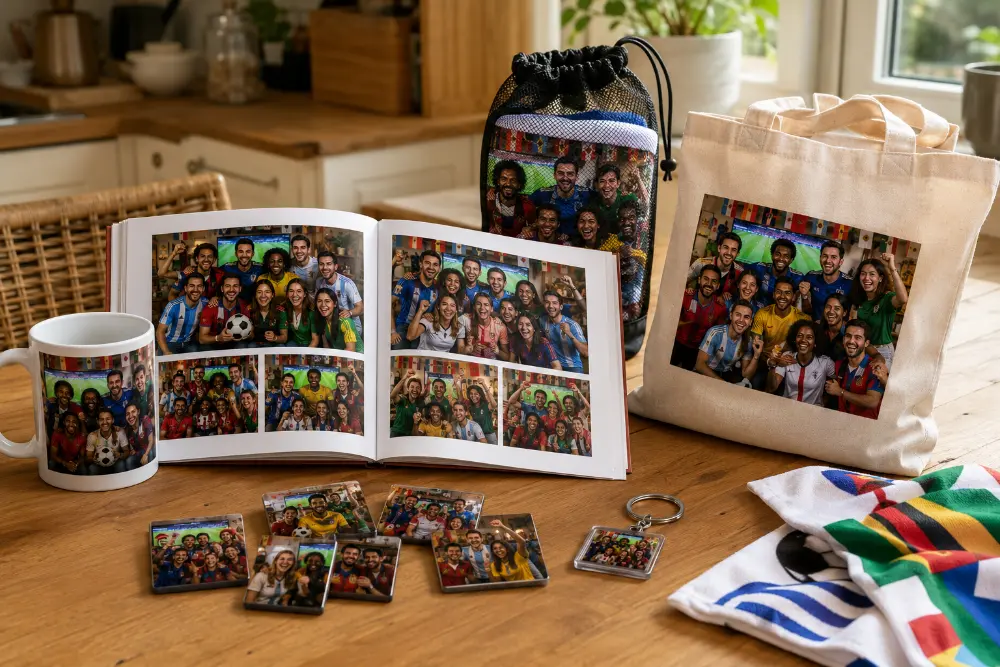
Get the best one or two off your phone and onto something physical. There is genuinely no better way to keep the summer of 2026 alive. For more inspiration, browse our complete guide to personalised photo gifts.
A photo book — for the full tournament story
If you are only going to make one keepsake, make it a personalised photo book. Six weeks of group photos, candid celebrations, and final-whistle hugs gathered into one book that tells the full story chronologically.
Photo mugs — for the daily reminder
A personalised photo mug is the keepsake that actually gets used. A group photo on a mug is something you see every morning when you make a cup of tea.
MIXPIX magnets — for the whole tournament on the fridge
MixMags photo magnets are small, square, magnetic photo prints. The entire tournament can live on the fridge side by side, match by match.
Photo keyrings — for the small token everyone keeps
A personalised photo keyring with the squad photo printed on it sits on the keychain forever — a tiny daily reminder of the summer.
Tote bags — for the actual match-day kit
A personalised tote bag with your group photo on it is a genuinely useful keepsake. Use it to carry scarves and snacks to the next match.
Sports towels — for the more active members of the squad
If your fan group plays five-a-side, a personalised sports towel with the squad photo printed across it is a brilliant in-joke that doubles as useful kit.
Part 8: UK venue-specific tips
The traditional British pub
Best spot: near the front window for natural light. Avoid the front of the bar (busy background) and directly under the dartboard light (harsh down-lighting).
The garden / beer garden
Best light: late afternoon, with the sun behind the camera. Move the group into open shade under a parasol if the sun is too harsh.
The home watch party
Best spot: standing in front of the sofa, with the TV behind the camera so the screen does not dominate. Pause the match at half-time to turn on all room lights.
The fan zone or stadium concourse
Best spot: just inside the entrance, where the lighting is even. Best time: 30–45 minutes before kick-off, before the crowd peaks.
Final thoughts: take more photos than you think you need
Take more photos than you think you need. A typical session produces 30–40 frames in burst mode. Of those, maybe 3 or 4 are properly good. One is genuinely brilliant. That is the one that goes on the mug, the magnet, or the cover of the photo book.
Frequently Asked Questions About World Cup Group Photos
-
For groups of 10 or more, use a tiered formation — front row crouching or kneeling, middle row seated, back row standing. Stagger the rows so faces are visible in the gaps between heads. Keep the gaps between people tight (5–10cm of shoulder overlap) and have everyone shout a word like “goal!” just before the shutter to get natural smiles.
-
Disable Night mode (it produces blur), turn on grid lines for composition, use the 1x main lens (or 0.5x wide-angle for groups over 10), and avoid Portrait mode for big groups. Shoot in burst mode by holding down the shutter to take 5–10 shots in succession.
-
Use the camera timer set to 10 seconds. Most phones can be set to take a burst of 3–5 shots automatically once the timer runs out. Lean the phone on a stable surface or use a small tripod. Run to your spot, get into position, and have the group shout a word together on “three” to get natural reactions.
-
Both. Posed photos taken at half-time or before kick-off are the ones that look good as keepsakes. Candid photos taken during goal celebrations capture the actual emotion of the tournament. The best fan group photo collections include both.